








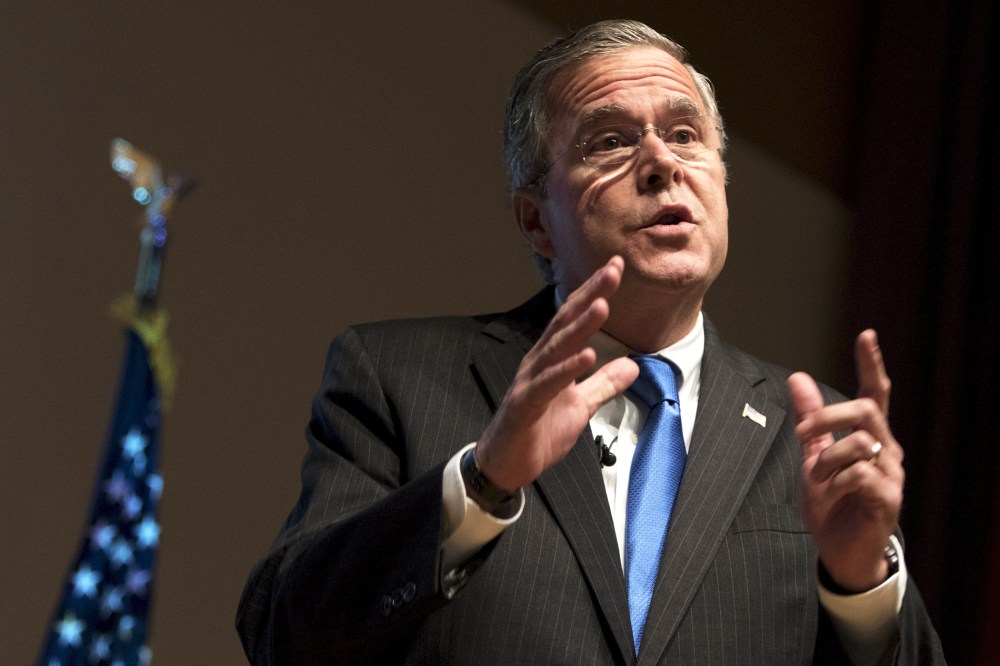
Republican presidential hopeful Jeb Bush suggested Thursday that he agrees with the Supreme Court decision that badly weakened the Voting Rights Act. And he went further, appearing to question the need for any federal regulation of voting at all.
At an Iowa forum sponsored by The Des Moines Register, a member of the audience asked the former Florida governor: “Where do you stand on the Voting Rights Act? Do you believe it should be reauthorized? If not, why not?”
“Reauthorized, you said?” Bush asked.
“Yes,” replied the questioner.
Bush responded:
I think if it’s to reauthorize it to continue to provide regulations on top of states, as though we were living in 1960, because those were basically when many of those rules were put in place, I don’t believe that we should do that. There’s been dramatic improvement in access to voting, I mean exponentially better improvement. And I don’t think there’s a role for the federal government to play in most places — could be some, but in most places — where they did have a constructive role in the ‘60s. So I don’t support reauthorizing it as is.
It’s difficult to decipher a clear position from Bush’s response, in part because the exchange is marred by confusion on both sides. The Voting Rights Act (VRA) was reauthorized in 2006 for another 25 years, in legislation signed by Bush’s brother, former President George W. Bush, so support for reauthorization isn’t the issue. The questioner may have meant to ask whether Bush supports legislation currently before Congress that would restore the VRA to its full strength after it was badly weakened by the Supreme Court’s 2013 ruling in Shelby County v. Holder. That decision neutered a key provision of the law that had required certain areas of the country with histories of voting discrimination to get federal approval before changing their election rules.
RELATED: Jeb Bush avoids question about George in recent interview
That’s the issue Jeb Bush seems to be responding to. And his answer seems to make clear that he supports the court’s controversial decision. Indeed, Bush’s argument that because things have improved since the 1960s, we no longer need voting protections that made sense at that time reproduces the key claim of Chief Justice John Roberts’ much-criticized opinion in Shelby.
But then Bush added that he doesn’t see a role for the federal government on voting issues in most places. That seems to suggest that he opposes the parts of the VRA left in tact by the Supreme Court—most prominently, the provision that continues to bar racial discrimination in voting and applies nationwide. It would also mean that Bush opposes other important federal voting laws, like the National Voter Registration Act, also known as the “Motor Voter” law, which requires states to offer voter registration opportunities at the DMV and public assistance agencies.
That’s a position that some on the right hold. The platform of the Texas Republican Party, for instance, calls for repeal of the VRA and Motor Voter, and calls another important federal voting law, the Help America Vote Act of 2002, unconstitutional. But it would put Bush way out of the mainstream on the issue, even among most conservatives, who accept that there’s still a role for the federal government to play in protecting access to the ballot. Of course, it may also be that Bush wasn’t intending to go that far, he just didn’t consider that even after Shelby, plenty of federal voting laws remain in place. A spokeswoman for Bush’s campaign didn’t immediately respond to a request to clarify his comments. Whatever Bush’s actual intent, Democratic groups pounced. American Bridge, which supports Hillary Clinton, quickly emailed video of the remarks to reporters, saying Bush “continues support of disenfranchisement.” Bush’s record on voting rights is already open to question. As Florida governor in 2000, his administration conducted a late purge of the voter rolls, which likely disenfranchised thousands of valid voters, perhaps tipping the election to his brother, George W. Bush, as a result. The scheme has been described as setting off the wave of voting restrictions that followed over the next decade or so. Bush planned another purge for 2004 but was forced to back down amid an outcry.
Zachary Roth Recommended


