








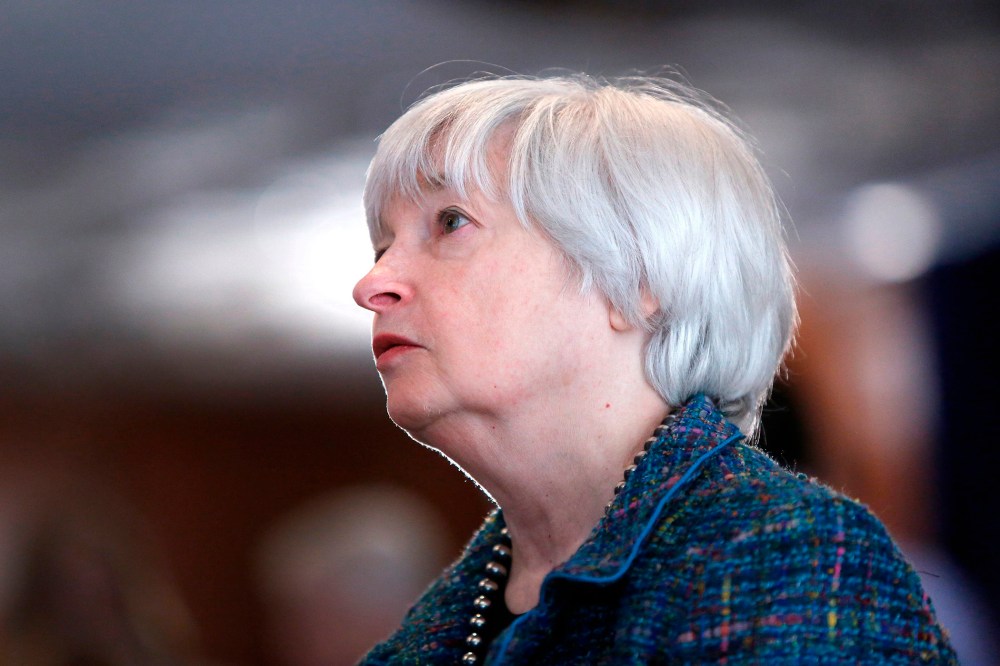
Federal Reserve chairs tend to choose their words very carefully. Given the Fed’s outsized role in managing the economy, the slightest hint or stray remark from its leader could send shock waves through financial markets. So when current Fed Chair Janet Yellen spoke about economic inequality earlier this month during a conference in Boston, she knew exactly what she was getting into.
RELATED: Fed chair shines a light on economic inequality
“It is no secret that the past few decades of widening inequality can be summed up as significant income and wealth gains for those at the very top and stagnant living standards for the majority,” said Yellen during an Oct. 17 speech at the Federal Reserve Bank of Boston. “I think it is appropriate to ask whether this trend is compatible with values rooted in our nation’s history, among them the high value Americans have traditionally placed on equality of opportunity.”
Yellen’s remarks, though they may seem innocuous, have triggered a minor tempest in the think tank universe. This week, several conservative economists argued inequality is not as big a problem as Yellen seems to claim. Many of them also argued that her remarks were inappropriate, because the Federal Reserve shouldn’t concern itself with a “partisan” issue like inequality at all. That’s the position the Heritage Foundation’s Joel Griffith and Stephen Moore took Tuesday in a commentary that described Yellen as “class warrior in chief.“
“The nation’s Fed chief ought to be a loud and clear voice for growth – not class envy,” they wrote.
Using slightly milder language, American Enterprise Institute scholar Michael R. Strain argued in The New York Times that the Fed chair should not “take sides in political debates,” in part to safeguard its independence from Congress. The power of Yellen’s soapbox should be deployed “within its narrowest, best defined parameters,” he wrote.
The brouhaha over Yellen’s remarks is actually one chapter in two ongoing arguments: One about the role of the Fed, and another about whether inequality is a genuine social ill. Although inequality is not inherently a partisan issue, it is true that conservatives tend to see overall growth as a better economic aim than reducing the wealth gap. They’re also more likely to favor a more limited role for the Federal Reserve: Assuming the Fed should even exist at all, it should mostly confine itself to safeguarding the U.S. dollar against inflation. RELATED: Red states consider minimum wage hike But for progressive economists — who tend to think of inequality as a far more pressing issue than inflation — the Federal Reserve does have a part to play in closing wealth disparities. Roosevelt Institute fellow Mike Konczal wrote a reply to Strain, in which he argued “it’s simply impossible to talk about the efficacy of monetary policy and full employment during the Great Recession without discussing inequality, or discussing issues where inequality is in the background.” (The Federal Reserve has a mandate to promote full employment as well as control inflation, and is the main entity in charge of managing U.S. monetary policy.) Perhaps the more immediate question is whether Yellen’s remarks signaled that she intends to have the Fed take a more active role in dealing with inequality. The central bank has limited power there — Yellen has previously implied that Congress has been acting as part of the problem rather than the solution to the country’s economic woes — but it does have some leeway to change things. Nobel Prize-winning economist Joe Stiglitz suggested on Tuesday one way it could deal with inequality: By using its regulatory authority of banks more aggressively.
Ned Resnikoff is an urban policy analyst, researcher, writer, and editor. His byline has appeared in a variety of publications, including the New York Times, San Francisco Chronicle, Dissent, and The Nation. He writes the newsletter Public Comment, which can be found at publiccomment.blog. Recommended


