









LAUREL, Maryland — If everything went according to plan, NASA’s New Horizons probe zoomed past Pluto on Tuesday, marking the climax of a first-of-its-kind mission that was launched nine and a half years ago. But we’ll have to wait until more than 13 hours after the encounter to hear for sure that it did the deed.
The piano-sized spacecraft is so busy taking pictures and making observations that it can’t turn its antenna around immediately to flash a message to Earth. And even when it does, it’ll take four and a half hours for the signal saying “I’m OK” to make the 3 billion-mile trip from beyond Pluto to Earth.
Watch: Our journey to Mars
The flyby took place at 7:49 a.m. ET Tuesday, with New Horizons coming within 7,800 miles (12,500 kilometers) of the dwarf planet’s mottled surface. To mark that event, science team members and VIPs gathered here at Johns Hopkins University Applied Physics Laboratory, where the mission has its operation center.
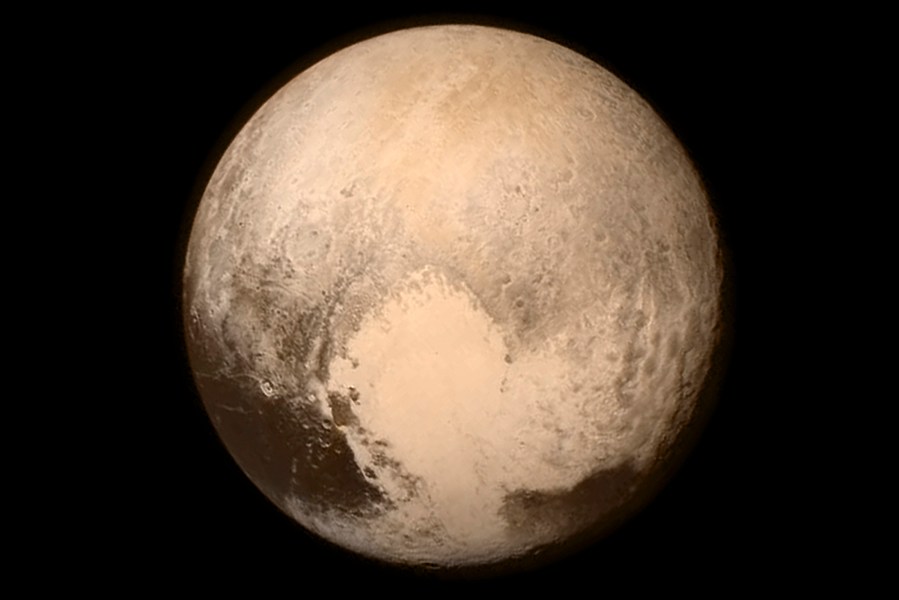
When the appointed time came, well-wishers applauded, waved American flags and chanted “USA! USA!” To mark the milestone, NASA released a colorized view of the dwarf planet that was sent back to Earth before New Horizons went out of contact on Monday night. The picture is part of a “fail-safe” series of observations that were made just in case the spacecraft suffers a catastrophic failure during the flyby.
While New Horizons is running through its pre-programmed routine, ground controllers are as oblivious as the rest of the world about the spacecraft’s fate. Even though there’s only a 1-in-10,000 chance that New Horizons will run into a stray piece of debris while passing through the Pluto system, mission operations manager Alice Bowman said the pressure “will be intense.”
“We’re out there on the frontier,” Bowman told reporters during a preview of the flyby. “Things can happen. Things do happen, and we have to be prepared for that.”
To ease the stress, Bowman and her team can rap on miniature cutting boards festooned with New Horizons logos. She said the good-luck charms were given to them by the mission’s principal investigator, Alan Stern of the Southwest Research Institute, so that they can “knock on wood” whenever they talk about what may or may not happen.
“We try never to talk about the things we fear the most. … So yes, it is science, but we are superstitious,” Bowman said.
Hours after the flyby, the mission time line calls for the spacecraft to take a 15-minute break from its observations and send a series of status reports back to Earth. Those signals are due to be received between 8:53 and 9:09 p.m. ET. “We will learn in a general sense if the spacecraft is healthy,” Bowman said.
If the signals are received and the report is positive, that’s when the real cheering begins. And you can see it all on NASA TV during a “Phone Home” presentation starting at 8:30 p.m. ET.
Meanwhile, on the far side of Pluto, New Horizons will continue making observations — and then start sending gigabytes’ worth of images and measurements back to Earth. “Science at NASA never sleeps, and I don’t think you will, either, for the next couple of days,” John Grunsfeld, NASA’s associate administrator for science, told reporters. Related: New Horizons space probe suffers glitch on approach to Pluto The mission already has captured the spotlight — in forms ranging from Tuesday’s Google Doodle to a Baltimore Sun op-ed column in which White House science adviser John Holdren and NASA Administrator Charles Bolden hail New Horizons as “a new milestone” in exploration and discovery. Grunsfeld said the heart of New Horizons’ appeal is its status as the first mission to the last frontier — that is, the icy worlds that lie beyond the orbit of Neptune. “Pluto is kind of a capstone of our solar system exploration, and also opening up this new realm,” he said. New Horizons’ findings will be making an impact on planetary science long after Tuesday’s flyby, said U.S. Sen. Barbara Mikulski, the Maryland Democrat who championed the $728 million mission when it was threatened with cancellation 15 years ago. “The fact is that we will be downloading this information for more than a year,” she said, “and we will be analyzing it for a generation.” This story originally appeared on NBCNews.com
Alan Boyle Recommended


