








This is a man’s world.
James Brown, the undisputed Godfather of Soul, first laid those words down on wax in 1966. In the 46 years since, as a nation, we’ve made great strides toward greater gender equality. The winds of change continue to swirl through Fortune 500 boardrooms and other quarters traditionally reserved for men. Our collective power is felt from Wall Street to Main Street, from your statehouse to the White House.
This was in evidence on Wednesday when Secretary of State Hillary Clinton sat before Senate and House Foreign Affairs Committees—not only as a woman, but as America’s top diplomat. Uniquely qualified, surefooted and accountable. Her blistering candor, laced with a genuine empathy for those who served and died in our nation’s stead, was matched only by her expansive, almost encyclopedic knowledge of the issues at hand.
If this is a man’s world, nobody told Hillary Clinton.
As she lectured a predominantly male panel of lawmakers on the primary mission and responsibilities of the Marine Corps Embassy Security Group, one more barrier was falling.
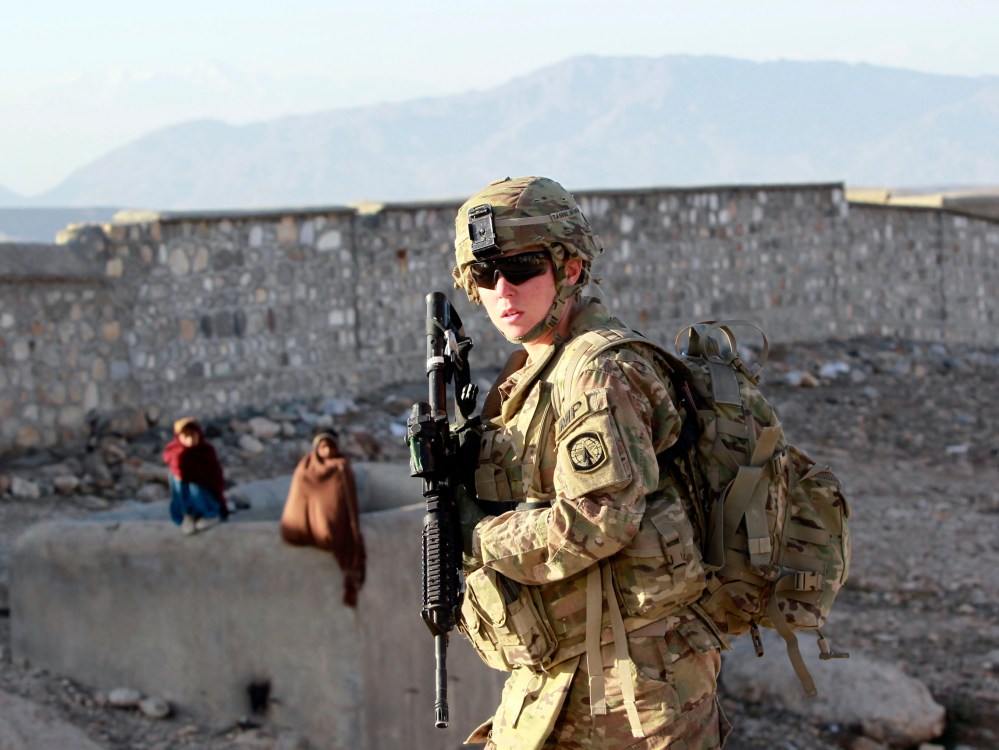
Pentagon sources report that Defense Secretary Leon E. Panetta is lifting the military’s ban on women in combat, opening more than 230,000 jobs once held by exclusively by servicemen. Women serving in our Armed Forces have long been frustrated with those restrictions, which often limit their access to military leadership roles—and the pay and benefits that come with them.
The reality is that women are already serving on the battlefield—on the ground, in the air and across the seas. They do so without formal recognition. Just ask Air National Guard Major Mary Jennings Hegar, a helicopter pilot. According to The New York Times, Major Hegar was “shot down, returned fire and was wounded while on the ground in Afghanistan.” Her efforts and experience were never formally recognized and rewarded. Consequently, according to the article, she could not seek a combat leadership position. It was as if the firefight had never happened.
Today, women comprise just 14% of the approximately 1.4 million active military personnel. Twenty-seven years ago, I signed up to become one of them. As an active duty Marine, I knew the restrictions well. I also understood that because I was a woman I needed to prove my competence, my worth, my capacity and willingness to fight every day. For women who choose to serve, none of that is taken for granted.
Despite distinguishing myself as an expert marksman, acing the Armed Services Vocational Aptitude Battery (ASVAB), and exceptional physical fitness test (PFT) results, I was never considered for a combat role. Rather, I was trained as a Public Affairs Broadcaster. I have no regrets about that. The Marines gave me a career that lasted a lifetime. Some of my sisters were assigned to work in personnel and administration, supply and other military occupational specialties (MOS) most often populated by women. A young woman I trained with at Parris Island erupted in tears when she learned she had been assigned to become a baker in a mess hall. She had enlisted to fight.
As a former Marine, I also understand that progress takes time. Critical assessments must be made. The readiness of combat forces must be sustained, as we advance what will ultimately mean a monumental sea change in military culture. Defense chiefs have until May 15 to submit implementation plans.
This is no time for Hollywood musings about the mythical G.I. Jane. Forget about Demi Moore doing push-ups in the rain. Special operations forces, including Navy SEALS and the Army’s Delta Force, will take longer to assess and even longer to integrate. However, if a woman meets every physical and mental criteria for a job, she should be allowed to do it and be formally recognized for it. Over the last decade, the strain of multiple wars in Afghanistan and Iraq as well as other military operations have expanded the need for a larger ready force. As a consequence, women have been called to do more, to be more. We have expanded our roles as medics, military police and intelligence officers. We are often attached to front-line units. And the lines of battle today are not so clear as they were in yesteryear. The enemy does not march in phalanx formation armed with bayonets and backed up by a line of canons. Although we still train troops to use bayonets in hand-to-hand combat, the enemy is more likely to be behind the wheel of a bomb-rigged car or carrying a rucksack packed with explosives. Enemy combatants do not subscribe to the Geneva Convention. They do not discriminate. And, when it comes to who we deem qualified to serve this nation, neither should we. The truth is we do serve. We do fight. And it’s time we were recognized for it. “This is a man’s world,” James Brown’s #1 Billboard hit said. “But it wouldn’t be nothing, nothing without a woman or a girl.”
Goldie Taylor Recommended


