








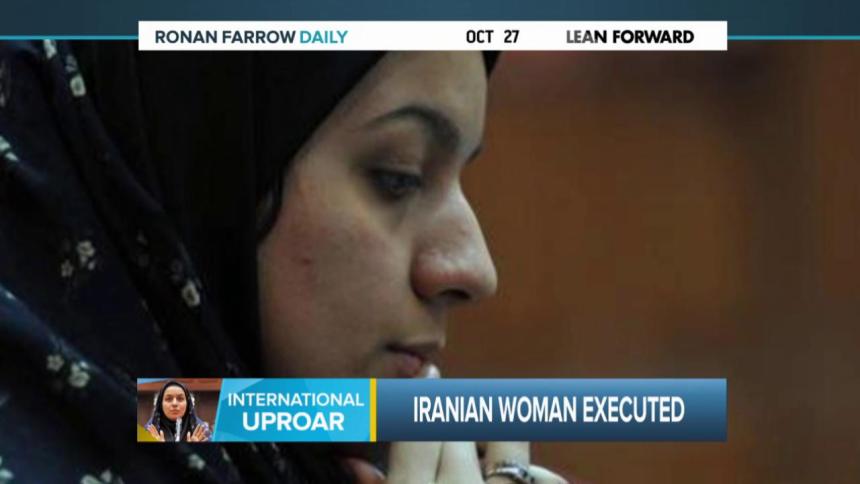
In a heartbreaking final message left by Reyhaneh Jabbari, who was hanged to death Saturday despite international outcry for killing her would-be rapist, the 26-year-old Iranian woman tells her mother to donate her organs after her execution.
“I don’t want to rot under the soil,” Jabbari says, in the English translation of a voice message left for her mother in April and released Saturday by Iranian activists. “I don’t want my eye or my young heart to turn into dust. Beg so that it is arranged that as soon as I am hanged my heart, kidney, eye, bones, and anything that can be transplanted be taken away from my body and given to someone who needs them as a gift.”
%22That%20ominous%20night%20it%20was%20I%20that%20should%20have%20been%20killed%20…%20The%20murderer%20would%20have%20never%20been%20found%20since%20we%20don%E2%80%99t%20have%20their%20wealth%20and%20their%20power.%22′
Jabbari was 19 when Morteza Abdolali Sarbandi, a former Iranian intelligence officer, called her to his office for an alleged interior design consultation, according to the United Nations. Jabbari reportedly admitted in court to stabbing Sarbani in self-defense when he tried to sexually assault her, but she claimed it was another man in the house who killed him.
Those allegations were never properly investigated, according to Amnesty International. She called an ambulance out of concern for her attacker after she escaped.
After her arrest in 2007, Jabbari was placed in solitary confinement for two months without access to a lawyer or her family. She was allegedly tortured, forced to confess under severe duress, and sentenced to death in 2009.
“The world allowed me to live for 19 years,” Jabbari says in the message to her mother released upon her death Saturday. “That ominous night it was I that should have been killed. My body would have been thrown in some corner of the city, and after a few days, the police would have taken you to the coroner’s office to identify my body and there you would also learn that I had been raped as well. The murderer would have never been found since we don’t have their wealth and their power.”
Instead, Jabbari says, “my body was not thrown aside, but into the grave of Evin Prison and its solitary wards, and now the grave-like prison of Shar-e Ray.”
During her trial, Jabbari was painted as a cold-blooded murderer, she says, even though she told the judge she was the kind of person who wouldn’t even kill mosquitoes and threw cockroaches away by their antennas. “Now I have become a premeditated murderer. My treatment of the animals was interpreted as being inclined to be a boy and the judge didn’t even trouble himself to look at the fact that at the time of the incident I had long and polished nails,” she says.
The United States joined in the international condemnation that followed news of Jabbari’s death Saturday. “There were serious concerns with the fairness of the trial and the circumstances surrounding this case, including reports of confessions made under severe duress,” said State Department spokesperson Jen Psaki. “We join our voice with those who call on Iran to respect the fair trial guarantees afforded to its people under Iran’s own laws and its international obligations.”
Photo essay: Life in Iran, beyond the headlines Human Rights groups have raised alarms over the surging number of executions in Iran since President Hassan Rouhani assumed power in 2013. More than 170 people have been killed by the Islamic Republic since the beginning of the year, according to the United Nations, including at least two women. Many more remain on death row. “The world did not love us,” Jabbari says in the final lines of her message to her mother. “It did not want my fate. And now I am giving in to it and embrace the death. Because in the court of God I will charge the inspectors, I will charge inspector Shamlou, I will charge judge, and the judges of country’s Supreme Court that beat me up when I was awake and did not refrain from harassing me. “In the court of the creator I will charge Dr. Farvandi, I will charge Qassem Shabani and all those that out of ignorance or with their lies wronged me and trampled on my rights and didn’t pay heed to the fact that sometimes what appears as reality is different from it,” she says. Read Reyhaneh Jabbari’s final message to her mother here, courtesy of the National Council of Resistance of Iran.
Benjamin Landy Recommended


