








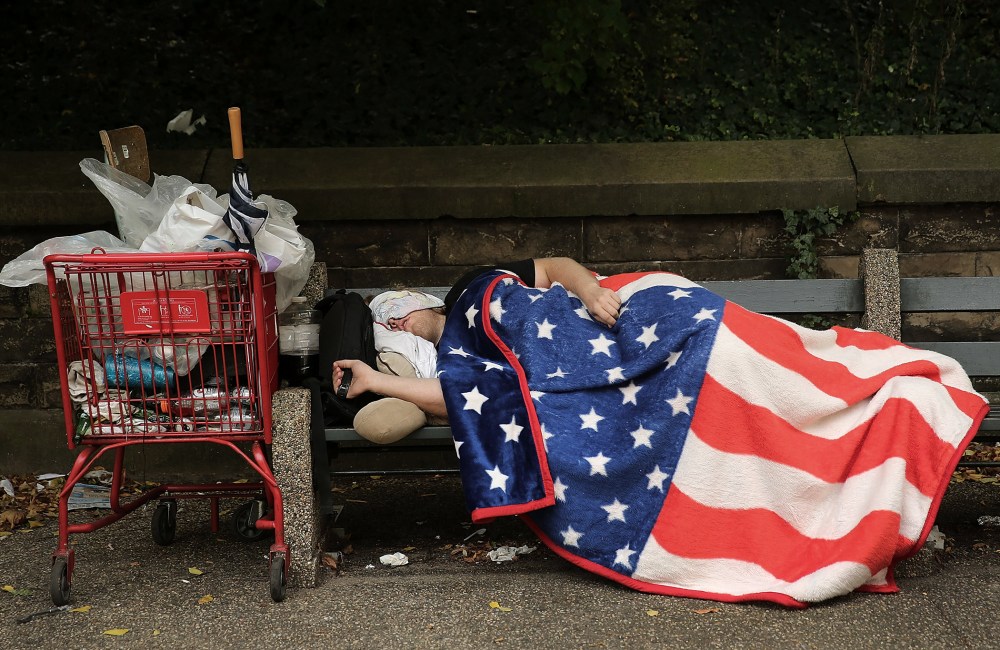
President Obama decried “the relentless, decades-long trend” of “a dangerous and growing inequality and lack of upward mobility” in a speech Wednesday, calling it “the defining challenge of our time.” Even as he spoke, fast-food workers prepared to strike in 100 cities and a new study showed one-third of all bank tellers are so poorly paid that they receive public assistance.
It’s odd that Obama even had to make the argument. During most of the previous century, few people ever questioned why too much income inequality would be inherently bad. But this was the third major speech Obama has given as president on the topic of economic inequality. The theme of the first was that income inequality limited upward mobility (“the rungs on the ladder of opportunity have grown farther and farther apart”). The theme of the second was that government policies affect how much economic inequality the country will experience. This latest speech emphasized that inequality screws up the economy and society in general, so that even if you aren’t worried about inequality or opportunity, you ought to be.
Such thinking represents a departure from the onetime prevailing view, most famously articulated by economist Arthur Okun in 1975, that greater equality came at the expense of economic efficiency. (At the time, income distribution was much more equal than it is today.) But the runup in income inequality that began in 1979 severely tested Okun’s formulation. Today there’s a tentative-but-growing consensus among economists that extreme economic inequality of the type the U.S. is experiencing impedes economic growth.
“One study,” President Obama said, “finds that growth is more fragile and recessions are more frequent in countries with greater inequality.” That 2011 paper, by Andrew G. Berg and Jonathan D. Ostry of the International Monetary Fund, calculated that a 10% decrease in income inequality increased the expected length of a period of economic growth by 50%. Obama also argued that “concentrated wealth at the top … together with lax regulation, may contribute to risky, speculative bubbles.” Several economists, including David Moss of Harvard Business School, have explored this link, which makes intuitive sense.
Moving on to the broader societal effects of the income gap, Obama said that “studies show we actually tend to trust each other less when there’s greater inequality.” Inequality is also “bad for our democracy,” Obama argued, since the dominance of wealthy campaign donors and “high-priced lobbyists and lawyers” leaves the public with “the bad taste that the system’s rigged.” He might have added that it leaves Congress especially partisan. Harvard historian Jill Lepore recently wrote in the New Yorker that “polarization in Congress maps onto one measure better than any other: economic inequality.”
What’s worse, Lepore wrote, is that there’s a feedback loop: as the partisan gap widens, Congress gets less done, which increases income inequality, which polarizes Congress further. “That’s what happens,” she concluded, “when the kitchen’s on fire and all you’ve got is matches.” A century ago the country’s plutocrats, plagued by violent protest from socialists and anarchists, feared that if economic inequality got too far out of hand the angry masses might overthrow capitalism. That obliged them to at least pay lip service to some vague notion of equality. And 50, 40, even 30 years ago, the country’s elites understood that too much inequality would harm the U.S.’s global competition with Soviet Russia for hearts and minds. Today, the Cold War is over and there’s no chance that capitalism will be overthrown. With the dangers of income inequality no longer self-evident, many Americans wonder why it’s still an issue. President Obama’s speech took a stab at answering that question. Given income inequality’s continuing rise, it probably won’t be the last time he’s called upon to do so.
Timothy Noah Recommended


