








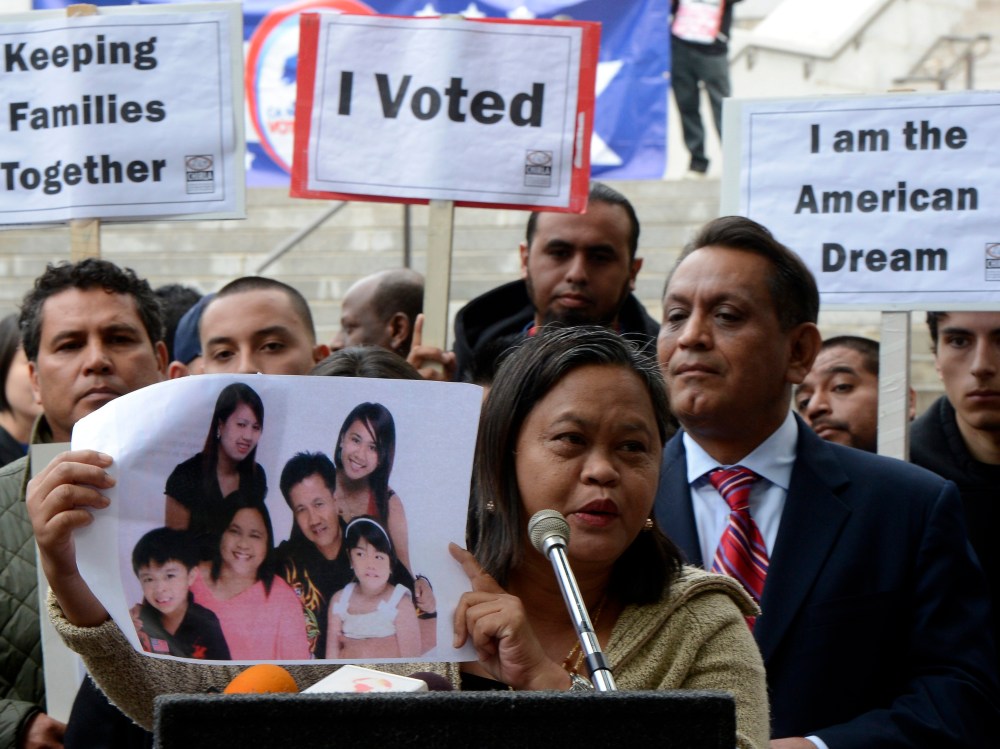
Can you tell? If you look close enough, maybe listen for an accent can you figure it out—legal or illegal?
If, like Sheriff Joe Arpaio you think you can, you’re wrong.
Illegals, or persons who are undocumented, come in all shapes and sizes—from dark-skinned Mexican men to blue-eyed French 20-somethings. And just as hard as differentiating who is in this country with their immigration paperwork in order is disentangling the meaning of legal v. illegal.
The term “illegal” conjures up images of shadowy criminal figures lurking in the night, such as was depicted in Sharon Angle’s 2010 Senate campaign ad.
How about a reality check? Illegal immigrants are the smiling face that greets you at your favorite restaurant, the loving arms that take care of your children, and the blistered hands that pick the fruit for your organic smoothie.
More often than not, the people we term as illegal are law-abiding citizens who pay taxes (though do not receive government benefits). These individuals are tightly woven into the fabric of our daily lives by making sure all of the goods and services we want are at our fingertips.
The fundamental difficulty in parsing out immigrants into legal and illegal is that they both come here for the same reason—demand. American employers want immigrants, whether they are biophysicists or landscapers, legal or illegal.
The problem and the root cause for the legal/illegal classification is that our immigration laws do not allow for demand to be sufficiently met through legal channels. The obsession with fitting people into neat little boxes of legal and illegal misses the larger issue of the systemic flaw within our immigration system—demand is not being met by legal supply channels.
The second difficulty in relying on the legal/illegal paradigm is that it doesn’t take into account the day-to-day reality of immigrant families. The two younger kids may be citizens but mom, dad, and the two oldest may be undocumented. Families are not neatly parsed into those that are legal or illegal. Close your eyes and think about your own family. Think about the gripping fear that you would live with if you knew you could be separated from your loved ones. In other words, the notion of simply keeping the legal ones in and booting out the illegal ones isn’t so simple. The final difficulty with the legal/illegal paradigm is that it shapes the way we think and act. It allows us to become detached from the human element involved in the issue of immigration. Its no coincidence that anti-immigrant advocates cling to the term “illegal.” This rhetorical construct allows them to have an easy target, the individual, while missing the larger institutional picture and the human element. An action may be illegal, but a human being is not. The dichotomy between legal and illegal is a false one and one that only stymies any advancement in the resolution of immigration.
Victoria Soto Recommended


