








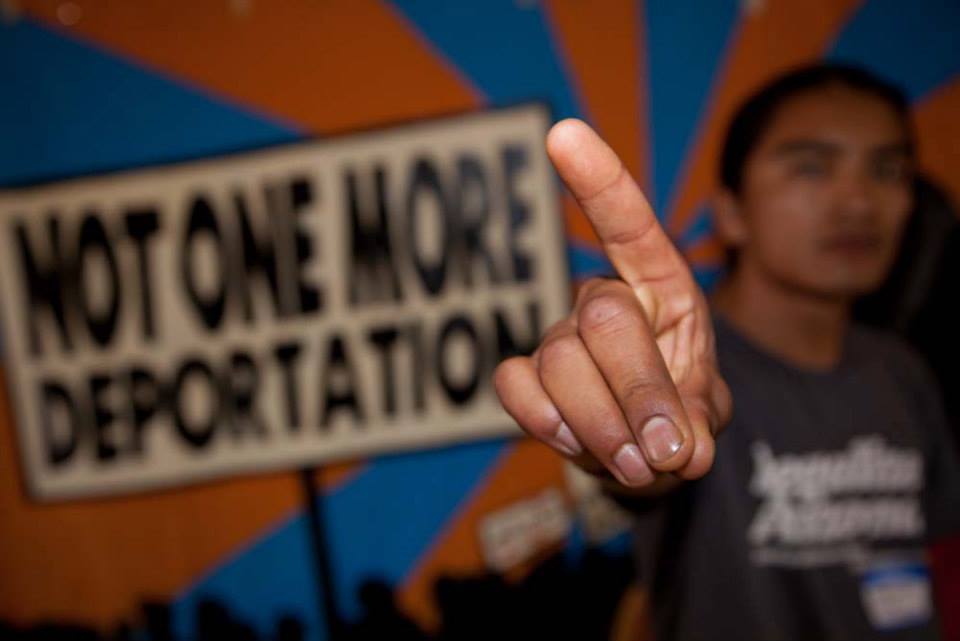
Sept. 15 marks the start of National Hispanic Heritage Month — or, as it is known in Spanish, Mes de la Herencia Hispana — a time when the United States pays tribute to the history, culture and contributions of past and present Hispanic Americans.
According to the 2010 Census, 50.5 million Americans identify as Hispanic — and that number is growing. Immigration has long been a part of America’s national history, and the role that immigrants have played — and still play — in building this country is one of the reasons “the American dream” is still shared around the world today. America is a place where new beginnings and new lives are possible.
From Sept. 15 to Oct. 15, msnbc.com will be profiling outstanding Hispanic activists who are making a difference in the fight for immigration reform and who are providing critical support services to undocumented communities.
%22I%20was%20detained%20for%20a%20traffic%20violation%20in%202011.%20Ended%20up%20in%20Arpaio%E2%80%99s%20jail%20with%20an%20ICE%20hold%2C%20and%20then%20transferred%20to%20ICE%20where%20I%20was%20given%20a%20%2410%2C500%20dollars%20bond.%20I%20really%20thought%20it%20was%20over%20for%20me.%22′
Name: Fernando Lopez
City, State: New Orleans, Louisiana
Occupation/Organization: Community organizer, Congress of Day Laborers
How did you get involved with immigration advocacy?
It was a year after arriving in Phoenix, Arizona. It was in the summer of 2010, the introduction of SB 1070. I remember going to a rally at the Capitol one day. Thousands of people showed up, and I started to volunteer to reach out to these people to build power within the community to defeat SB 1070. I liked it, and since then, I got hooked. I also realized that the community has more power than we think and when people realize this power, gathers and organizes, a true democratic change is possible.
Give us a sense of what your day looks like:
On any average day, I’m somehow involved with the community, facilitating conversations between community members and decision makers, ICE [U.S. Immigration and Customs Enforcement], courts, etc. Just an example; this past Wednesday, Sept. 10, we received the mayor of New Orleans. [It was a] day full of planning meetings with members to develop demands, also taking care of the daily basis work, courts, ICE check-ins, one-on-ones. We have our general meeting every Wednesday to which 300 to 400 people attend every week, and it needs plenty of teamwork to make it happen. After the meeting is over, we do one-on-one consultations with people until around midnight.
What is the biggest misconception about immigration reform/undocumented immigrants?
The biggest misconception is that the government is deporting only criminals. It uses its resources to create this misconception to legitimize over 2 million deportations only on the Obama administration; on the other side we have mainstream media promoting this misconception, creating a fearful and close-minded population that supports the unjust treatment and criminalization, incarceration, and deportation of workers and their families.
What is your expectation of President Obama and Congress in regard to the border crisis?
At this point, is hard to expect anything good from politicians in Washington. They are going to continue using the border crisis as an excuse to [not] act on immigration, both, the president and congress. And if they ever give relief to the community they will also militarize the border even more as a condition. What I expect from the rest of us is to learn more about this border culture, why people are fleeing their homes, why that border is there and since when. The situation in which we live today has root-causes. We need to build grass-roots to change the communities we live in, where directly affected people are.
What type of help is most needed on the ground and how can one get involved? We organize with workers that are being treated as disposable objects despite their contributions to the reconstruction of New Orleans. El Congreso started seven years ago. Next year is the 10th anniversary of Katrina and until now, the work of the migrant community hasn’t been recognized. Today we [not] only have workers organizing for better treatment, we have a membership of over 500 people formed by whole families. Our biggest challenge is not having a permanent space for the development of our work. Our community needs a secure, permanent space to create the necessary change for ourselves. We need the whole country pitching-in for this. Big part of the future of our work depends on having our own building. Was there ever an instance when you felt defeated? What made you keep going? I was detained for a traffic violation in 2011. Ended up in [Arizona Sheriff Joe] Arpaio’s jail with an ICE hold, and then transferred to ICE where I was given a $10,500-dollar bond. I really thought it was over for me. Where was I going to get $10,500? But the community in Arizona came together and did everything in their power to raise the money, I mean everything: Car washes, food selling, movie screenings, donations etc. I couldn’t believe that people that weren’t even my family would do such thing for me. After a month I was released thanks to them. I was given a second chance by the community, a community that made me believe in people’s power and the power of organizing. Correction: Due to an editing mistake, an earlier version of this article misidentified Sheriff Joe Arpaio as serving in Texas. He is a sheriff in Arizona. More on Fernando, read: Heavy Police Tactics A Reality For Immigrants, Latinos Too Stay in touch with Fernando on Twitter @CongresoNola. Read: Veronica Isabel Dahlberg ‘s story: Immigration activist describes roots of her commitment to advocacy
Traci Lee
Alicia Maule Recommended


