








CHARLESTON, South Carolina— The Rev. Clementa Pinckney’s widow was draped in all black, including a lacy hat that framed her head like a beautiful, sad rose. Her two little girls wore white bows in their hair. The smaller of the two, dressed in a pink sweater and pink shoes, took tiny, measured steps toward her father’s casket.
“I know you were shot at the Church and you went to heaven,” Malana, the girl in pink wrote in her father’s funeral program. “I love you so much! And I know that you know that I love you too.”
The three of them sat before an audience of church leaders, countless strangers and the president of the United States on Friday to mourn the death and celebrate the life of Rev. Pinckney, one of the nine people killed in last week’s massacre at the Mother Emanuel A.M.E Church.
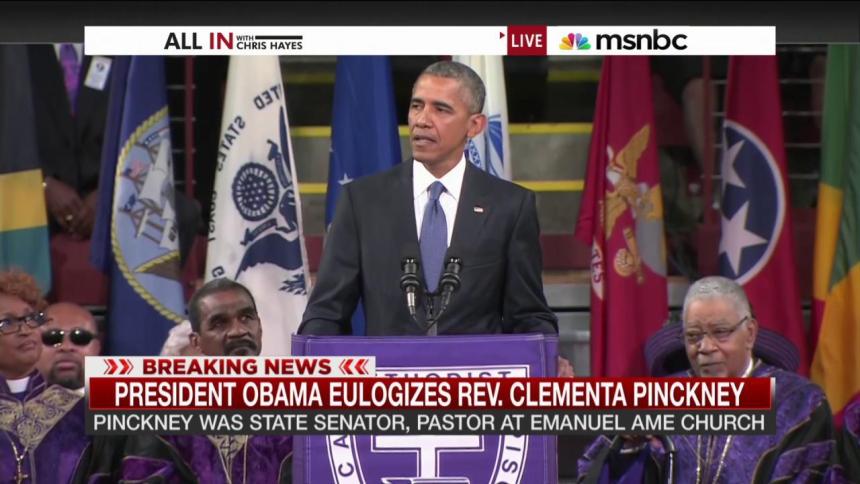
Obama delivered Pinckney’s eulogy on Friday, calling Pinckney a “good man,” full of graciousness and the anointed progeny of a long line of preachers and protesters who sowed the seeds of hope and change in the pulpit as well in the community.
“What a good man. Sometimes I think that’s the best thing to hope for when you’re eulogized – after all the words and recitations and resumes are read, to just say someone was a good man,” President Obama said of Pinckney, who also served as a state senator.
“You don’t have to be of high station to be a good man. Preacher by 13. Pastor by 18. Public servant by 23. What a life Clementa Pinckney lived,” Obama said. “What an example he set. What a model for his faith. And then to lose him at 41 — slain in his sanctuary with eight wonderful members of his flock, each at different stages in life but bound together by a common commitment to God.”
RELATED: Rev. Pinckney’s casket carried out of church
Obama then read the names of the parishioners who died alongside Pinckney, calling them “people so full of kindness” and “people of faith.” In another moment, Obama walked over to the girls, Malana and Eliana, and hugged them. The girls both appeared small in the his arms, recalling embraces the president has shared with his own daughters in the past.
This image crystalized for many what it truly means to have a African-American in the White House, a man whose racial awareness has proven critical in bridging the gap between the highest office in the land and perpetually beleaguered black America.
Before the sun came up, hundreds had already gathered down the street from the College of Charleston where the funeral was held. Many said they woke up early to pray for the reverend’s family. Others drove through the night and through state lines to attend, while others drove from across town.
“I had to be here to offer support and encouragement for this family and this community,” said Scotty Swinney, who drove into Charleston from Savannah, Georgia. “We have to come together to bring about change. We have to keep believing it will happen.”
%22I%20think%20it%E2%80%99s%20a%20travesty%20that%20Rev.%20Pinckney%E2%80%99s%20body%20laid%20there%20under%20that%20flag%20that%20was%20used%20as%20a%20rallying%20cry%20for%20his%20killer.%22′
Friends, former colleagues and religious leaders spoke for the hours-long service, sharing stories of Pinckney’s big heart and gentle voice. First lady Michelle Obama and Vice President Joe Biden were in attendance, as well as former secretary of state and Democratic presidential candidate Hillary Clinton. A bipartisan group of lawmakers joined the president on Air Force One to attend the service, including House Speaker John Boehner and Reps. Elijah Cummings and John Lewis.
The service capped an agonizing week that began last Wednesday night, when confessed killer Dylann Roof, 21, opened fire on parishioners during a Bible study meeting. Pinckney’s widow, Jennifer, and Malana, were in the church during the shooting and hit beneath a desk in his office when the gunfire started.
According to police, Roof stood over one of the victims and made a racist statement before fleeing the church. He was captured the following day in North Carolina. He’s been charged with nine counts of murder and a related gun charge. In a manifesto allegedly penned by Roof, race emerges as the prime motivator behind the shooting.
At one point, Obama connected the attack, which is being investigated by the Department of Justice as a hate crime, to homegrown racial terror of the past. He said we don’t know if Roof knew of the historic role the church played in black culture, “But he surely sensed the meaning of his violent act.”
“It was an act that drew on a long history of bombs and arson and shots fired at churches, not random, but as a means of control, a way to terrorize and oppress,” Obama said. “An act that he imagined would incite fear and recrimination; violence and suspicion. An act that he presumed would deepen divisions that trace back to our nation’s original sin. Oh, but God works in mysterious ways. God has different ideas.”
Roof, Obama said, was too blinded by hatred to see the grace surrounding Rev. Pinckney and his Bible study group.
“The alleged killer could have never anticipated the way the families of the fallen would respond when they saw him in court — in the midst of unspeakable grief, with words of forgiveness. He couldn’t imagine that.”
In the days after the shooting, many of the victim’s families offered their forgiveness to Roof, setting a tone that has been commended by politicians and people of faith from Charleston and far beyond. There has been a sense of racial unity, of black and white together pushing back against the last vestiges of racism in the state.
On Friday Obama found himself in familiar territory, not just as the nation’s consoler-in-chief in a time of tragedy, but also a beacon to members of the African-American community, by far the president’s most loyal and adoring constituents.
In his stirring speech, Obama time and again tapped into the deep emotional and historic connection he has with the black community and the black church community.
RELATED: President Obama: Emanuel AME ‘a phoenix rising from the ashes’ At times his cadence rose like that of a traditional black preacher nearing the climax of sermon. At other times Obama and funeral-goers engaged in a familiar call and response. In one telling moment, Obama took a long pause before he began to sing Amazing Grace, to which nearly every voice in the place responded in kind. But more than anything else the president elegantly articulated the thorny entwinement of the black experience and racial subjugation, the kind of which manifests in symbols including the Confederate flag. “For too long, we were blind to the pain that the Confederate flag stirred in too many of our citizens… For many, black and white, that flag was a reminder of systemic oppression and racial subjugation. We see that now,” Obama said. “Removing the flag from this state’s capitol would not be an act of political correctness; it would not be an insult to the valor of Confederate soldiers. It would simply be an acknowledgment that the cause for which they fought — the cause of slavery — was wrong — the imposition of Jim Crow after the Civil War, the resistance to civil rights for all people was wrong. It would be one step in an honest accounting of America’s history; a modest but meaningful balm for so many unhealed wounds.” %22Grace%20is%20amazing%20and%20the%20more%20we%20show%20of%20it%20right%20now%2C%20it%E2%80%99s%20like%20a%20snowball%2C%20a%20snowball%20heading%20toward%20justice%20and%20equality.%22′ Gov. Nikki Haley and other prominent white politicians on the state and federal level have said it’s time for the flag to be removed from the State Capitol, where Pinckney earned the distinction as the youngest African-American legislator ever elected. Haley and the legislature have called for a special session to debate the removal of the Confederate flag from the statehouse grounds. On Thursday, Pinckney’s body laid in state at the capitol, where the flag still flew. “I think it’s a travesty that Rev. Pinckney’s body laid there under that flag that was used as a rallying cry for his killer,” said Sylvia Skeeter, one of the several hundred mourners who attended the service at the TD Arena at the College of Charleston, located just a few blocks from Mother Emanuel Church. In addressing the broken sanctity of black blood spilled inside of the church, Obama recalled the central role that the church has played for African-Americans. “Our pain cuts that much deeper because it happened in a church. The church is and always has been the center of African-American life, a place to call our own in a too often hostile world, a sanctuary from so many hardships,” Obama said. He then talked of the church as “hush harbors” where slaves could worship in safety, as a rest stop for those traversing the Underground Railroad and as prayer houses and bunkers for their free descendants and foot soldiers in the Civil Rights Movement. “They have been, and continue to be, community centers where we organize for jobs and justice; places of scholarship and network; places where children are loved and fed and kept out of harm’s way, and told that they are beautiful and smart and taught that they matter,” Obama said. “That’s what the black church means. Our beating heart. The place where our dignity as a people is inviolate. When there’s no better example of this tradition than Mother Emanuel, a church built by blacks seeking liberty, burned to the ground because its founder sought to end slavery, only to rise up again, a Phoenix from these ashes.” For all of the sadness and all of the hurt and all of the unimaginable grief the family of those killed in the church shooting, one word uttered over and again during Rev. Pinckney’s funeral— grace— could sum up the counterweight of all those emotions. A number of the nearly two dozen reverends and pastors who spoke at Pinckney’s service invoked the word. As did President Obama in noting Pinckney’s disposition and the resolve of the community in the wake of the tragedy. “I walked away reminded of how strong grace is, how powerful it is,” said Deidrich Thomas, who traveled about two and a half hours to attend the service. “Grace will see us through this. That’s what the president just said. Grace is amazing and the more we show of it right now, it’s like a snowball, a snowball heading toward justice and equality.”
Trymaine Lee
Trymaine Lee is an NBC News correspondent. Recommended


