








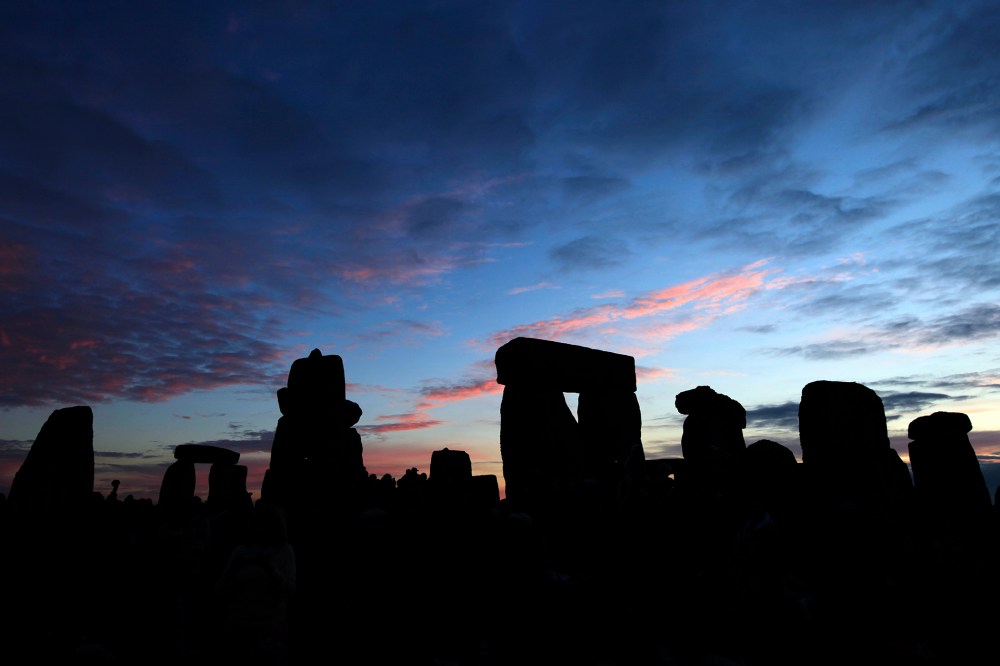
LONDON — The hidden remains of a major prehistoric stone monument have been discovered about a mile from Britain’s iconic Stonehenge site.
At least 90 enormous stone monoliths, some measuring up to 15 feet, lined an “arena” forming what researchers have called a “superhenge” near the neolilthic site in Wiltshire, England. Archaeologists believe they may have been used for religious rites or solstice rituals.
“It’s truly remarkable,” said Vince Gaffney, one of the archaeologists leading the project. “We don’t think there’s anything quite like this anywhere else in the world. This is completely new and the scale is extraordinary.”
Now lying on their sides covered by three-feet of earth, researchers believe the stones were placed around 4,500 years ago along the south-eastern edge of what later became the Durrington Walls — a large Neolithic settlement.
The circular enclosure ringed by a ditch and bank is nearly a mile across. It is the largest earthwork of its kind in the U.K.
“These things are theatrical,” said Prof. Gaffney, of Britain’s University of Bradford. “They’re designed to impress and impose; to give the idea of authority to the living and the dead. It really does create a massive impression.”
The stones remained undiscovered until Prof. Gaffney and his team investigated the area around the famous stone circle with ground-penetrating radar.
Although the exact reason for the stones placement remains a mystery, part of Durrington Walls is aligned with the rising sun on the winter solstice, the shortest day of the year and researchers believe this may be significant.
The archaeologists believe that at some stage the stones were pushed over in a deliberate attempt to preserve them.
“There was a transformation in the landscape that we do not understand,” Gaffney said. “The stones had significance. These are special places. Societies are mobilized, as with the great cathedrals, to create these things.”
Although none of the stones have yet been excavated a unique “sarsen” or limestone standing stone, remains in an adjacent field. Its presence suggests that the other buried stones of a similar size may have been sourced locally, according to Gaffney’s colleague and fellow archaeologist, Nick Snashall. He added that they revealed “previously unsuspected twists in its age-old tale.” “The presence what appear to be stones, surrounding the site of one of the largest Neolithic settlements in Europe adds a whole new chapter to the Stonehenge story,” he said. This story originally appeared on NBCNews.com
Henry Austin Recommended


