








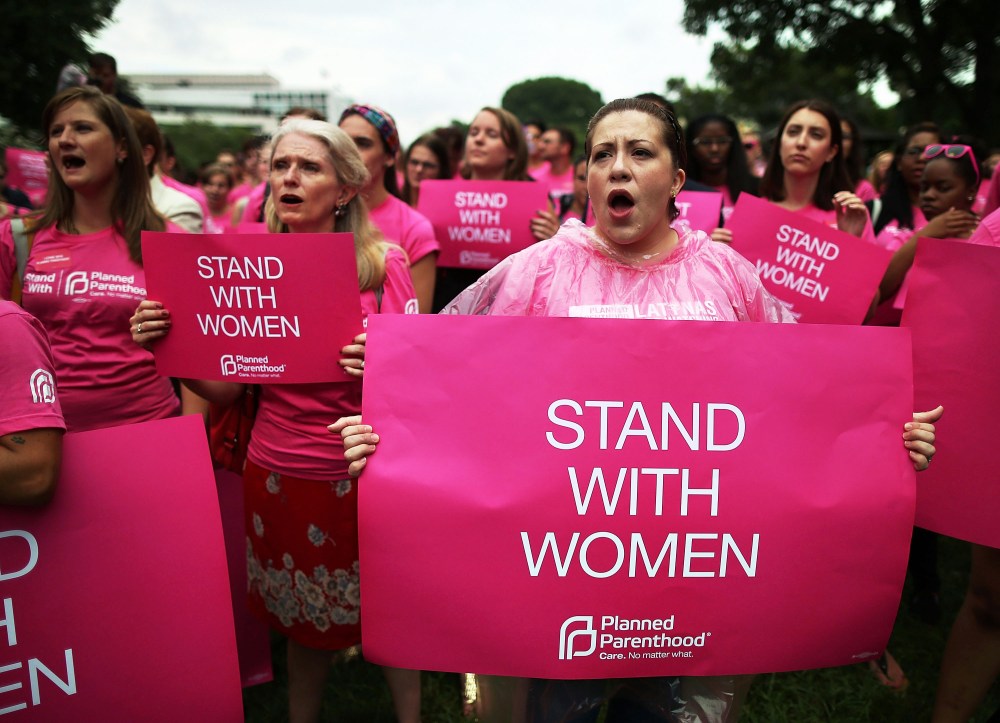
For years, lawmakers from the U.S. Senate to states across the country have cited the abuses at Kermit Gosnell’s Pennsylvania clinic to restrict access to abortion. Today, California Governor Jerry Brown didn’t mention Gosnell’s name, but by signing the Early Access to Abortion Bill into law, he did more than any of those legislators to prevent another Gosnell.
The Early Access to Abortion Bill will enable trained nurse practitioners, certified nurse midwives, and physician assistants to perform first-trimester abortions by vacuum aspiration. It’s the logic of cause and effect: If you make it easier to access an abortion, earlier, and from a legitimate provider, there will be fewer desperate customers turning to unsafe providers.
Nearly one third of women will have an abortion before the age of 45, but the number of providers is at best stagnant and in many places diminishing. In California, the country’s most populous state, almost half of women live in a county without an abortion provider. Nationally, the number of counties without an abortion provider is 87%–where a third of American women live.
The new law puts California in stark contrast with other states. States like Arizona have in recent years have already explicitly banned anyone but a doctor from performing the relatively simple first-trimester procedure. In the last few months alone, Iowa moved to prevent women in rural areas from consulting with a doctor via webcam before taking abortion pills; most of Virginia’s clinics will have their fate determined by the next election; and new Texas laws threaten to close one-third of abortion clinics. There’s another departure from those states: California’s law is guided by actual medical evidence, including a multi-year empirical study.
“Abortion complications were clinically equivalent between newly trained NPs, CNMs, and PAs and physicians, supporting the adoption of policies to allow these providers to perform early aspirations to expand access to abortion care,” wrote medical and public health researchers from the University of California at San Francisco, led by Tracy Weitz. They got a waiver to test the safety of non-physicians conducting aspiration abortions. (The complication rate out of 11,487 abortions was less than 2% for both categories.) Meanwhile, documents from recent audits reveal that the Texas clinic regulations that will likely shutter many of the state’s clinics aren’t prompted by any actual health violations, nor would the regulations demonstrably make them safer.
Women who went to Gosnell, sometimes repeatedly and usually without complaint, plainly felt they had no other choice. They were predominately low-income and women of color–the same groups that will be the likeliest to benefit from California’s law, since research shows that they are more likely to see nurse practitioners or physician assistants than obstetricians and gynecologists. Some women also ended up at Gosnell’s clinic because they were too far along for another provider or for Pennsylvania’s legal limit. There is some research indicating that some of the later abortions that politicians like to rail against are preventable–if women were able to access abortion earlier. According to the University of San Francisco’s Advancing New Standards in Reproductive Health (with which Weitz is affiliated), a 2006 study found that 58% of women having abortions “reported that they would have liked to have had the abortion earlier. The most common reasons for delay were that it took a long time to make arrangements (59%).” A separate study, from 2008, “found that inaccurate referrals, difficulty finding an appropriate provider and the time needed to collect the money all delayed women’s abortions.” Earlier abortions are cheaper and have lower risks of complications. Dana Cody of the Life Legal Defense Foundation said Brown is sanctioning “back-alley abortions,” saying that “with Gosnell and all the other clinics that have been exposed for deficiencies in practice and harming women to killing women, to allow non-physicians to perform abortions is just negligence.” In fact, the groups that used Gosnell as a cudgel for new abortion laws should have been cheering Brown’s decision, not testifying against it.
Irin Carmon Recommended


