








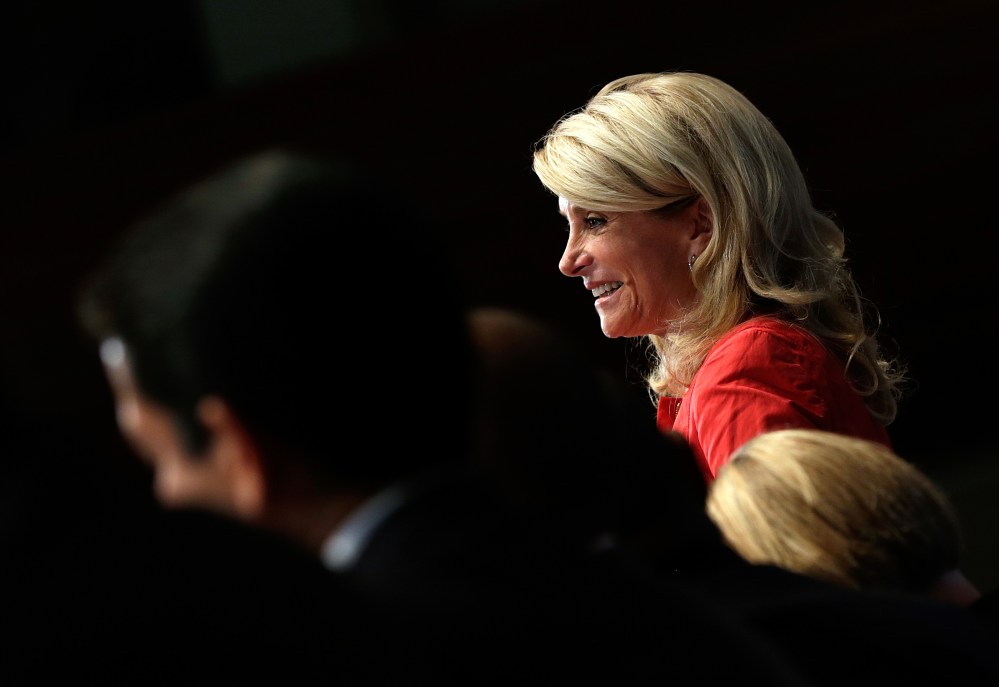
You’ve heard about the explosion in Texas’ Hispanic population that looks set to make the deep-red state competitive for Democrats before too long. But most experts say those trends won’t become game-changers for another decade or so—too late to help Wendy Davis’ bid for governor next year. That doesn’t mean that there’s no path to victory for Davis, though.
Rather than riding a demographic wave into the Governor’s Mansion, Davis has a chance to instead put together a cross-racial coalition that brings together minorities and liberal or moderate whites—especially women—Democrats and Texas political experts say. The task might have been made a little easier Monday when a federal judge appointed by President George W. Bush blocked a key part of the abortion law that Davis gained a national profile by filibustering—making it trickier for Republicans to paint her as an extremist on the issue.
Still, given the partisan realities of the Lone Star State, where no Democrat has been elected governor since 1990, it’s a long shot that would require almost everything to break her way. But with a proven statewide candidate, Attorney General Greg Abbott, as her probable Republican opponent, it’s likely the best chance Davis has got.
The strategy is comparable to the one used in Obama’s 2012 victory nationwide, when the president won an overwhelming minority of non-white voters, while holding onto enough liberal and moderate whites to eke out a majority. It’s also an approach Davis has used before: Whites made up around half of her state Senate district. In her 2008 and 2012 victories, both of which surprised many observers, Davis won large majorities of black and Hispanic voters, while staying competitive with whites by running as a centrist Democrat focused on education and economic development.
“There’s a little bit of a template,” Matt Angle, a veteran Texas Democratic political consultant who helped recruit Davis for the state Senate in 2008 told MSNBC. “And then Wendy Davis really energizes that by just being an extraordinary candidate who defies any type of ideological labels.”
Texas Democrats see any increase in minority turnout driven by demogrpahic changes as a bonus. Instead, they’re relying on a two-pronged strategy: Boosting Democratic margins with existing Hispanic voters; and cutting the party’s deficit with whites.
Here’s how they see the math: First, they assume an electorate that’s roughly 65% white. (In 2010 it was 67% white, and most projections put it at around 65% this time around). If Davis can win close to 70% of the Hispanic vote, and 35% of the white vote, she’d have a chance to get to a majority, given reliable black support for Democrats.
Increasing the margin with Hispanics
Winning seven in ten Hispanic votes will be a heavy lift for Davis, but it’s not impossible. In the past, Texas Hispanics have been more open than Hispanics in other states to voting Republican. When he was governor, George W. Bush got nearly half the Hispanic vote. To get close to 70%, Democratic strategists say, they’ll need to make Hispanics vote more like they do elsewhere.
Last year, for instance, Mitt Romney won just 28% of the Hispanic vote nationwide. “We need to do what we can to keep Greg Abbott in Romney-esque territory in the Hispanic vote,” Jason Stanford, a Texas Democratic political consultant, told MSNBC (Stanford has written opinion columns for MSNBC). “Anywhere around 30, we’re happy. Under 30, we’re dancing in the streets.”
To do it, Davis will need to capitalize on the GOP’s efforts to curry favor with nativist white voters, said Stanford. He noted that every Republican running for lieutenant governor—an important post in Texas—is in favor of repealing the DREAM Act, an issue that goes to the heart of Texas Hispanics’ hopes for their kids’ futures. A backlash fromTexas’ GOP-backed voter ID law could also help, if Democrats can educate Hispanic voters on the law’s disproportionate impact on minorities.
Davis will have help. In 2010, the Democratic candidate for governor, Bill White, didn’t raise enough money to run a robust turnout operation in the state’s key Democratic strongholds: the major metro areas of Dallas, Houston, San Antonio, and Austin, and the heavily Hispanic strip along the lengthy Mexican border. That likely won’t be a problem for Davis, a progressive star with a national profile—especially given the support her campaign is already getting from Battleground Texas, a field organizing network with close ties to the Obama campaign.
The bottom line: Davis will likely improve on 2010, when Rick Perry won 38% of the Hispanic vote against White. But keeping Abbott close to 30% could be a tall order.
Limiting the damage with whites
The other piece of the strategy, getting to 35% of the white vote, figures to be even harder for Davis—though not impossible. The key here is likely to be suburban women.
“There is some evidence that the rightward swing of the Tea Party, for a range of reasons probably, is moving suburban women away from the GOP,” Jim Henson, the director of the Texas Politics Project at the University of Texas, told MSNBC. Henson notes that In October 2010, 50% of suburban women identified as Republicans, according to a Texas Tribune poll. By this June, that number was down to 38%. That’s where the abortion issue could help Davis not only to motivate her base of liberal abortion-rights supporters, but also reach out to independent women. Forty-five percent of suburban women think abortion should be allowed in all cases as a matter of personal choice, compared to 36% of Texans generally, according to a recent poll. Stanford said many “soft Republicans” are far closer to Davis on the issue than they are to Abbott, who opposes exceptions for rape and incest, and squarely backed Rick Perry’s push to eliminate Planned Parenthood clinics. “It’s not about abortion,” Stanford said. “It’s about men bullying them and closing clinics where they get healthcare.” And Davis will likely get an inadvertent boost from the GOP. “It’s not just a matter of Wendy Davis appealing to women voters, it’s Greg Abbott and other Republicans really alienating women voters,” Angle said. “So in terms of getting an increased Anglo vote, you get a lot of otherwise independent women willing to vote for a mainstream Democrat.” The impact of Texas’s voter ID law here is hard to predict. Lately, there have been fears that it could disenfranchise women, who are more likely than men to have a mismatch between the name on their driver’s license and that on their voter registration. When Davis herself went to vote Tuesday on several constiutional amendments, just such a mismatch required her to sign an affidavit stating that she was who she said she was. That recourse existed only because Davis herself had added an amendment to the bill allowing for voters to sign an affidavit in such situations, rather than being forced to cast a provisional ballot. But it’s perhaps equally likely that the issue could create a backlash of just the type Angle’s talking about. Another part of boosting the Democratic performance among white voters, said Henson, is going after pockets of Democrats in exurban and rural areas, especially inside the state’s central triangle between Dallas, San Antonio, and Houston—who for years have been neglected by the state party. That’s an area where Battleground Texas, the Obama-linked group, will likely play a key role. “A lot of the rural and semi-rural areas have been largely abandoned,” said Henson. “There’s a lot of yellow-dog Democratic voters that have just been kind of out there on their own.” White won 29% of the white vote in 2010, and Davis seems likely to outperform that total. A poll over the summer from Public Policy Polling, a Democratic firm, found Davis already at the magic 35% mark—a result that did not go unnoticed among Texas political observers. Then there’s a tantalizing wildcard: In the 2010 governor’s race, a Tea Party candidate, Debra Medina, won 18% of the vote in the Republican primary. Medina has been flirting with the idea of running again, as an independent. It’s unlikely, but if it happened it could scramble the dynamics completely–in Davis’s favor. Sanford said it would be a “game-changer.”
Zachary Roth Recommended


