








Something unexpected is happening in the Republican presidential field.
Leading GOP candidates once denied the reality of manmade climate change, but now they seem to be softening their posture and subtly embracing it.
Democratic candidates Hillary Clinton and Bernie Sanders have long pledged to deepen President Obama’s climate commitments if elected to office. The Republican candidates are still far from believers or political backers of the president’s agenda. But a close parsing of their comments suggest the party of no is becoming the party of maybe – or perhaps even the party of yes.
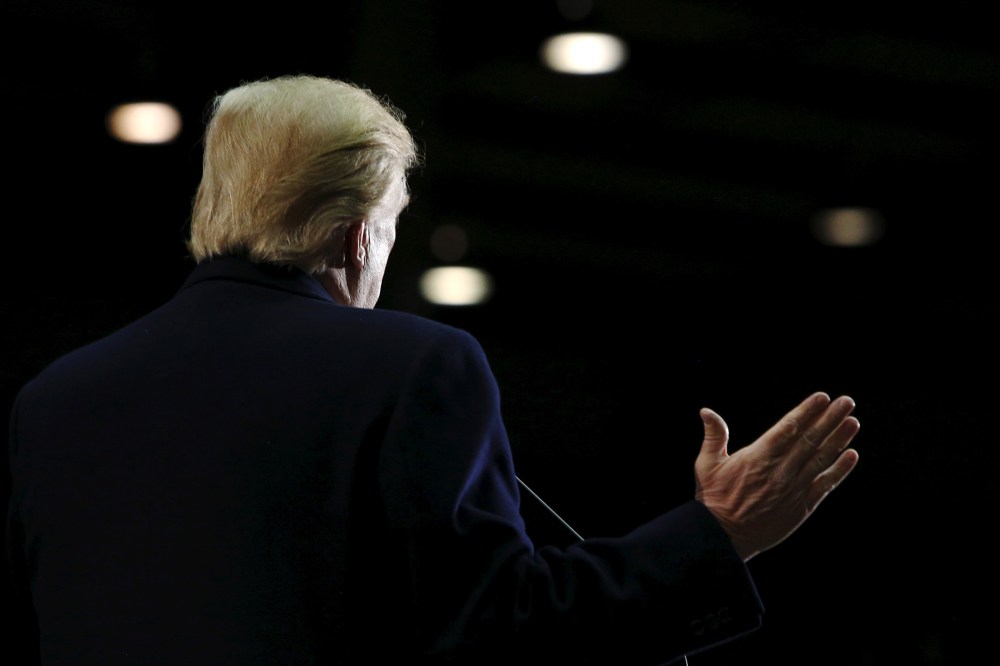
Take the case of Donald Trump, the billionaire contrarian and big winner of the New Hampshire primary on Tuesday. His denial of climate change has been a centerpiece of his act for years.
WATCH: SCOTUS blocks Obama’s climate plan
In tweets between 2012 and early 2015, he called climate change a “con job,” a “canard,” a “hoax,” “bulls**t,” and a concept “created by and for the Chinese in order to make U.S. manufacturing non-competitive.”
But as his political star has risen, he’s changed his tune on global warming.
He’s walked back his wildest conspiracy theories and toned down his claims that cold weather somehow disproves global warming. He’s also retired some of his most incendiary language (“con job,” “canard”) and wrapped what remains in strong qualifiers.
In January, for example, after relentless mockery from the Sanders campaign, Trump told “Fox & Friends” that his tweet about climate change as a Chinese plot was a “joke.”
“Obviously, I joke,” he said. “I know much about climate change. I’d be — received environmental awards. And I often joke that this is done for the benefit of China.”
The Republican front-runner still uses the word “hoax,” deploying it on December 30 at a rally in Hilton Head, S.C. But he bookends it in un-Trump-like uncertainty. “A lot of it is a hoax,” he said, according to ThinkProgress, a left-leaning news site “I mean, it’s a money-making industry, OK? It’s a hoax, a lot of it.”
You can trace the change to September, when Trump delivered his most expansive comments on climate change. Speaking with conservative radio host Hugh Hewitt, he criticized Obama for trying “to solve a problem that I don’t think in any major fashion exists.”
So, that’s news: Trump seems to accept that climate change is a problem. Granted, he doesn’t think it’s a major problem but his mind remains open to change. “I am not a believer,” he told Hewitt, “unless somebody can prove something to me.”
It’s not just Trump whose rhetoric has opened the door to a more scientific perspective on policy.
Ohio Gov. John Kasich – fresh off a campaign-boosting second-place finish in New Hampshire – has been a believer since 2012.
“I happen to believe there is a problem with climate change,” he told The Hill at the time. “I don’t want to overreact to it, I can’t measure it all, but I respect the creation that the Lord has given us and I want to make sure we protect it.”
A Kasich spokesperson confirmed in December that the governor’s views haven’t changed. He “believes that climate change is real and that human activity contributes to it,” spokesperson Rob Nichols told The New York Times.
Admittedly, Kasich has also said that humans are not the “primary” cause, a view that breaks with mainstream science. But he thinks that people can harm the planet and that a government response may be warranted. It even sounds like he’d support an ambitious plan of action if he could be convinced that clean energy can be good for the economy.
That’s about the same ideological place you’ll find Florida Sen. Marco Rubio and former Florida Gov. Jeb Bush. They are afraid that action on climate change will torpedo the economy.
Bush has gone from equivocator to perhaps the most progressive environmentalist in the GOP field. First, the equivocation, which flared in May 2015 at a campaign stop in New Hampshire: “For people to say the science is decided on this is just really arrogant,” he told a crowd. “It’s this intellectual arrogance that now you can’t have a conversation about it.” But at another rally in New Hampshire in February, before a surging fourth place finish in the primary, Bush sounded like a level-headed realist. “Look, the climate’s changing,” he said, admitting that it was hurting moose in the Granite State. “We have billions of people who live on the planet; we clearly have an impact on it. To deny it doesn’t make sense.” Rubio is a harder case, but even he seems to be softening. Two years ago, he was a complete denier, saying “I do not believe that human activity is causing these dramatic changes to our climate.” RELATED: How Obama plans to change how most of the country is powered Then, at a GOP debate in September, he insisted that he’s “not skeptical” of climate change. Rather, he’s skeptical of Obama’s response to climate change, because he’s sure it will stop jobs growth without slowing the global warming. Elsewhere, he’s expressed doubt about the settled scientific fact that humans are driving climate change. The only outright denier left in the top-rank of the Republican field is Texas Sen. Ted Cruz. He’s claimed that climate change is “the perfect pseudo-scientific theory” and “not science” but “religion.” He’s denied that the temperature is rising, citing satellite data that scientists say he’s misinterpreting. But Obama seems to think that even Cruz could come around if the senator wins the White House. The reason: a world-wide climate consensus, one Obama thinks could overwhelm what remains of Republican skepticism. “American leadership involves not just playing to American constituency back home, but you now are in fact at the center of what happens around the world,” he told reporters in December, inviting them into his successor’s mindset. “And that your credibility and America’s ability to influence events depends on taking seriously what other countries care about.” Later that month he went even further, admitting that the next president could undo his legacy on climate change—but doubting that such a reversal would actually happen. “By the time that even a Republican president came into office, what you would have seen would be a growing realization that not only should we do something about climate change, but it’s not only a challenge, it’s also an opportunity,” he told NPR. If the field’s shifting positions are any sign, Obama can rest easy. The centerpiece of his attack on climate change will remain intact.
Tony Dokoupil Recommended


