








After the “Knock-Knock” joke heard around the world fell flat, the defense had nowhere to go but up. But who ever expected the State of Florida to take them there?
With a few distinctive yet destructive missteps, the State’s presentation of evidence in the trial of George Zimmerman provided a string of reasonable doubts commencing with the testimony of Rachel Jeantel, the young woman that Trayvon Martin was on the phone with before he was killed.
Jeantel appeared recalcitrant from the moment she entered the courtroom. When Jeantel was forced to admit she couldn’t read cursive writing in a letter that was sent to Martin’s mother that bellowed to the jury that the State didn’t bother to get to know Jeantel. The state wouldn’t bother to protect Jeantel and was more disconnected from Jeantel than even defense attorney Don West. Instead of embarrassing a key witness, the State could have asked the defense to simply agree to put the letter Jeantel wrote to Martin’s mother into evidence. That option automatically puts the witness by your side. But you have to get to know your witness to actually do that.
At that point, the state appeared to not be fully committed to this trial. When the state called FBI audio expert Dr. Hirotaka Nakasone, the defense’s pre-trial witness, to testify that it was not possible to identify the screams on the 911 call, he may as well have had a banner reading “Reasonable Doubt” above his head.
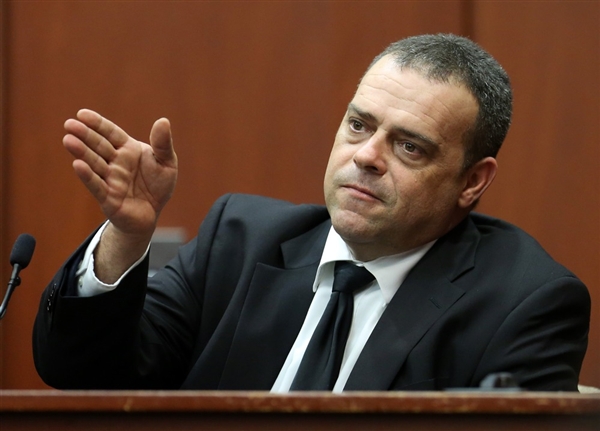
When Detective Chris Serino testified that he believed Zimmerman was telling the truth, it took about 15 hours for the state to object – long after the jury went to sleep with that ringing endorsement in their heads.
But objections were noticeably absent in both Serino’s testimony as well as Jeantel’s. Mr. West barraged Jeantel with hypothetical questions regarding what Martin was thinking, or may have been doing, when he encountered Zimmerman. That’s not allowed. Except when no one objects to it.
With these moves, and others, the state seemed to hand Zimmerman’s self-defense to the jury on a silver platter. The State put into evidence several of Zimmerman’s statements including a Fox News interview, his reenactment for the police and an interview from the police station. Presumably their idea was to highlight Zimmerman’s inconsistencies. However, a prosecutor never enters exculpatory statements (those that say he isn’t guilty) by a defendant. Never. While Zimmerman did have inconsistencies, he overwhelmingly stayed on message that he was defending himself.
The State (like most prosecutors in this country) should have left out Zimmerman’s self-serving statements and focused more on the five prior calls to police to corroborate their theory that he had ill will, spite or hatred. That would have forced Zimmerman’s hand. He would have had to testify to provide a foundation for the jury to consider the self-defense instruction. Important to note, the defense cannot enter prior statements by the defendant. Instead, the State sent a subtle message that it believed Zimmerman’s statements. Yes – it did. With every piece of evidence, with every witness put forth, attorneys send a message to the jury that they find it credible, believable and corroborative.
If Zimmerman had testified, undoubtedly , the prosecution would have found something inconsistent with at least one of those prior statements. At that point, the State could impeach Zimmerman with a prior statement by playing it in front of the jury and questioning him about it. The State could have asked him if he knew what ‘Stand Your Ground’ was. If he said no, he could have been confronted him with the ‘A’ his professor testified he got in the class that covered that law. If he said yes, confront him with the Fox interview where he said he did not know what ‘Stand Your Ground’ was. See how this works? In testifying, Zimmerman would have had to demonstrate with that infamous dummy how Martin allegedly reached for his gun. Zimmerman would have been asked to scream so the jury could compare it to the 911 call from the night of the shooting. Zimmerman simply could not have maintained composure or kept track of his inconsistencies during cross-examination. Remember how he almost passed out when the Judge was questioning him about taking the stand? The State of Florida gave Zimmerman an out and gave us yet another reason to question our system of justice. It is supposed to be the best in the world – but it just doesn’t feel like that today. Editor’s note: George Zimmerman has sued NBC Universal for defamation. The company strongly denies the allegation.
Seema Iyer Recommended


