








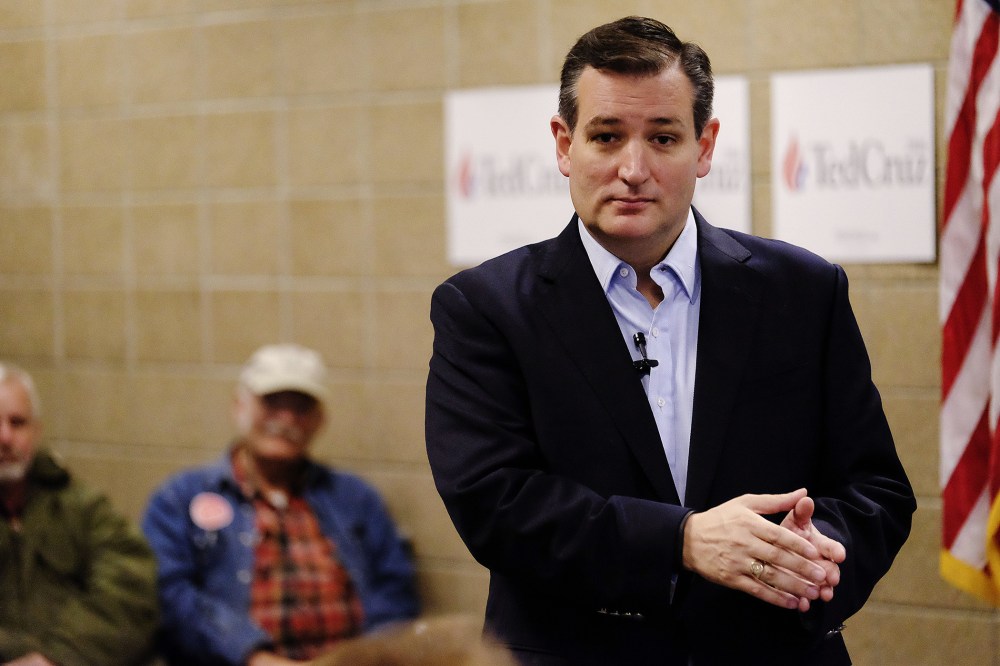
KINGSTON, New Hampshire — Nancy Buckley, a Republican from Massachusetts, drove to a packed Veterans of Foreign Wars hall here, where she and several dozen predominantly older voters waited patiently for Texas Sen. Ted Cruz to speak.
“I’m looking for someone who won’t approve amnesty,” Buckley told MSNBC. “It’s probably down to Cruz and Trump right now, [I’m] just trying to get a feel for them both.”
Amid the graying crowd, a handful of young men in Cruz-branded vests and sweaters moved through the room collecting personal information. The candidate stood in the back of the room in front of a camera to do a satellite interview with Sean Hannity.
RELATED: Where the 2016 candidates stand on combating ISIS
“We saw one Republican after another giving an ode to amnesty … None of them are losing their jobs, but they’re happy to tell working men and women across this country that your job can be taken away by people coming here illegally,” Cruz told Hannity.
The crowd behind him whooped and cheered, making it difficult for the candidate to hear the next question in his earpiece over chants of “We choose Cruz! We choose Cruz!”
The%20fight%20over%20immigration%20–%20and%20recently%2C%20over%20refugees%20–%20has%20marked%20a%20coming%20out%20party%20for%20a%20Cruz%20campaign%20that%20until%20recently%20was%20quietly%20focused%20on%20building%20a%20formidable%20ground%20game%20and%20fundraising%20operation%20as%20candidates%20like%20Donald%20Trump%20and%20Ben%20Carson%20hogged%20the%20spotlight.’
Later that evening, Cruz stoked what would become a multi-round feud with rival GOP hopeful Marco Rubio by delivering a broadside against the Florida senator’s bipartisan immigration bill, which Cruz described to reporters as “the brainchild of Chuck Schumer and Barack Obama that would have granted amnesty to 12 million people here illegally.”
Buckley had gotten her wish.
The fight over immigration — and recently, over refugees — has marked a coming out party for a Cruz campaign that until recently was quietly focused on building a formidable ground game and fundraising operation as candidates like Donald Trump and Ben Carson hogged the spotlight. Now, after a pair of effective debate performances, Cruz is more actively distinguishing himself from his rivals in a position of growing strength.
Last week’s shocking attacks in Paris stoked already simmering fears of malicious border-crossers into a towering political inferno. And Cruz, sensing his moment, has eagerly fanned the flames. He introduced legislation to block Syrian refugees – except, via a loophole, Christians – and challenged President Obama to a debate on the issue after Obama accused the entire GOP field of cowardly scapegoating Syrians fleeing the violence. “I would encourage you, Mr. President, to come back and insult me to my face,” Cruz said.
The latest NBC News/SurveyMonkey poll put Cruz at a new high of 18%, tied with Carson and second only to Trump. Top campaign aides see a clear path to the nomination and their strategy sounds as plausible as anyone in the race. It’s time to start taking a Cruz nomination seriously.
The case for Cruz
If you’re a rock ribbed conservative, the case for Cruz is straightforward: He combines the visceral evangelical appeal of Carson, the outsider message of Trump, the discipline of Rubio, a dash of Rand Paul’s libertarianism, and the fundraising and organizing game of Obama. It’s a tough combination to ignore.
%E2%80%9CCruz%20has%20better%20organization%20in%20the%20Super%20Tuesday%20states%20on%20March%201%20than%20most%20have%20in%20Iowa%20right%20now.%22′
In fact, where Rubio team has spent months fending off Obama comparisons focusing on his inexperience, Cruz’s campaign actively encourages such talk.
“I think the country is yearning for a conservative who will be as dedicated to conservative values as Barack Obama was dedicated to liberal values,” Mark Campbell, Cruz’s political director, volunteered to MSNBC after the last GOP debate.
In interviews, Cruz’s staff and supporters laid out a concise and plausible strategy for their candidate to win the nomination. The first step: Consolidate right-wing support in the early voting states and then overrun the remaining competition with a superior ground game in later contests. In particular, they see an opportunity for Cruz to score big in the “SEC primary” on March 1, which features several southern states including Cruz’s native Texas.
“Cruz has better organization in the Super Tuesday states on March 1 than most have in Iowa right now,” Iowa radio host Steve Deace, a key Cruz supporter in the state, told MSNBC. “The further we go into the field, that’s where you really see more of his organization and fundraising advantage begin to really take hold.”
No%20one%20knows%20how%20Cruz%E2%80%99s%20soldiers%20will%20perform%20until%20they%E2%80%99re%20tested%2C%20but%20his%20fundraising%20is%20strong%20evidence%20that%20things%20are%20on%20the%20right%20track.’
The campaign worked to organize its supporters early on – it named chairs for every single county in the first four primary and caucus states, for example, and developed a competitive “Cruz Crew” app for volunteers who can score points by identifying potential backers.
No one knows how Cruz’s soldiers will perform until they’re tested, but his fundraising is strong evidence that things are on the right track.
Cruz’s critics in the Senate have long accused him of ginning up needless crises to rile up conservatives, collect email addresses, and raise money ahead of a presidential run. Say what you want about his intentions, but the constant Capitol Hill shutdown standoffs have indeed built Cruz into a grassroots power.
In a cycle where rivals like Rubio and Jeb Bush have struggled to raise hard campaign cash (as opposed to unlimited money donations to outside groups), Cruz and his database of supporters are racking up small donations while still courting millionaires. Among Republicans, only Carson outraised Cruz last quarter.
Cruz’s conservative lane
Talk to Cruz and his supporters about where the race is heading and you hear a lot of conversation about “lanes.” Cruz has said the race is narrowing into a “conservative lane” and a “moderate lane,” with his own campaign poised to win the former and Rubio poised to own the latter. Rick Tyler, Cruz’s spokesman, says it’s a “conservative lane” and an “establishment lane.” Deace sees three lanes, a “conservative lane” that includes Cruz, an “establishment lane,” but also a separate “outsider lane” that includes Trump and Carson that Cruz doesn’t need to consolidate as quickly.
The idea, his aides contend, is that Cruz only needs to get to a two- or three-person race before his advantages kick in and push him over the finish line. Rubio will lock down the moderates, Cruz will lock down the hardcore right, and then they’ll fight over the broad conservative pool of voters in-between. This is the dynamic that’s driven them to open conflict, with Rubio trying to undermine Cruz’s conservative credentials and Cruz trying to do the same for Rubio.
Trump and Carson have stayed ahead of Cruz in polling averages on the state and national level so far, but no one else in the field other than Rubio seems like much of a threat. Bobby Jindal, Scott Walker, and fellow Texan Rick Perry are gone. Mike Huckabee and Rick Santorum, rivals for evangelical support in Iowa, look weak. Paul has fizzled, leaving libertarians up for grabs.
“It’s all playing out as he wanted it to,” Amanda Carpenter, a former communications director for Cruz, told MSNBC.
Unlike other candidates who have teed off on Carson and Trump in hopes of moving up, Cruz has never resorted to attacks on those outsider rivals. Instead, he has carefully avoided criticizing them and made a show of it at every turn. Even on Friday, when Cruz said he disagreed with Trump’s pledge to implement a database of Muslims, he took care to add he has “no interest in attacking Donald Trump” and liked him personally.
“I’m actually immensely grateful Donald Trump is running,” Cruz said in New Hampshire last week. “He has helped frame the central issue of this primary as ‘Who will stand up to Washington?’ Now, if that’s the central issue then the natural next question is who actually has stood up to Washington?” Trump so far has paid back the favor by refraining from attacking Cruz, while hinting he might change his mind later. The truce is no small feat considering Trump is the most famous birther in America and Cruz was born in Canada, which should make him ineligible to be president if you take Trump’s position on the Constitution’s requirements for the office (most legal scholars do not). %E2%80%9CIt%E2%80%99s%20all%20playing%20out%20as%20he%20wanted%20it%20to.%E2%80%9D’ The Cruz campaign’s strategy reflects a quiet confidence that Trump and Carson voters will come around to Cruz, who is already openly teasing a final showdown with Rubio, as the best compromise between outsider cred and plausible experience. “It’s like playing golf,” Jeff Roe, Cruz’s campaign manager, told MSNBC. “You have to work on your own score before you can play anyone else.” As Cruz has proven in the debates, he’s a relentlessly on-message candidate compared to Trump and Carson, who are often confused on policy and frequently sucked into odd side-controversies. Whereas Trump rattles off whatever comes to mind, it’s rare to hear an untested Cruz line – one Weekly Standard reporter who wrote a 2013 profile contemplated jumping from a moving car to avoid hearing Cruz tell him the same talking point again. To the extent Cruz has made gaffes, they’ve come from applying the right scripted talking point at the wrong time, like the time Cruz used an old Joe Biden joke after Beau Biden died, or an old Jimmy Carter line after Carter was diagnosed with cancer. Carefully reading conservative minds Cruz’s backers sell his consistency on issues as a core selling point – “Even if you disagree with him, he says what he means,” as one aide put it — but his real trick is carefully reading conservative minds and then translating their thoughts back to them. To that end, Cruz has done more than just avoid criticizing Trump — he has used the real estate mogul as market research to nail down the often unpredictable id of the populist right and then shifted his own positions and rhetoric accordingly. Take immigration. Until recently, Cruz was not just tolerant of immigration, he was a proud spokesman for its alleged social and economic benefits. Just months ago, he would name-check legislation he had introduced to increase the number of high-skilled H1B visas and would tell audiences these workers had created more jobs for native born workers. RELATED: Cruz to Obama: ‘Insult me to my face’ Then Trump happened, along with an uptick in concern about H1B abuses, and Cruz pulled an about-face in tone and position. Last week, he announced a new plan to freeze immigration levels until the economy improves and has taken to warning in his stump speech that undocumented immigrants are stealing work from deserving Americans. Cruz, whose father left Cuba after being beaten by agents of the Batista regime, also changed his tune on refugees (along with plenty of others in both parties) after the Paris attacks. %E2%80%9CCruz%E2%80%99s%20entire%20strategy%20has%20been%20geared%20toward%20winning%20the%20primary%2C%20but%20there%E2%80%99s%20no%20thought%20–%20or%20at%20least%20very%20little%20thought%20–%20given%20to%20how%20you%20win%20the%20White%20House.%E2%80%9D%20′ As recently as last February, when ISIS atrocities were in the news, Cruz said in a Fox News interview that America had “welcomed refugees, the tired, huddled masses, for centuries” and that it was possible to screen out possible terrorists among Syrians escaping violence. This week, he introduced legislation to block Muslim – but not Christian – U.S.-bound refugees from Syria and other Middle Eastern states. America, Cruz said, “simply cannot accept refugees from countries that have a significant terrorist presence.” Rubio, for his part, has cleverly tried to exploit Cruz’s reluctance to break with the right by attacking him on areas where the default “conservative” position is not entirely clear. Cruz has worked successfully to peel libertarian votes from Paul by backing curbs on NSA data collection, for example, but Rubio argued this week that Cruz’s vote to reform the program weakened national security. Cruz has also pitched a middle path between Paul-style non-interventionism and Rubio-style hawkishness when it came to America’s Middle East conflicts, another area where there’s no one “right” answer for every part of the GOP base. The biggest disagreement between Rubio and Cruz isn’t on policy, however, it’s on strategy. Rubio sees the election as a struggle to widen the GOP coalition by making the party more welcoming to immigrants, young voters, and minorities. One of his star endorsements so far is freshman Sen. Cory Gardner of Colorado, who won his race in 2014 in part by tacking to the middle on issues like immigration. Cruz sees the election as a battle to fire up an existing GOP coalition that he views as depressed by moderate half-measures. His biggest recent endorsement is Iowa Rep. Steve King, famous for accusing young undocumented immigrants of being drug mules with “calves the size of cantaloupes” from hauling marijuana. One approach requires, at least in presentation, concessions to the middle. The other requires constant conflict to inflame the base. “Cruz’s entire strategy has been geared toward winning the primary, but there’s no thought — or at least very little thought — given to how you win the White House,” Brian Walsh, an unaligned GOP strategist, told MSNBC. “It’s really simple math in terms of the level of Hispanic support, the level of support from women, the level of support from independent voters that Republicans will need.” But that’s a problem for another day. For now, Cruz is focused on his lane, and it looks wider than ever.
Benjy Sarlin Recommended


