








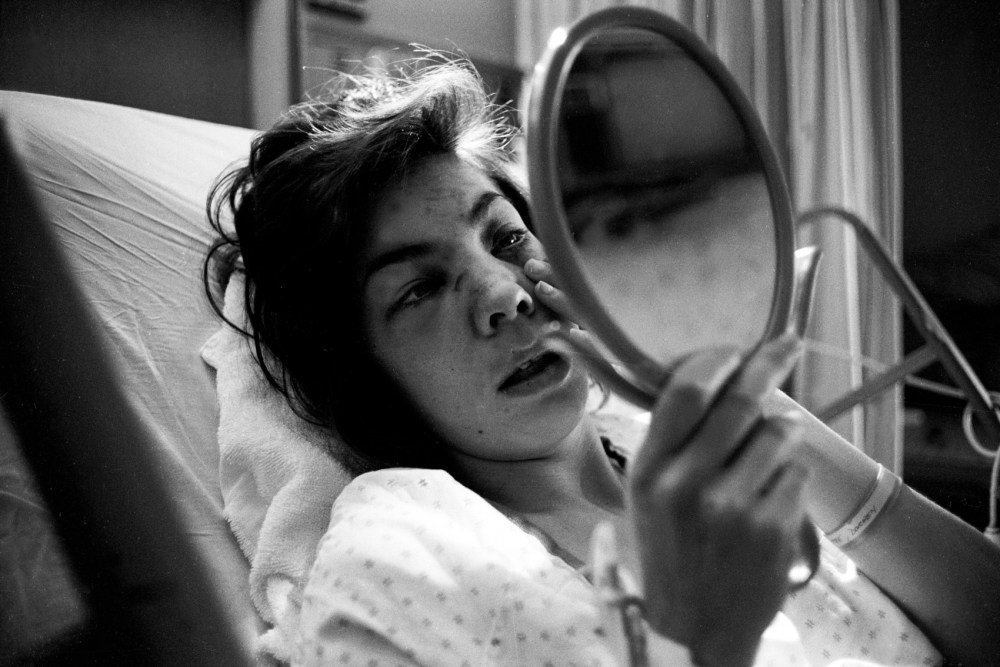
There are psychological answers to the question of why people — disproportionately women — stay with abusive partners. Since the video of Ray Rice beating his wife, Janay Palmer, in an elevator surfaced, some of those answers have come from women using the hashtag #whyistayed. The abuser made them feel worthless. They believed in a perfect marriage. They believed it would stop.
#whyistayed he told me he would never do it again #whyileft he never stopped
— Lady Grim (@grim_mandy) September 9, 2014There are also practical reasons, ones with policy solutions. Celebrating its 20th anniversary this week after being reauthorized in 2013, the Violence Against Women Act (VAWA) helps, but it doesn’t provide everything a survivor would need in order to leave an abusive relationship. In current-day America, women say they have been fired from their jobs or evicted from their apartments for being victims of domestic violence. And advocates are still trying to figure out how to solve this brutal probability: Leaving the relationship is one of the key determinants in whether an victim will be murdered by an abusive intimate partner.
“It is a problem that is really pernicious, that is one that requires our constant attention,” said Lisalyn Jacobs, vice president at Legal Momentum, which works with many survivors and lobbied to get VAWA reauthorized.
I was told marriage is forever. I didn’t want to be a failure #whyistayed
— Jessica Merrell (@jmillermerrell) September 9, 2014Here are a few solutions that advocates are seeking.
Take away abusers’ guns. As Vice President Joe Biden noted to NBC News Tuesday, domestic violence is actually down 60% overall. But it’s still incredibly deadly to women. According to the Violence Policy Center, every week nine women are shot to death by their husband or partner. There are programs across the country focusing on “lethality assessments” — essentially, whether, or when, an abuser will kill, and how to best prevent it.
#whyistayed because he said he would kill himself if I left
— Jenny Martin (@JennyMartin_UQ) September 9, 2014The Lautenberg amendment already prohibits people convicted of misdemeanor domestic violence from possessing firearms. And in some jurisdictions, simply getting a protection order, not a conviction, is enough to prevent the abuser from buying a firearm. But there are loopholes for evading the federal database: An abuser can buy a gun from a family member or online, or may already have a gun. “It takes boots on the ground to go out and find that person and get them to surrender that gun,” says Jacobs. “That requires the officer to find someone who perhaps does not wish to be found.”
#whyistayed I thought it was love. He tol me nobody else would ever love me. I believed him
— Allie Van Stean (@tinydancerAllie) September 9, 2014Advocates are working with Senators Kirsten Gillibrand and Richard Blumenthal, as well as Congresswoman Gwen Moore, to allocate funds that would incentivize local law enforcement to do that. And of course, though no one seriously expects it to happen, broader gun safety legislation could help, too.
Enable economic survival. Many people understand that a victim can be economically dependent on an abuser, especially if children are involved. But it goes beyond just making more money — an abuser can actually sabotage his target’s job prospects, or indirectly get her fired. “Your workplace is a place where the abuser knows where to find you,” Jacobs points out. She recently heard from a woman whose partner repeatedly called her coworkers to make threats. “Abusers do everything they can to make a survivor appear unstable to their employers, so they will get fed up and fire them,” Jacobs said.
#whyistayed When I disclosed to someone I trusted that I thought the next time I might die they said 'you have made your bed now lie in it' In April, a New York City woman sued Chipotle for firing her in 2013 after she took time off to heal from abuse injuries. The suit alleges that she showed her managers the police report and her injuries, but that, when she returned, her manager fired her and said she had “too many issues outside work.” Paid leave legislation often includes specific stipulations that it can be used for domestic violence, and unemployment insurance can help for women who decide they need to leave their jobs or move. More than 30 states offer unemployment insurance for victims of domestic violence or sexual assault — but not all states, and not for all kinds of violence. “Victims’ needs do not change because they cross state lines,” said Jacobs, whose group would like to see Congress insure a minimum standard of providing unemployment insurance. Strengthen housing protections. “When we do our survey every year, we ask service providers, ‘What are survivors asking from you?’ And housing rises to the top every time,” said Monica McLaughlin of the National Network to End Domestic Violence. “The availability of affordable housing is shrinking in this country, and survivors face additional barriers, especially if they are evicted based on the behavior of their abuser.” One of the crucial provisions of VAWA is protections for victims who live in federally-subsidized Section 8 housing. It protects them from eviction on the basis of being victims of violence, and includes a new provision that allows them to transfer to a different residence. In private housing, McLaughlin said, “the landlord doesn’t have carte blanche, but depending on local laws on nuisance statutes, landlords can attempt to use them against survivors.” In the past, lawsuits against such landlords have been brought under the Fair Housing Act, but many survivors don’t know their rights. Lakisha Briggs lived in Norristown, Pennsylvania, and the town had an ordinance that, according to the ACLU, “encouraged landlords to evict tenants when the police are called to a property three times in four months for ‘disorderly behavior,’ including for incidents of domestic violence.” Terrified she would be homeless, Briggs stopped calling the police when her ex-boyfriend abused her, even when he attacked her with a brick. Neighbors called the police after her ex-boyfriend stabbed her in the neck with broken glass. This week, Norristown, Pennsylvania said it would pay Briggs $495,000 and repeal the ordinance. Some might say she’s lucky just to be alive.
Irin Carmon Recommended


