








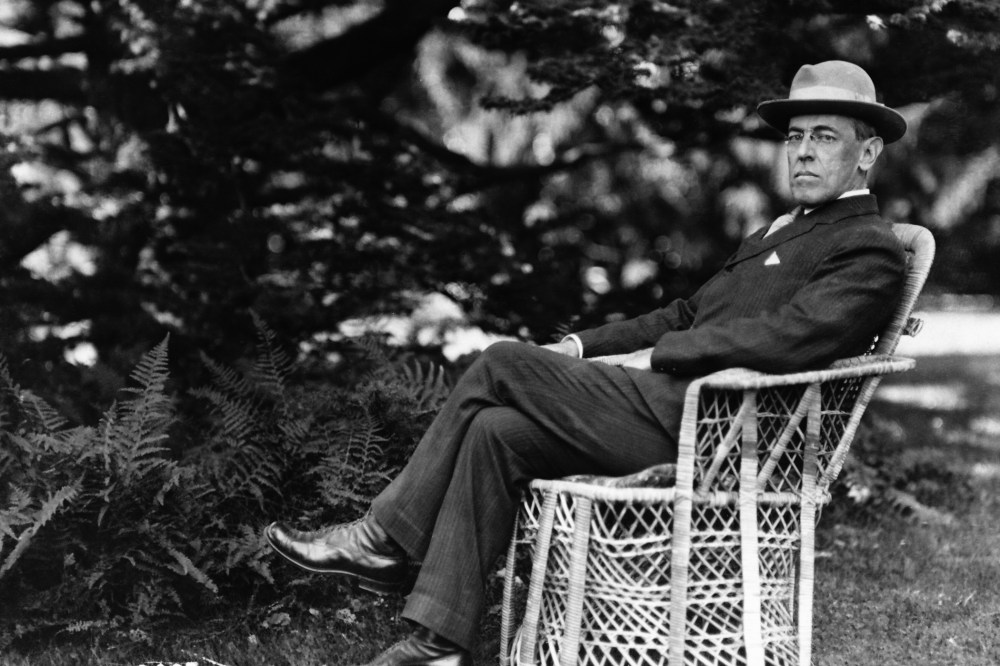
For decades, former president Woodrow Wilson has been hailed for his internationalism and influence on American diplomacy, but an activist movement born on the campus of Princeton University, where he once also served as president, has thrust his ugly record on race into the national conversation.
For nearly a year, an activist group at the school — the Black Justice League — has been campaigning to get Wilson’s name removed from buildings on campus. Their movement culminated with a 32-hour sit-in at the Ivy League school president’s office last week. Princeton’s president, Christopher L. Eisgruber, has agreed to consider their request, which comes on the heels of a spike in black student activism around the country (which in the case of the University of Missouri, led to resignations of school officials).
RELATED: Lyndon Johnson was a civil rights hero. But also a racist.
Wilson, the first Southerner to occupy the White House after the Civil War, served as president of Princeton from 1902 to 1910. He used his tenure at the school as a springboard to the presidency of the United States, where he presided over one of the darkest periods for African-Americans in the country’s history.
Wilson made no secret of his racial animus while in office. He openly supported the re-segregation of federal offices in the nation’s capital: “Segregation is not humiliating, but a benefit,” he once infamously said to a delegation of black activists. He also resisted backing anti-lynching legislation, spoke fondly of the Ku Klux Klan — whose numbers swelled during his tenure in office — and even attended a private screening at the White House of the pro-KKK silent film “The Birth of a Nation.”
We out here. We been here. We ain't leaving. We are loved.
Posted by Black Justice League on Thursday, November 19, 2015
“It is like writing history with lightning,” Wilson reportedly said of the film which portrayed African-Americans — played by white actors in blackface — as savages and rapists, “and my only regret is that it is all so terribly true.”
“He was in every way an unreconstructed racist,” Joy-Ann Reid, MSNBC correspondent and author of “Fracture: Barack Obama, the Clintons, and the Racial Divide,” told MSNBC. She points out that while the fact that Wilson screened “The Birth of a Nation” is perhaps well known, that he “identified” with it, is not. And Reid believes that the efforts of students to shine a light on his more unsavory aspects should be applauded for “starting a conversation.”
“In the wake of what happened in Charleston, South Carolina, [with the Confederate flag] young black people are thinking about whether it’s OK to give a pass to symbols of hate,” Reid added. For instance, in South Carolina, students of color at Clemson University would have to live in dorms named after Benjamin Tillman, an avowed white supremacist, or have to drive down Jefferson Davis Avenue, named after the Confederacy icon, to reach Martin Luther King Boulevard on the streets of Selma, Alabama.
Reid believes that when locations are named after individuals, it does send a tacit message of approval. “We shouldn’t be celebrating these people,” she said.
William R. Keylor, a professor of history and international relations at Boston University who has written critically about Wilson’s record on race in the past believes that while the protests against the 28th president can be a “teaching moment,” it would be a mistake to try to expunge his name from our institutions. “You have to look at the whole person, you can’t just focus on the negative,” Keylor told MSNBC.
RELATED: Princeton University agrees to weigh erasing Woodrow Wilson’s name
Keylor argues that Wilson’s muscular progressiveism was a precursor to the New Deal of Franklin Delano Roosevelt, and not unlike that president, he believes his insensitivity on race should be noted but not be allowed to entirely overshadow his accomplishments — such as creating the Federal Reserve Board and the federal income tax. Keylor says he thinks the move to remove Wilson’s name from buildings could be problematic because several other historic figures, like Abraham Lincoln, could arguably receive the same treatment.
“I think we’re going to have to take down monuments and names of most of the public officials in the United States,” said Keylor. “We can’t find perfection in public officials. If we try to do that, there won’t be many left.” Woodrow Wilson, A History of the American People, quoted in DW Griffith's Birth of a Nation (1915): pic.twitter.com/aPbysugueJ Keylor’s concerns have been echoed in a Change.org petition countering Princeton protesters, which suggests that the removal of Wilson’s name from campus could establish a “dangerous precedent.” “We call for increased dialogue and the creation of a process that properly considers the input of all students and faculty, not merely those who are the loudest,” reads the petition, which that accuses the Black Justice League of imposing their ideology on the rest of the student population. However, Wilglory Tanjong, a sophomore at Princeton and a member of the Black Justice League who penned an anti-Wilson op-ed in The Daily Princetonian that helped to buoy the movement, pushed back on that assertion. “Woodrow Wilson is highly idolized on Princeton’s campus. With prominent buildings that bear this name, awards, a cafe and even a skit in a play that nearly every student sees during their time here is dedicated to his honoring. To Princeton, he is a god,” Tanjong told MSNBC via email. “But how can we honor a man who reverted the advancement of African Americans yet claim to be an ‘inclusive’ and ‘welcoming’ community?” “To those who think that removing Wilson’s name sets a dangerous precedent in terms of our historical figures needs to consider shifting the focus on how the actions of these individuals have resulted in the position marginalized people are subjugated to today. We should focus on addressing the issues of our past so that the peculiar institution that slavery was is acknowledged, addressed and amended,” she added. Tanjong is hopeful about the Black Justice League’s prospects of achieving their goal, which she says is not to “erase history.” “We want these discussions to continue,” she added. “We want the university to actively work to educate students about its ties to slavery while simultaneously working to correct our university’s wrongdoings by hiring more professors of color, providing adequate resources for students of color, scoping out cultural spaces for students to engage and learn about the histories of the oppressed, and educating the community about issues of race and identity.”
Adam Howard Recommended


