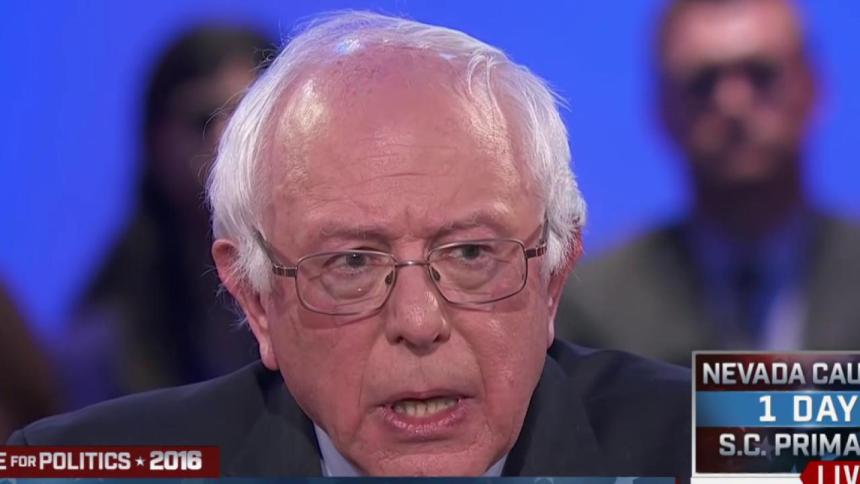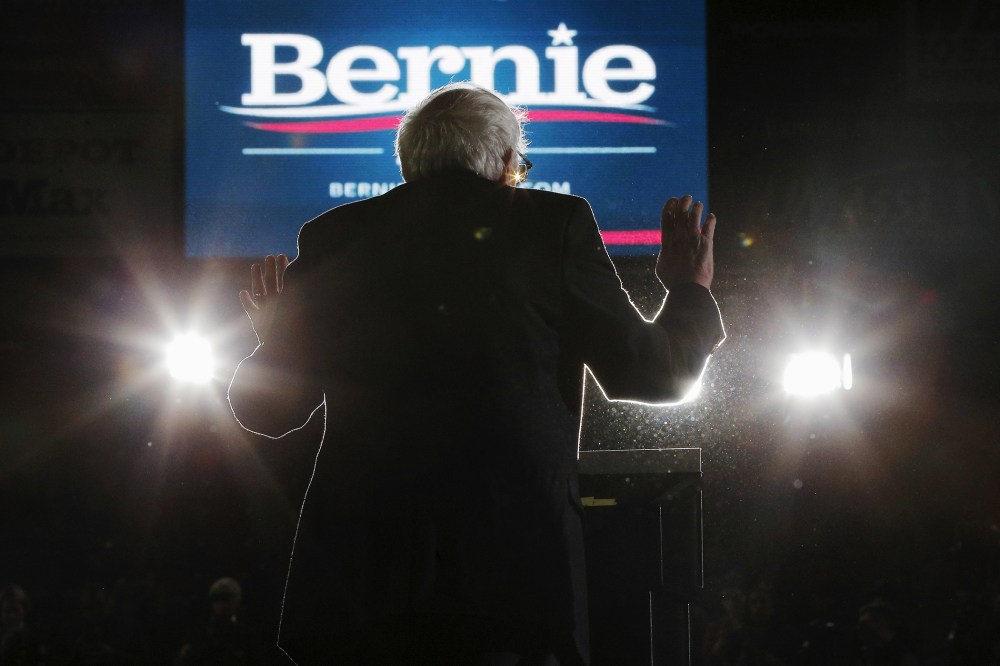
Bernie Sanders’ path to the Democratic presidential nomination, always a longshot, counted on wins to beget more wins, so Saturday’s loss in Nevada is a major setback. But facing critics saying the race is essentially over, the candidate and his top aides insist they can get their groove back.
“What this is about is a slog, if I may use that word, state by state by state,” Sanders told reporters at a press conference in Boston Monday, insisting that “Y-E-S” he can still win. “So for the media, please do not come to be state by state and ask, ‘Is this the end of the world?’”
RELATED: Sanders goes on offense after Nevada loss
Still, Sanders wanted a win so badly in Nevada that he never wrote a concession speech, according to aides, and the night before the caucuses he said that historians would mark Nevada as the beginning of his promised political revolution. That revolution has been delayed indefinitely after Saturday’s contest, which offered perhaps his best chance to shatter the theory that he can’t win minority voters.
Right now, a lot would have to go right for Sanders and wrong for Clinton for him to win the nomination. But Sanders’ candidacy, as he reminded reporters Monday, “is about more than electing a president, this is about a political revolution.”
He and his team have a plan. They say they’re in this all the way to the Democratic National Convention. Whether for the sake of revolution or actually winning the presidency, here’s how he and his team think they can get there.
Despite the Nevada loss, Sanders still has some huge assets: A seemingly infinite supply of small-dollar donations, the Democratic Party’s proportional allocation system of delegates, and a message that is clearly resonating with Democratic primary voters.
Media outlets that keep track of delegates project a near impossible road ahead for Sanders. But Tad Devine, Sanders’ top strategist, rejected the tyranny of delegate arithmetic, saying that campaigns are not static and could change at any time.
“We haven’t gotten near our potential yet with Democratic primary voters,” Devine said. “But she’s got no place to go but down.”
The reasons candidates quit is not because of delegate projections, Devine said, but because they run out of money when their donors get anxious and close their checkbooks. “We can probably continue this race all the way through California. I don’t see the pressure to get out because we’re not dependent on the big donors,” Devine said. “As long as the people who support us think it’s important to continue, then we will continue.”
Sanders raked in astonishing amounts of money after his near-tie in Iowa and large win in New Hampshire, but it remains to be seen if donors will pony up in more challenging times. The campaign did not release fundraising data after Nevada, but $3 million passed through ActBlue, the service Sanders’ campaign uses to process its online donations, the two days after the caucus.
The campaign has a good shot at outright winning four or five states on March 1, a.k.a. Super Tuesday, when 11 states will hold primaries or caucuses and 880 delegates will be at stake, plus more later. In addition to the caucus states of Minnesota and Colorado, and the New England states of Massachusetts and Vermont, where he lives and serves, Sanders is targeting Oklahoma, where he will visit Wednesday.
RELATED: Dem party chair aim to ‘engage and energize’ young black voters in SC
Sanders is also eyeing caucuses later next week in Kansas, Nebraska and Maine. He’s also set to visit Kansas City Wednesday, and is likely to spend time soon in states like Illinois and Ohio, which already have early voting underway.
Meanwhile, states where Sanders falls short are not a total loss. While the Republican nomination process includes winner-take-all states, Democrats award delegates proportional to the vote total, so they often end up splitting delegates roughly evenly. Delegate allocations only get really lopsided if someone wins by more than 20 percentage points.
That means Sanders can collect plenty of delegates in states he probably can’t win, like South Carolina, which hosts a primary on Saturday, or delegate-rich Super Tuesday states like Texas and Virginia. With the potential to win up to five out of 11 states on Super Tuesday and hold his own in the other important contests, Sanders hopes to end the night with a “pretty solid haul of delegates,” Devine said. But Sanders’ path still mostly runs through white regions. His campaign is currently advertising in five states, all of which are more than two-thirds white according to the University of Virginia’s Center for Politics: Colorado (80 percent white), Massachusetts (85 percent white), Minnesota (89 percent white), Michigan (72 percent white), and Oklahoma (82 percent white). Caucus states, including Kansas, Nebraska, and Maine, also tend to be overwhelmingly white. So do later caucus states like Idaho and Utah, where a new poll showed him leading Clinton by 22 points. Devine acknowledged that this is a challenge, but noted that Sanders has made real progress in winning over Latinos and said he might have better luck with African-American voters outside the South, where Clinton has long held ties. “We must grow our support in a broad range of voter categories where she has shown advantage,” he said. “We need to do better — much better — with African-Americans.” Sanders isn’t currently advertising in other Super Tuesday states, like Texas or Virginia, and Devine said the campaign is not planning to go on air in expensive media markets like Dallas or Houston. Instead, he said new media spending may more likely be on digital, or be highly targeted based on delegate opportunities. Sanders has been spending a lot of money, but Devine said this was part of a strategy to win big, and added that costs would actually go down as the contest moves into states where they’ll deploy fewer staff than Iowa or New Hampshire. He also said some of the spending went to fundraising infrastructure that will pay dividends down the road. The Vermont senator has been eyeing Michigan, a much larger state that votes on March 8, as he and his campaign know they need a major victory. “We’ve got to demonstrate that this not going to be a second-place campaign,” said Devine, noting the campaign has already been running TV ads in the state. One silver lining of the Nevada loss for Sanders may be the restoration of low expectations, which allowed him to spin even narrow losses as a win. If he’s been counted out of the race, any win can be painted as significant. “To win states against Hillary Clinton, when there’s this second wave of, ‘It’s all over, Hillary’s won,’ that in itself is impressive,” said Devine. Sanders is undoubtedly tapping a real nerve in the Democratic Party, and capturing the hearts and minds of many of the party’s base. Sunday night in Greenville, South Carolina, a conservative part of the state, Sanders attracted 5,200 supporters for a rally bigger than almost any Clinton has held.
Alex Seitz-Wald Recommended