








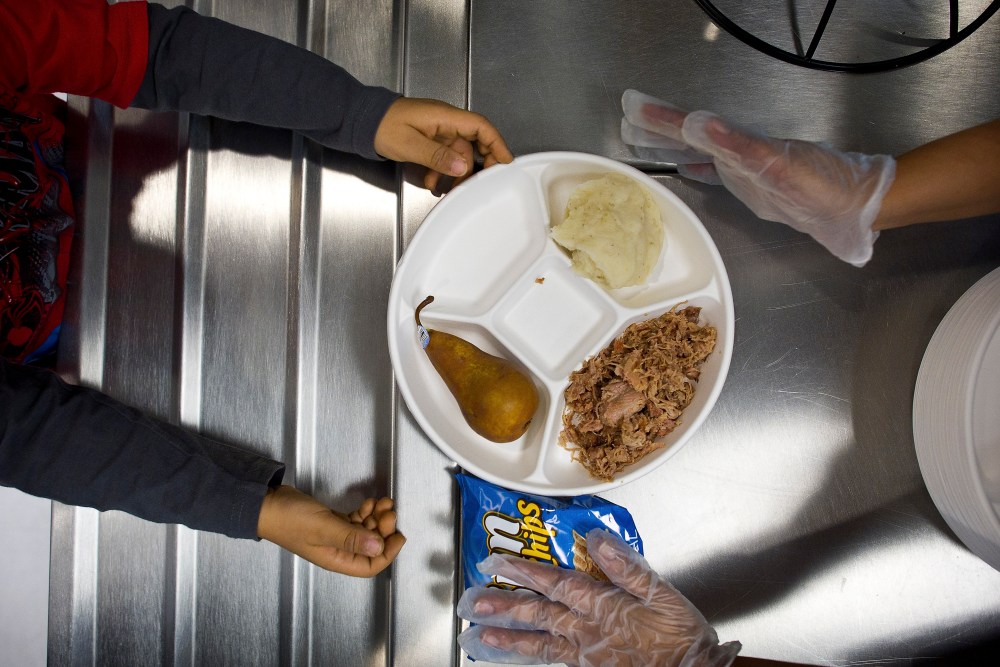
The Republican-controlled House Appropriations Committee on Monday released its draft of the 2015 Agriculture Appropriations Bill, which includes $27 million for a pilot program to reduce child hunger in rural areas. Sounds innocuous enough, except the $27 million program was actually the committee’s substitute for a White House proposal which would have allocated $30 million to child hunger across urban and rural areas.
Talking Points Memo founder Josh Marshall reacted to the news of the substitution saying “‘urban’ kids are now out of luck” thanks to the legislation. However, the truth may be a little more complicated than that.
Children in metropolitan areas aren’t being totally left out of the cold when it comes to anti-hunger spending, and rural food insecurity does present certain unique policy challenges. At the same time, the House committee’s proposal is likely to help fewer people of color than the White House proposal. And while rural areas may be unique in terms of the challenges they face, they’re not where most of America’s hungry are concentrated.
The racially charged semiotics of “urban” poverty have a long history. Recently, Wisconsin Republican Rep. Paul Ryan found himself on the defensive after he said people in the “inner cities” have a “real culture problem,” which was taken to be a coded invocation of racist stereotypes about poor African Americans. Early media reports seemed to indicate that the House Appropriations Committee was engaging in a related phenomenon, shifting public spending away from racially diverse urban areas in order to help predominantly white rural areas.
House Appropriations Committee spokesperson Jennifer Hing rejected that interpretation, pointing out that children in urban areas wouldn’t exactly be left out in the cold by the law. Each year, the federal government spends hundreds of millions of dollars on the Summer Food Service Program, which provides meals to low-income children when school is not in session and they don’t have access to free or reduced school lunch. In 2012, for example, the government allocated $402 million to the program, and the White House has requested $493 million for 2015, according to the Food Research and Action Center. The $27 million set aside in the proposed agriculture appropriations bill would go towards developing methods of providing access to those meals in rural areas.
“We received a report from USDA on the difficulties that rural areas face with summer feeding programs,” said Hing. Rural, isolated parts of the country can develop high rates of food insecurity due to the lack of transportation infrastructure or other amenities which reduce hunger. The county with the highest food insecurity rate in the nation and the county with the highest food insecurity rate are both heavily rural. They are also both disproportionately non-white. The most recent edition of Feeding America’s Map the Meal Gap report finds that 51.5% of all counties with high food insecurity are predominantly rural. However, in absolute numbers, however, cities tend to house more food insecure households than non-metropolitan (rural) areas, according to the USDA. Rural areas have slightly higher food insecurity than the national average, but it’s still lower than urban areas. More to the point, the $27 million would probably not go towards helping all rural areas. Instead it would go to “rural counties designated in 40 U.S.C. 14102.” That section of the United States code outlines which counties belong to the “Appalachian Region,” meaning that the bill’s pilot program would likely have a very specific regional focus. Counties from 13 east coast states are included in the legal definition of the region, including all of West Virginia. That region of the United States is nearly 24% whiter than the rest of the country and has a median income which is about 18% lower, according to data collected by the Appalachian Regional Commission.
Ned Resnikoff is an urban policy analyst, researcher, writer, and editor. His byline has appeared in a variety of publications, including the New York Times, San Francisco Chronicle, Dissent, and The Nation. He writes the newsletter Public Comment, which can be found at publiccomment.blog. Recommended


