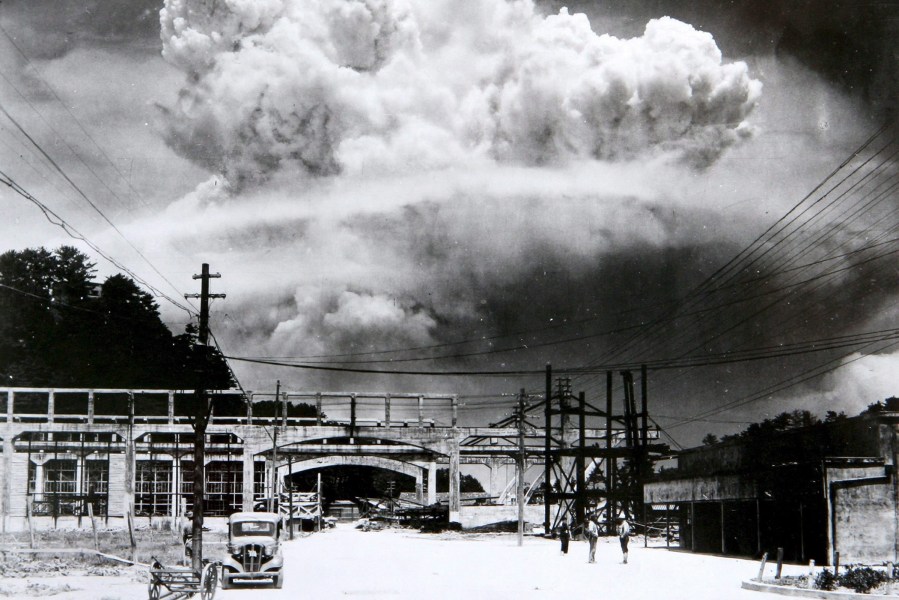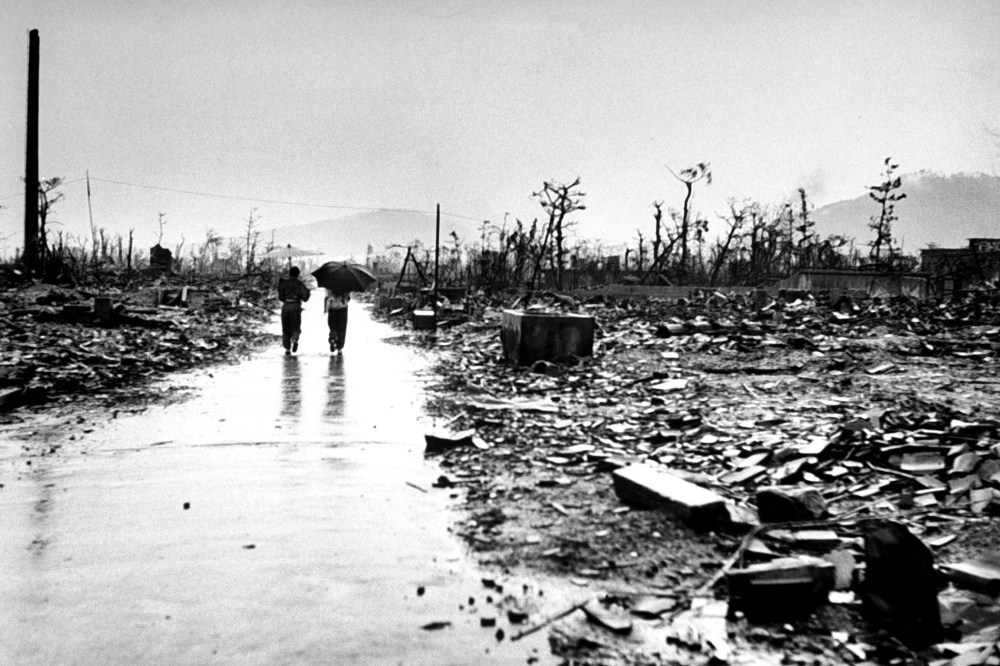
Seventy years after the U.S. dropped the first wartime atomic bomb on Japan, nine nations are estimated to possess a total of around 16,000 nuclear weapons.
This potentially world-ending technology was introduced at exactly 8:15 a.m. Japanese time on the morning of August 6, 1945. A U.S. Air Force B-29 dubbed the Enola Gay flew over the Japanese city of Hiroshima and dropped the bomb code-named “Little Boy.”
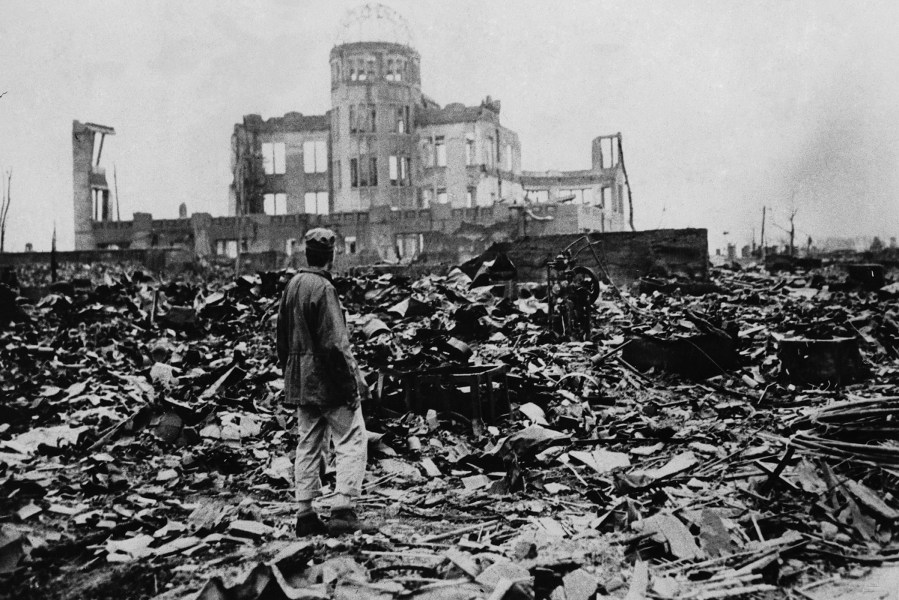
Three days later, the U.S. dropped an even larger bomb, “Fat Man,” over Nagasaki. At least 100,000 people were killed instantly across both cities; Japan’s surrender in World War II came within one week.
These events precipitated a seven-decade nuclear arms race. Here’s where things stand today:
How many nuclear weapons are there in the world today?
Most analysts agree there are currently close to 16,000 nuclear weapons in existence, 90 percent of which are owned by the U.S. and Russia.
This may seem like a lot, but it’s far fewer than the peak Cold War stockpile in 1986, when the global arsenal exceeded 60,000, according to the Stockholm International Peace Research Institute (Sipri).
That’s not to say the world is turning its back on nukes.
President Barack Obama optimistically declared in April 2009 that he would lead the way toward “a world without nuclear weapons.” But the government is projected to spend $348 billion on its nuclear arsenal over the next 10 years, according to a Congressional Budget Office estimate released in January.
Although the raw numbers are decreasing, this continued investment has built bombs many times more powerful than those used in 1945.
“It’s generally believed that the warheads used on Hiroshima and Nagasaki were 15 kilotons,” said Tariq Rauf, director of Sipri’s Disarmament, Arms Control and Non-Proliferation Program. “The smallest weapon in the arsenal of the U.S. and Russia today is 100 kilotons.”
Rauf added: “The dangers of the Cold War are still with us. The total numbers have gone down, but the number of warheads that could reach their target in 20 minutes has not changed so much.”
Who else has nuclear weapons besides the U.S. and Russia?
Nine nations are known or widely believed to possess nuclear weapons: the U.S., Russia, China, the U.K., France, India, Pakistan, Israel and North Korea.
American allies Britain and France have decreased their stockpiles to just a few hundred each. And the U.K. is among a handful of nations — including Germany, Greece, Italy, the Netherlands and Turkey — that allow the U.S. to keep atomic bombs at bases on their soil.
Rivals India and Pakistan have been involved in four wars and countless border scuffles since their partition in 1947. They have around 100 nuclear weapons each, according to Sipri.
Christopher A. Bidwell, a senior fellow at the Federation of American Scientists, believes that far from escalating their conflict, the acquisition of nukes by these tense neighbors meant that they were no longer able to engage in full-blown warfare.
Aware of what an actual war might risk, he said, India and Pakistan now seem reluctant to escalate hostilities beyond the low-level border fighting we see today.
Israel has a policy of not commenting on its nukes. However “it is generally accepted by friend and foe alike” that they have around 80 warheads, according to the Bulletin of the Atomic Scientists.
Experts say North Korea has fewer than 10 warheads. But despite its regular stream of truculent rhetoric on the subject, the reclusive nation has so far failed to successfully develop a long-range method of delivery.
Are world powers trying to get rid of their nuclear weapons?
In principle, yes.
Almost every country on the planet has now signed the Nuclear Non-Proliferation Treaty. This accord, known as the NPT, first came into force in 1970 with the aim of preventing the spread of nuclear weapons around the world.
The treaty gave special status to the earliest nations to test nuclear weapons — the U.S., Russia, China, the U.K. and France — meaning they were allowed to keep their bombs while working toward getting rid of them. All the other signatories promised not to build or buy their own weapons.
However, India, Pakistan, Israel, and North Korea have refused to sign the NPT. These countries were relative latecomers to the world of nuclear testing and as such would not enjoy the special status of their nuclear predecessors. Signing the treaty would in theory mean giving up their stockpiles.
Critics of the NPT point to these countries’ apparent impunity, as well as the billions of dollars still being spent on existing nuclear programs.
Others, like Dr. Page Stoutland, at the the nonpartisan, non-profit Nuclear Threat Initiative, say the treaty is “very imperfect, yet its the best thing going.”
In the 1960s, many analysts believed that the number of states with nuclear weapons would increase to around two dozen. That prediction has fallen well short, owing largely to the treaty, according to Stoutland, who is vice president for scientific and technical affairs at the NTI.
“It has created a barrier to many states who might be thinking about their own weapons program,” he said.
Are we safer than we were in the Cold War?
Experts and campaigners are still divided on the safety and necessity of modern-day nuclear weapons.
Some, like Bidwell, say that the technology is beneficial as it has stopped world powers entering into full-blown wars with each other. Others, such as Rauf, say that instead we have merely fought proxy wars in places such as Vietnam and Afghanistan. Meanwhile, there are still believed to be around 4,300 nuclear weapons deployed at active bases worldwide. As many as half of America’s deployed weapons are believed to be on a so-called “hair-trigger alert,” meaning they can be launched within minutes if necessary. “This increases the risk of an accidental or mistaken launch with potentially catastrophic outcomes,” according to the Union of Concerned Scientists, a Massachusetts-based nonprofit organization. Most agree, however, the threat of Washington and Moscow willfully engaging in mutually-assured destruction has dipped significantly since the early 1990s. “Despite the situation in Crimea and Eastern Ukraine, it’s not really conceivable that U.S. and Russia would use nuclear weapons against each other in that scenario,” said Stoutland at the NTI. While the bomb was first used as a weapon of war in 1945, Bidwell said its main use is now as a “political weapon,” shaping geopolitics while remaining safely in its launcher. “No one intends to use it until they absolutely have to,” said Bidwell, who also served as a naval officer in the 1980s. What about a nuclear bomb being detonated by accident? It is well documented that the Cold War was pock-marked with several terrifying near-misses. A year before the Cuban Missile Crisis of 1962, the U.S. accidentally dropped two hydrogen bombs over North Carolina after a B-52 bomber broke up midair. A low-voltage switch was all that stopped the four-megaton devices detonating over the Eastern Seaboard, averting a likely cataclysm involving millions of Americans, according to documents released under the Freedom of Information Act. The Soviet Union had its own mishaps. In 1983, its newly developed early-warning system wrongly detected the launch of intercontinental ballistic missiles from America. It was only one Soviet air force officer who identified the error and was credited with preventing a possible retaliation. “We made it by the skin of our teeth though an intense arms race with the Soviet Union,” according to Dr. Robert Standish Norris, a senior fellow at the Federation of American Scientists. Many analysts believe this threat has not diminished entirely. Creaking Cold War technology still underpins the nuclear arsenal of the U.S. and Russia, hence the eagerness to upgrade their infrastructure. “People do things they don’t mean to do, and nuclear weapons systems are very complex,” Stoutland added, spelling out the recipe for what he says is the minimal but existential threat of an accident. “It’s difficult to have complete assurance that something cannot go wrong.” What about terrorists and other non-state actors? After the post-Cold War entente, and particularly after 9/11, the global focus shifted to stopping militant organizations getting hold a nuclear bomb. The U.S. was especially keen to stamp out the potential nightmare scenario of someone detonating a small nuclear device in the center of one of its major cities. However, as that threat has decreased, a new one has sprung up in its place: cyber security.Organizations such as the International Atomic Energy Agency (IAEA) have been central in “the global effort to lock up the materials that could be used to make a nuclear weapon,” Stoutland said. “This still remains a concern but a lot of progress has been made in the past few decades,” he added. “One of the key issues is that command and control systems are so complex that one cannot be 100 percent confident that the system is secure,” Stoutland added. Cyber attacks could interrupt a nation’s ability to communicate launch orders, trick a radar system into believing there was an imminent attack, or take direct control of a weapon. “This is certainly an emerging problem,” Stoutland added. “But I’m confident there are plenty of people within the American and Russian governments who are focused on this exact issue.”
Alexander Smith Recommended