








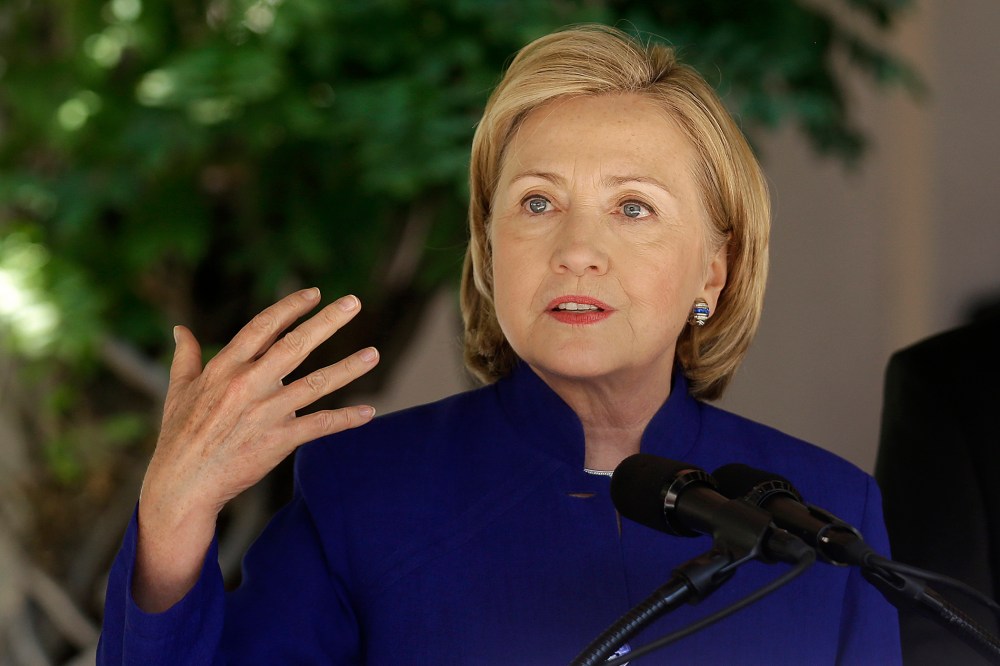
It has been more than six years since Hillary Clinton has been required to weigh in on domestic political issues, first ensconced in the State Department and then in private citizenship. But as she steps back onto the political stage, the potential 2016 presidential candidate will have to make some “hard choices” on a handful of thorny issues that divide her own party.
“One salutary effect of Republican radicalism is to unify Democrats,” said Will Marshall, president of the Progressive Policy Institute, a moderate Democratic think tank that helped feed Bill Clinton’s White House with new policy ideas. “Having said that, there are some important fault lines that will become apparent as we move into the next presidential election cycle.”
One of those is on energy issues, and we may get a glimpse into Clinton’s thinking Thursday when she keynotes a clean energy summit in Las Vegas hosted by Senate Majority Leader Harry Reid — though don’t expect too much news.
The National Clean Energy Summit has become a go-to destination for Democratic politicos, donors, and industry figures interested in clean energy, attracting the likes of Bill Clinton, Al Gore, and many others.
This year, Reid will introduce Clinton, and White House councilor John Podesta, a longtime Clinton ally, will host the discussion. Agriculture Secretary Tom Vilsack and others will also be on hand.
Neera Tanden, the president of the progressive Center for American Progress think tank, which is co-sponsoring the event, told msnbc Clinton’s attendance is in keeping with the former secretary of state’s long record of support for clean energy.
“She’s going to talk about how this remains a potential area of economic growth and it’s increasingly one where we have global competition,” said Tanden, who was the policy director of Clinton’s 2008 presidential campaign, citing China’s aggressive moves into solar energy. “She’s still looking at these things through an international lens.”
Democrats are in broad agreement on the majority of issues that deal with energy, the environment, and climate, said Tanden, and there were few meaningful differences between Clinton and then-Sen. Barack Obama on these issues during the 2008 primary. Of course, that doesn’t mean the candidates didn’t attack each other, but fights over the 2005 Energy Bill and a Gas Tax Holiday seem superficial today.
One area of agreement is on climate. As secretary of state, Clinton pushed hard for international climate treaties. But domestically, since most of Obama’s actions to curb emissions have been through executive authority, rather than legislative action, he’s going to need a successor to keep those policies alive.
“If Hillary Clinton is the next candidate, it’s going to be important that she continue the legacy that Obama has begun here by sustaining and strengthening what he started,” Michael Mann, a prominent climate policy researcher at the University of Pennsylvania, told msnbc. So far, Clinton has voiced support for Obama’s work, especially his carbon regulations.
But there are at least two outstanding issues which could prove problematic for any wannabe Democratic nominee. The first is the Keystone XL pipeline, which continues to split Democrats both in Reid’s caucus and in the broader public.
Clinton’s State Department oversaw the review process for the pipeline, but the 650 pages of her new memoir “Hard Choices” do not mention the project once. And she’s mostly dodged questions from reporters on the ground, saying it would improper for her to interfere with the ongoing review process. The environmental review process Clinton’ State Department started face criticism from the left as it was seen as being overly friendly to industry, leading to another review.
The pipeline is a catch 22 for Democrats: Approve it and face the ire of the left, cancel it and face the ire of the right. Many are hoping President Obama will take the hit on his way out to spare the next nominee, so perhaps Clinton won’t have to weigh in at all.
Either way, Tanden agreed it’s highly unlikely that Clinton will decide to make news on the pipeline Thursday.
The other energy issue that looks like it could split Democrats in 2016 is what do about the massive American oil and gas boom of recent years, brought about by the use of “fracking” techniques.
People in Marshall’s camp see this as an economic windfall for the U.S., in terms of jobs, investment, and energy independence. Environmentalists, on the other hand, are expressing growing concern about environmental damage, including everything from drinking water contamination leaks to man-made earthquakes.
A potential nominee will face pressure to crack down on fracking and federal regulations for the industry, which is now regulated by states.
Both sides are members in good standing of the Democratic coalition, and have legitimate claims, so it may require some Clintonian traingulation. “Anybody who wants to be the Democratic nominee will have to strike a balance between the needs of the economy and concerns about the environmental impact of energy production,” Marshall told msnbc. “It’s a fault line, so you’ve got to walk a line.

Alex Seitz-Wald