








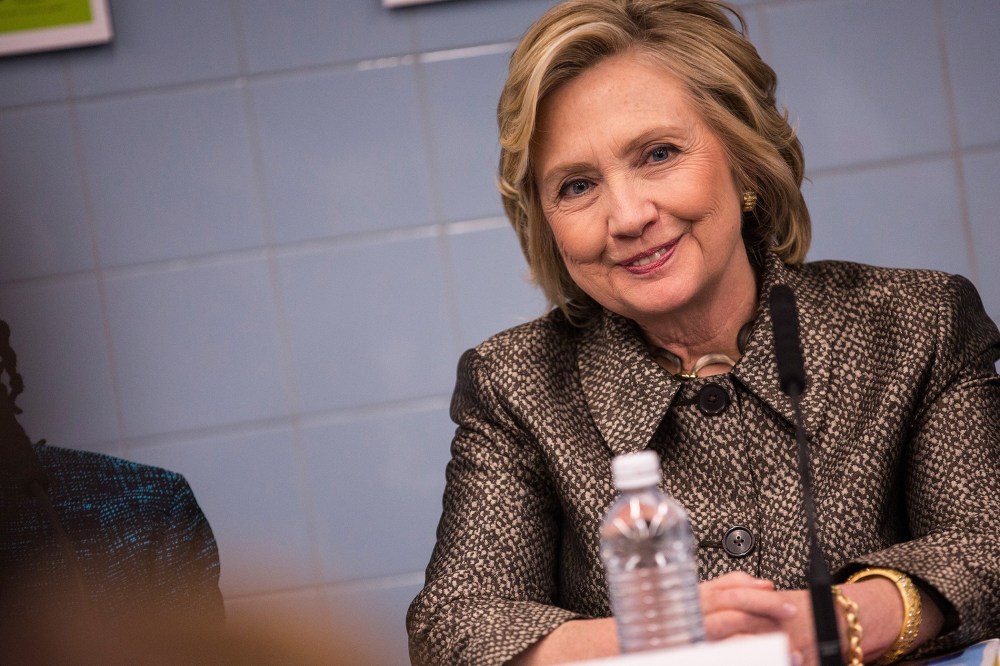
Hillary Clinton came to a grade school in a poor neighborhood in Brooklyn Wednesday to talk about reading to children. It was, like many of Clinton’s recent public appearances, the kind of nonpartisan, anodyne fare befitting a former public official like herself. She sat next to the first lady of the city, read “Brown Bear” to toddlers, and listened to local parents discuss their storytelling habits to their kids.
Meanwhile, on the Internet, Clinton’s tweet from earlier in the day slamming Arkansas’s religious freedom bill was making headlines and exciting liberals, who shared it thousands of times. It was, like many of Clinton’s recent tweets, the kind of partisan political fare befitting someone about to run for president of the United States, like herself. The bill “would permit unfair discrimination against #LGBT Americans,” Clinton warned, urging the state’s Republican governor to veto it.
The contrast fits a pattern of Clinton’s waning days of private life before a second presidential run, which is due later this month.
RELATED: Hillary Clinton’s surprise event
On stage, Clinton preaches a post-partisan message of Americans coming together in a “nice warm purple space” to get things done. Online, her Twitter account does the dirty work of politics.
In public, she praises Republican Rep. Paul Ryan and waxes nostalgic for when Newt Gingrich was Speaker of the House. In tweets, she knocks Republicans on issues foreign and domestic, weighs in on news of the day, and breaks her silence on controversies over her use of a private email account.
Clinton’s Twitter strategy annoys the reporters assigned to cover her, since there are no opportunities for follow up questions, but there’s a benefit in keeping these two parts of her persona separate for now.
Over her long career, Clinton has been most popular when she’s seen as least partisan. She was seen most favorably during her tenure as secretary of state, a traditionally nonpartisan job that had her speaking on behalf of all Americans diplomatically. And she was also popular as first lady – but only after abandoning a divisive health care reform push.
It’s inevitable that her popularity will return to earth as she enters the campaign fray, but her team is hoping to keep her out of the partisan mud as long as possible.
Without a major primary challenge at the moment, she can focus on moderate general election voters and appeal to pragmatism over ideological purity.
Her Twitter account, meanwhile, keeps her partisan messaging at a remove, while still allowing her to energize the Democratic base and get her message out to a hungry press corps.
And Twitter offers one huge benefit reality does not: Data. Clinton is “obsessed with data,” as she often professes, and her social media communication strategy allows her to gage responses to various messages in real time and in detail. That’s impossible at a public event. Until recently, Clinton used speaking arrangements to weigh in on issues of the day. At a women’s conference in Boston last year, she spoke about Ferguson and issues with race and policing. At an award ceremony in December, she spoke out against torture. But after she began assembling a campaign team to help her plan her campaign launch, Twitter became her primary means to weigh in on thorny political issues. On Wednesday, Clinton was only dragged down into the world of politics by a reporter for NY1, who shouted a question about whether she would be returning to Brooklyn soon, where he noted her campaign is expected to be headquartered. “All in good time,” Ms. Clinton replied. “I was happy to be here at this exemplary center, and supporting the good work that the mayor and first lady are doing on behalf of our kids.”
Alex Seitz-Wald Recommended


