








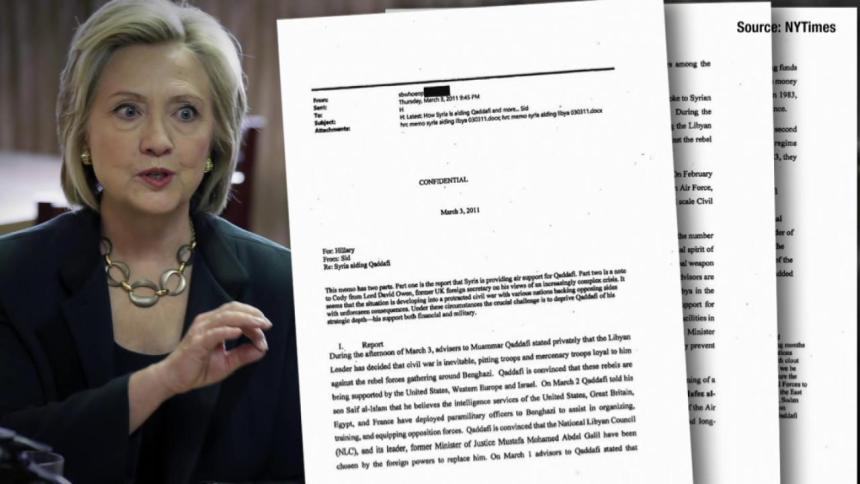
Hillary Clinton had sensitive but unclassified information in the private email account she used as secretary of state, and distributed internally several memos on the Benghazi attack from a friend whose closeness to Clinton has become controversial.
Those are among the revelations from the first batch of Clinton’s emails from her private server made public, after being obtained by The New York Times Thursday morning. The State Department will soon start making batches of the emails public on a rolling basis, but it could take months for all of her emails to be released.
Related: Hillary Clinton meets the press
Clinton turned over 55,000 pages of email from her private server, and said Tuesday that she wants them to be released as soon as possible. But State needs time to process them, leading a federal judge this week to say that the department should release them on a rolling basis beginning as soon as possible. State is supposed to produce a timetable for the release by next week.
The department last year turned over roughly 850 pages of emails related to Libya to the House Select Committee on Benghazi, and the Times obtained a tranche of those.
The 349 pages put online by the paper appear to contain no bombshells nor classified information. There is nothing in the emails to support some of the wilder claims Republicans have made about Clinton’s role in the attack, like that she issued a stand-down order to U.S. forces hoping to intervene in the attack.
But they could raise new questions about her use of email and that of her longtime adviser, Sidney Blumenthal, whom Obama White House officials had barred from serving in the State Department.
The emails also include “Sensitive but Unclassified” information, including one from a year and half before the Benghazi attack in which U.S. envoy Chris Stevens considered leaving the country due to deteriorating security.
The envoy’s delegation is currently doing a phased checkout (paying the hotel bills, moving some comms to the boat, etc.),” read email that forwarded to Clinton by Huma Abedin, her longtime aide. “He will monitor the situation to see if it deteriorates further, but no decision has been made on departure. He will wait 2-3 more hours, then revisit the decision on departure.”
Stevens was killed in the U.S. diplomatic outpost in Benghazi on September 11, 2012 when attackers set fire to the compound.
Related: Benghazi probe to focus on Clinton ally Sidney Blumenthal
The emails from before the Benghazi attack also show how invested Clinton was in the administration’s Libya policy before the situation deteriorated.
In one from August of 2011, top aide Jake Sullivan sends a draft memo to Clinton’s chief of staff and the State Department’s spokesperson meant to highlight Clinton’s “leadership/ownership/stewardship of this country’s Libya policy from start to finish.”
“She was instrumental in securing the authorization, building the collation, and tightening the noose around Qadhafi and his regime,” Sullivan wrote in the memo.
And the documents also show that Clinton seemed to take advice on Libya from longtime friend and aide Sid Blumenthal, who sent Clinton emails that she forwarded to officials in the government via a top aide.
Blumenthal is not a foreign policy expert, and was apparently engaged with business hoping to make money in Libya.
During an appearance at a small business event in Iowa this week, Clinton downplayed and defended taking Blumenthal’s advice. “I have many, many old friends,” she said. “He’s been a friend of mine for a long time. He sent me unsolicited emails, which I passed on in some instances, and that’s just part of the give-and-take,” she said. “When you’re in the public eye, when you’re in an official position, I think you do have to work to make sure you’re not caught in a bubble and you only hear from a certain small group of people.” The emails show Blumenthal sent Clinton numerous memos on Libya and on the Benghazi terror attack. He offered different explanations for the attack as time went on, first blaming demonstrators and then saying it was a premeditated attack by a local al Qaeda affiliate. That second explanation conflicted with the Obama administration’s understanding of the attack at the time, though they later revised their explanation. Clinton and her team have downplayed the significance of Blumenthal’s advice, noting that his memos were always unsolicited and that she and aides sometimes dismissed them. “This one strains credulity. What do you think?” Clinton wrote to Sullivan, who frequently appears in the emails. He replied: “Definitely. I can share if you like, but it seems like a thin conspiracy theory.” With most, Clinton simply forwarded them to Sullivan with “fyi.” Forwarding the emails from her personal account to Sullivan’s state.gov account may have had the affect of archiving the emails. But on rare occasion, Clinton seemed to find value in Blumenthal’s memos. She thanked Blumenthal for one memo that came a few weeks after the Benghazi attack by saying it was “very useful.” She passed it on to Sullivan, saying, “Useful insight. Pls circulate.” Blumenthal replied by inviting Clinton to dinner after the upcoming presidential election. “Post-election, we’d like to have you over for dinner. Bill can come, too, if he’s in town. Whatever works,” he wrote. Blumenthal was recently subpoenaed by the House Benghazi committee, which sent U.S. Marshalls to his home. Clinton is expected to testify soon, though a date has not been decided. Abedin might also be asked to appear. The emails offer only a small window into Clinton’s management style, as aides to her have noted that email was not her primary means of conducting business. Most previous secretaries of state hardly used at all. And the emails made public today are only a small portion of a small subset of the total universe of her correspondence. Clinton had said she wants all the emails released as soon as possible, and allies expect that will answer most remaining questions about her electronic correspondence.
Alex Seitz-Wald Recommended


