








The federal lawsuit filed to block North Carolina’s restrictive new voting laws is set to test the government’s ability to protect voting rights in the aftermath of a Supreme Court decision gutting the Voting Rights Act.
“If North Carolina can do this without facing a penalty, then other states may follow suit,” says Rick Hasen, a law professor at UC Irvine and the author of Election Law Blog. “It’s just going to prove that states can pass restrictive voting laws without many consequences.”
Often referred to as simply the state’s voter ID law, the package of voting changes in passed North Carolina over the summer following a Republican takeover of the state legislature is one of the most restrictive in the country.
Aside from an strict ID requirement, it cuts back on early voting, eliminates same-day voter registration, makes it easier to challenge voters at the ballot box and bars counties from extending voting times because of long lines.
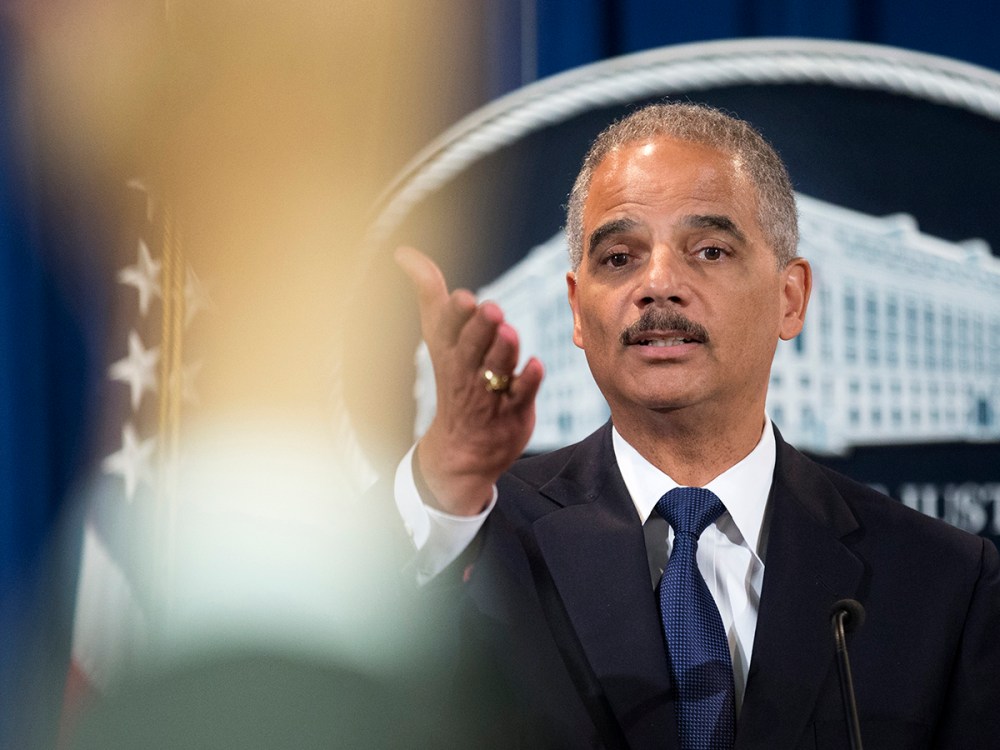
Attorney General Eric Holder says all of those changes disproportionately affect minority voters, and that’s not a coincidence.
“The clear and intended effects of these changes would contract the electorate and result in unequal access to participation in the political process on account of race,” Holder said Monday.
The Justice Department has filed a similar lawsuit in Texas.
If successful in both states, the Obama administration could reconstruct a small part of the federal supervision of elections that existed prior to last summer’s Supreme Court ruling. Failure, on the other hand, could signal to Republican-controlled states that they have a free hand to pass similarly restrictive voting laws. With Congress unlikely to act on patching the Voting Rights Act, the Obama administration’s only option for doing so is through the courts.
The federal lawsuit has two parts.
In one part, it asks the court to block the North Carolina law under Section 2 of the Voting Rights Act, which bars laws that would have the purpose or effect of discriminating against minorities.
The second part asks the court to require North Carolina to submit its election law changes to the federal government beforehand, a process called “preclearance.” Before the Supreme Court struck down part of the Voting Rights Act last summer, North Carolina was one of many states with a history of racial discrimination in voting that was subject to that requirement.
Section 3 of the Voting Rights Act allows the federal government to argue that states with recent histories of deliberate discrimination in voting to be subject to “preclearance.”
To block the law under Section 2, the Justice Department has to prove that North Carolina’s election law changes will have the effect of making it harder for minorities to vote. Placing the entire state back under “preclearance” however, requires a finding of intentional discrimination, which can be difficult to prove. Unlike Texas, where state legislators were foolish enough to openly discuss diluting the Latino vote over email, North Carolina legislators stuck to their talking points about election integrity. They said the measures were necessary to combat voter fraud, even though some provisions (like eliminating early voting) simply wouldn’t do that. In fact, in-person voter fraud in North Carolina, like in any other state, is extremely minimal. In 2012, according to NBC affiliate WNCN, voter fraud referrals accounted for 0.00174 percent of the ballots cast, and 0.000738 percent in 2010. The lawsuit argues however, that the combination of all those laws, along with the fact that North Carolina state legislators heard testimony about their adverse effect on minority voters and blocked efforts to alter the bill to mitigate those effects, proves that the law’s supporters knew they were hurting minority voters. The state also waited until after the Supreme Court struck down part of the Voting Rights Act to make the changes, implying that they knew that the law would be blocked by the feds as discriminatory had they acted any earlier. “It’s a little hard for North Carolina to feign ignorance and pretend this was all the outcome of a neutral, rational legislative process,” says Brenda Wright, an election law expert with the liberal think tank Demos. “If you choose to carry out partisan ends by deliberately disenfranchising some voters of color, you can’t pretend that’s not discrimination.” If the Justice Department loses its Section 3 lawsuits, which deal with ‘preclearance,’ the aftermath of the Supreme Court’s Voting Rights Act ruling wouldn’t change much, according to Hasen. But if it loses its Section 2 lawsuit in North Carolina, there could be a flood of restrictive voting laws in other states as Republicans push the limits of how far they can go to alter the system to their advantage. That’s what happened after the 2008 case, in which the conservative-dominated Supreme Court upheld Indiana’s voter ID law, despite evidence it would disenfranchise poor or minority voters. “When the Supreme Court rejected challenges to Indiana’s tough voter ID law, a bunch of other states who had been waiting enacted similar laws,” Hasen says. “I do think it will a create a potent political issue for Democrats, who would then also be able to run against the courts, if the courts see no problem with these rules.”
Adam Serwer Recommended


