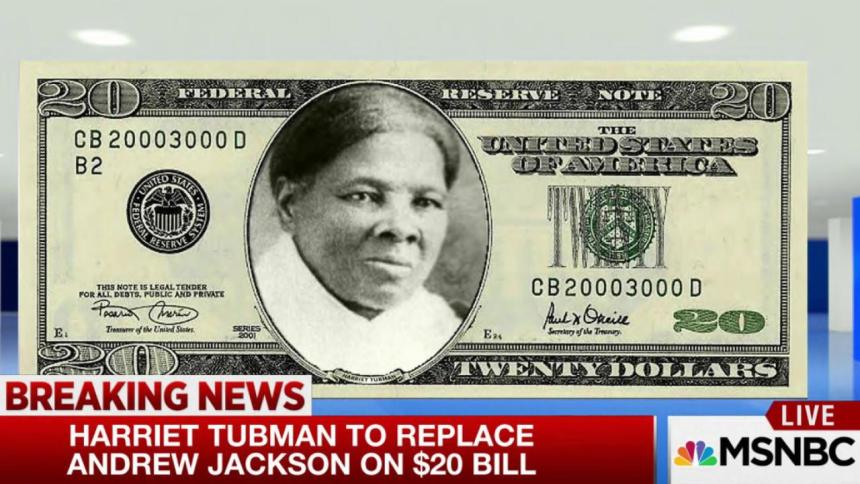
The Treasury Department’s historic announcement on Wednesday that in 2020 former slave and Underground Railroad hero Harriet Tubman would become the first woman and person of color to appear on paper currency in the U.S. was, with the notable exceptions of Dr. Ben Carson and Republican presidential front-runner Donald Trump, met with widespread praise and appreciation.
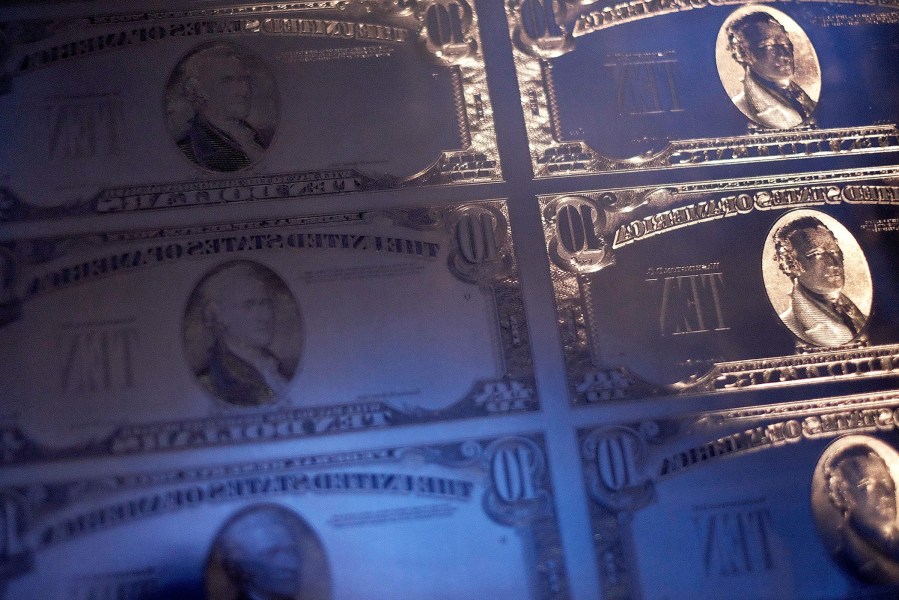
And Tubman’s triumph is not singular. Women suffragettes will finally get their due on the back of the $10 bill, which was subjected to contentious debate in wake of a resurgence of Alexander Hamilton’s popularity, thanks to the hit Broadway musical which bears his name. And civil rights icons like Dr. Martin Luther King, Jr. will also share space on the flip side of the $5 bill.
“It’s a very pleasant surprise,” Barbara Ortiz Howard, founder of Women on 20s, an organization that has been tirelessly campaigning for months to get a female featured on the $20 bill, told MSNBC on Thursday. “This is very meaningful because when we cannot see women or people color of all members our society represented in our cultural landscape we deprive ourselves of the richness of our fellow citizens and what they have contributed.”
Media coverage around potential currency changes has ratcheted up in recent weeks in anticipation of Treasury Secretary Jack Lew’s announcement, but few observers may know the bureaucratic hoops Howard and other activists had to jump through to make their voices heard and the frustrating delays they endured.
RELATED: How ‘Hamilton’ reignited $20 bill fight
“You would think something like this would be fairly simple,” she said. But from the moment the idea of changing the $10 bill was first raised there was a great deal of debate and deliberation over who should be replaced, as well as who should be included and where. If the decision wasn’t made at the right time, in the appropriate way, it could have taken many more decades to see a woman recognized on our currency.
Ultimately, Howard says Treasury made the right decision because “when something is so deeply authentic it becomes irresistible.”
Still, that doesn’t mean she believes her organization’s work is finished. “I think there is building on this in a way that we can all grow and appreciate the opportunity that we have and I think there is making sure the deeds match the words.”
Women on 20s had long advocated for Jackson’s removal in part because of his controversial handling of Native American issues during his presidency. Jackson oversaw the so-called “Trail of Tears” — a massive displacement of Native Americans in the aftermath of the Indian Removal Act, that led to the premature deaths of thousands — which he signed into law in 1830. And throughout his presidency he pushed to curtail the rights of native peoples.
“The announced removal of Andrew Jackson from the face of the $20 is an enormous victory for Native women in the United States,” Mary Kathryn Nagle, a playwright, attorney and citizen of the Cherokee Nation of Oklahoma, said in a statement to MSNBC on Thursday. “Andrew Jackson, during his years as president, worked tirelessly to destroy the inherent right of Indian Nations to exercise jurisdiction on their own lands.”
Still, she added: “The fact that Andrew Jackson remains on the bill at all signals we have more work to do.”
“I don’t think we can just take a brush and scrub clean our history,” said Howard. “We definitely have to call it out, so we can learn from it.” She is currently lobbying Treasury to reach out to Native American groups to make sure they have more of a say in how their history can be accurately reflected on our currency going forward.
Meanwhile, Shola Lynch, a filmmaker who oversees the New York Public Library’s Schomburg Center for Research in Black Culture’s collections of movies, video recordings, music and spoken recordings, hopes the Tubman news will inspire millions of Americans to revisit her history in a meaningful way. She also hopes the $20 bill is more reflective of the fearless activism of her earlier years instead of presenting the non-threatening elderly woman most people are accustomed to seeing.
“I think as she’s become an icon her image has been flattened in a sense,” she told MSNBC on Thursday. Lynch believes that the majority of the popular narratives around Tubman “erase what is genius about her and also some of her agency.” “We do prefer our historical characters to be manageable, and not necessarily dashing, particularly women,” she added. Part of the reason Tubman’s story has to a certain degree been simplified is that there has not been a lot of extensive historical research into her past. She could not read or write, so her story was largely interpreted by others and there is not a lot of primary source material for historians to chew on. What most Americans have been exposed to are the few photos that exist of Tubman, as a docile, elderly woman. “We think of her as this little old lady – that is the antithesis of what she was,” Lynch said. As Frederick Douglass wrote in a letter to Tubman in 1868, “The difference between us is very marked. Most that I have done and suffered in the service of our cause has been in public, and I have received much encouragement at every step of the way. You, on the other hand, have labored in a private way. I have wrought in the day – you in the night.” In Lynch’s opinion, a truly revolutionary act would be to feature Tubman in her late 20s or early 30s when “she was doing her most dangerous work.” After all, besides making several dangerous sojourns to the South to liberate slaves, she also served as unofficial spy for the Union army in the Civil War (although she was denied a pension for her efforts) and she was someone whose strategic acumen shouldn’t be underestimated. Lynch thinks it is ironic that Tubman, an outlaw who got away with it, is replacing Andrew Jackson, a slaver owner and trader when that institution was legal. Today, Tubman is on the righteous side of history — and soon enough the $20 bill. “We’re gonna look at her every day and remember,” she said. “I just hope it’s a good picture!”
Adam Howard Recommended