








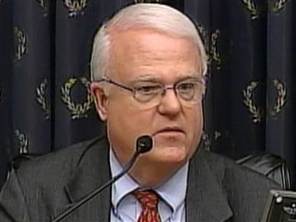
The Republican congressman who led the re-authorization of the Voting Rights Act (VRA) says the law is still crucial for protecting minority voting rights and should be upheld—but he supports recent GOP efforts to make voting harder.
Rep. Jim Sensenbrenner’s nuanced position may not make him a voting-rights champion. But it underscores just what a radical step the Supreme Court would be taking if it strikes down the heart of the law in a case beginning Wednesday.
At issue in Shelby County v. Holder is a provision of the Voting Right Act, known as Section 5, which allows the federal government to block even minor election changes made by certain southern states and counties with a history of racial discrimination, if they’re deemed to reduce minority voting power.
In 2006, Congress overwhelmingly re-authorized the VRA, including Section 5—a process in which Sensenbrenner, who at the time chaired the House Judiciary Committee, played a leading role.
“The hearings I led amassed a 12,000 page record which showed that there are jurisdictions under Section 5 that continue to try to deliberately disenfranchise minority voters,” Sensenbrenner told msnbc.com in an interview Monday. “Less by making it hard to register, but by doing things like redistricting, moving polling places to the other side of town and the like…making it literally impossible for a minority candidate to get elected.”
Sensenbrenner, who has represented a suburban district in Wisconsin since 1979, notes that counties that have shown they’ve cleaned up their act can apply to the Justice Department for a “bailout” from Section 5—something that’s almost always granted.
And yet the veteran lawmaker said he doesn’t see the recent slew of GOP-backed efforts to make voting harder—including photo ID laws, purges of voter rolls, and cutbacks to early voting—as the kind of racially discriminatory tactics that Section 5 exists to stop. He says he backed a controversial photo ID law pushed by Wisconsin governor Scott Walker, which was blocked by a court, and describes such measures as legitimate efforts to ensure the integrity of the election process.
“Photo ID laws, I think, are color-blind,” said Sensenbrenner. “There is not the overwhelming evidence that, for example, voter ID or early voting discriminate on a race-based matter.” In at least some cases, the courts disagree. The Justice Department last year used Section 5 to block a photo ID law in South Carolina and an effort to reduce early voting days in Florida, moves that were upheld by the courts. Studies have shown that African-Americans are more likely than whites to lack a photo ID, and to take advantage of early voting, including during “Souls to the Polls” drives that often are held after church services on the Sunday before the election. But though Sensenbrenner may be no Rep. John Lewis, D-Ga., he’s adamant that racial discrimination in voting still exists, and that the federal government needs a mechanism to address it. “It’s not as widespread as it was before 1965, which was really terrible,” Sensenbrenner said. “But to say that the jurisdictions that have not woken up in the last 47 years, that the Supreme Court should allow them off the hook, I think is wrong, given that the courts have always deferred to the record that Congress has established.”
Zachary Roth Recommended


