








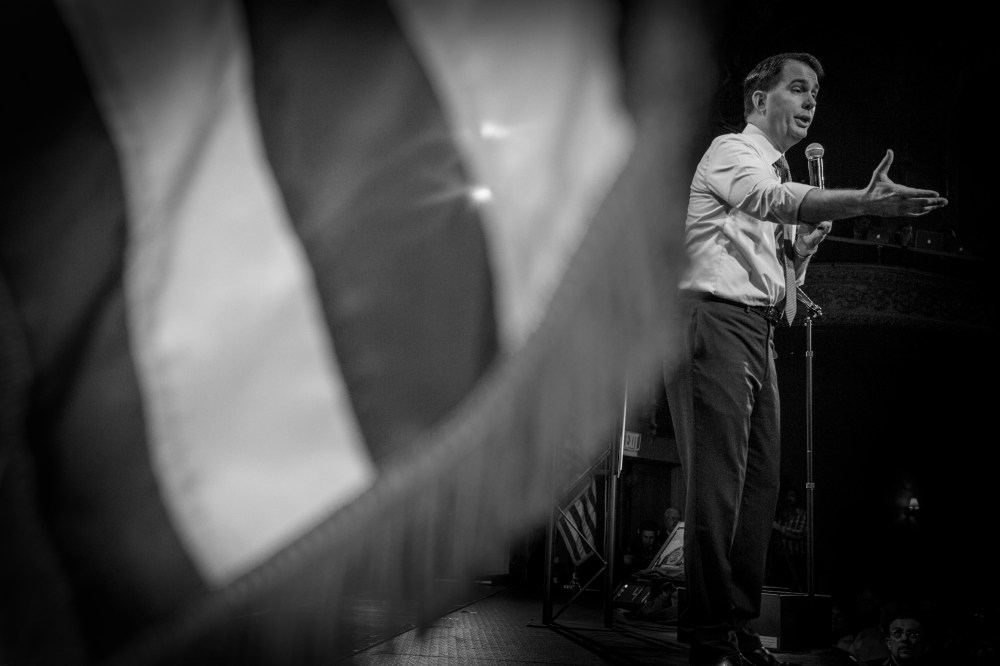
Facing budget shortfalls, a handful of prominent Republicans governors want to cut funding for higher education to help make up the gap, while insisting that tax hikes are a non-starter.
Wisconsin Gov. Scott Walker wants a $300 million funding cut for higher education, and Gov. Bobby Jindal has proposed the same level of cuts in Louisiana. Arizona Gov. Doug Ducey wants at least a $75 million cut to higher ed, and Kansas Gov. Sam Brownback is aiming to cut $45 million from K-12 schools and higher education combined.
RELATED: Kansas Gov. Sam Brownback to cut $45 million in public-school funding
“The people of Wisconsin deserve a government that is more effective, more efficient and more accountable, and this plan protects the taxpayers and allows for a stronger UW System in the future,” said Walker, who’s tying the cuts to greater autonomy for state universities. Both he and Jindal are under heightened scrutiny as they’re considering presidential bids for 2016.
State governments have largely recovered from the worst of the recession, when falling revenues decimated their budgets, and most have begun to restore funding for higher education. But some state budgets are still strapped in part because of the enthusiasm Republican lawmakers have for new tax cuts and their reluctance to raise taxes to make up for fiscal shortfalls.

In Wisconsin, Walker has targeted higher education funds to make up for a $650 million budget gap that the state is facing after its Republicans pushed through $2 billion in tax cuts. Walker, in fact, proposes further property tax cuts in his latest budget, further reducing revenue to the state coffers.
Arizona Gov. Ducey’s budget also preserves major business tax cuts that the state had passed in 2011, despite calls by Democrats to reverse some of them to help address the state’s $1.5 billion shortfall. “This protects taxpayers by rejecting calls to raise taxes. It asks all areas of government to share in the work to develop and find savings,” Ducey said.
Jindal blamed Louisana’s budget woes on the steep, unexpected decline in oil prices in recent months. But others point out that the state’s fiscal woes far predate the crash in oil prices — with some, such as fellow Louisiana Republican Sen. David Vitter, accusing Jindal of exacerbating the problem by recklessly expanding tax breaks.
Kansas, meanwhile, has been in fiscal disarray after Brownback pushed through massive tax cuts, creating a huge budget shortfall and even leading the state to be downgraded by ratings agencies. While he’s proposed some tax increases, Brownback is also relying on the education cuts to help make up the gap.
RELATED: The GOP’s real agenda on taxes
In most of these states, the higher education cuts could mean higher tuition and fewer services. As state support has dwindled, public colleges and universities have shifted the burden to students and their families. In 2012, money collected from tuition exceeded state funding for public colleges nationwide for the very first time, according to a January report from the Government Accountability Office.
“To compensate for lost state funding, public colleges and universities have both steeply increased tuition and pared back spending, often in ways that compromise the quality of the education that they offer,” the Center for Budget and Policy Priorities (CBPP) wrote in a report last year.
In Wisconsin, Walker has tried to avoid the problem by explicitly prohibiting college and universities to raise their tuition for the next two years, when his proposed budget cuts are scheduled to take effect. That simply means, however, that the the state university system will have to look for other ways to save money. Walker’s budget would give the University of Wisconsin system greater leeway to do so, granting it more authority over construction projects, contracting, and merit-based pay. His approach builds on broader criticism that college and universities themselves aren’t doing enough to become more cost-effective, simply passing on cost of the cuts to students instead of embracing broader reforms. “Until the 2008 recession, institutional spending patterns showed more evidence of cost shifting and budget balancing than cost reduction or restructuring,” the National Association of State Budget Offices said in a 2013 report. “Over time, spending on instruction has declined slightly, and administrative and general support costs have increased.” Others warn, however, that students could suffer in other ways from the cutbacks. “You’ve seen state university systems increasing the size of classes, shuttering whole campuses, and you’re seeing programs being eliminated or consolidated,” says CBPP’s Michael Mitchell. The faculty at the University of Wisconsin-Madison issued a resolution strongly condemning Walker’s cuts. RELATED: The GOP’s inequality conundrum “A major reduction in state support would diminish the quality, breadth, and access to education for Wisconsin residents,” the resolution said. It added: “Implementing these budget cuts would pose significant challenges for our administrative leadership, limit our capacity to retain our world-class faculty, and reduce our effectiveness in meeting the needs of students.” Nationwide, higher education funding still hasn’t returned to pre-recession levels in terms of spending per capita. Funding increased 7% overall last year, but it remained about 23% below 2008 levels, according to the CBPP.
Suzy Khimm Recommended


