








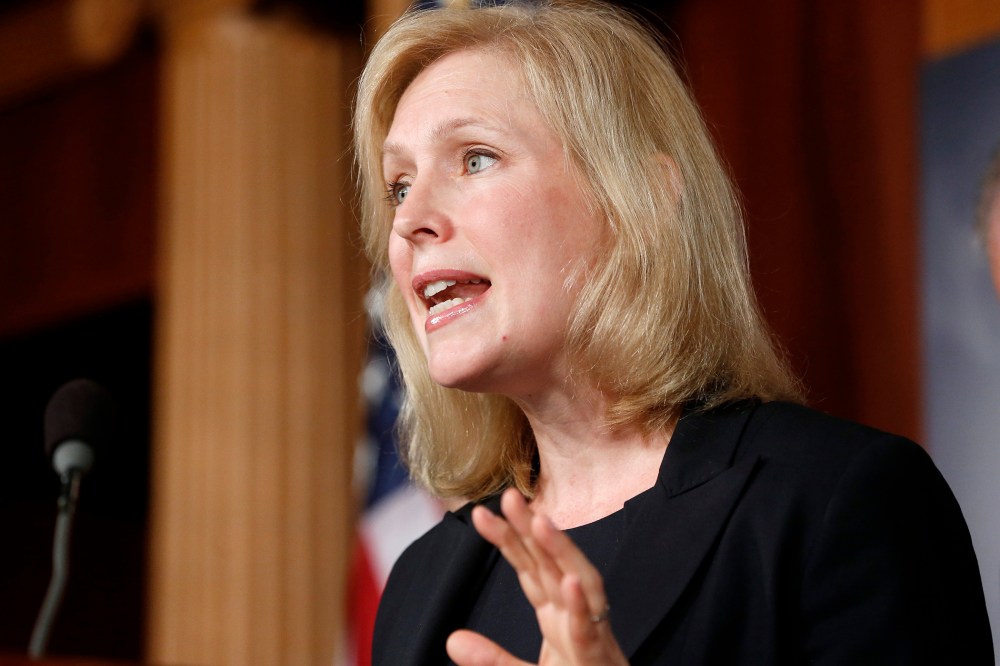
Sen. Kirsten Gillibrand won’t take no for an answer. The New York Democrat, widely credited with shining a harsh spotlight in the past year on sexual abuse in the U.S. military, is standing by a proposed radical change to the system of prosecuting such cases that goes far beyond other compromise measures advocated by other Democrats and has invited strong pushback from military leaders.
The National Defense Authorization (NDAA) Act that passed on Dec. 19 included some two-dozen changes to the way the military handles sexual assault. But the measure leaves decisions about prosecution within the military chain of command, a move Gillibrand insists would empower predators and prevent them from being brought to justice.
When Gillibrand excoriated military leaders at a Senate Armed Services Committee for defending a system that lets commanders who can’t – or won’t – distinguish between “a slap on the ass and a rape,” as she put it, it was a signal that she would take on sexual assault in the ranks as tenaciously as she did her drive to repeal the “don’t ask, don’t tell” policy of allowing gays in the military to serve openly. Opposition from the Pentagon and fellow legislators could doom Gillibrand’s proposal, the Military Justice Improvement Act (MJIA), which could come up for a vote in February but still needs seven votes to ward off the threat of a filibuster.
Even so, opposition from Congress and from top military brass may have done more to help than to doom Gillibrand’s cause.
“If there wasn’t that much pushback, there wouldn’t be so much notice,” said Paula Coughlin, a former Navy lieutenant who exposed the rampant sexual assault by Navy and Marine Corps officers at the infamous 1991 Tailhook Convention. “If her efforts weren’t being so outrageously thwarted by the Defense Department, if they hadn’t responded in such a ridiculous and antiquated way, it could have just gone away.”
Opponents of Gillibrand’s legislation, including Gillibrand’s fellow Senate Democrat, Claire McCaskill of Missouri, insist that removing certain prosecution decisions from commanders could incite anarchy in the ranks. If a commander cannot retain complete authority, the argument goes, how can he be held responsible for crimes committed on his watch?
“Commanders need to be held accountable regardless of whether or not they have this authority,” Kate O’Gorman, political director of the Iraq and Afghanistan Veterans Association, told msnbc. Giving these decisions to trained prosecutors “allows commanders to concentrate on prevention and on the climate” within their units. “By not passing [the MJIA], we can’t say we’ve done everything we can to address this issue,” O’Gorman said.
A host of incremental sexual assault reforms were included in the NDAA, but survivors and advocates say any solution short of Gillibrand’s proposal would be incomplete.
“If you talk to people on the street, they’ll say [the military’s sexual assault problem] is solved. The dynamic that is unfolding, it is not fixed,” said Coughlin.
Added Couglin, “If they can count 26,000 members who were assaulted last year, why would they want to wait for another year? We need a better plan.”
Gillibrand isn’t the first to propose such a remedy — Rep. Jackie Speier, D-Calif., has been pushing for the removal of sexual assault prosecutions from the chain of command since 2011. But Gillibrand has used her position on the Senate Armed Services Committee force more changes than ever before.
Gillibrand’s take-no-prisoners approach on the issue and her work to end “don’t ask, don’t tell” has helped catapult her onto the list of future presidential contenders.
Anu Bhagwati, executive director of Service Women’s Action Network and a former Marine Corps captain, told msnbc that her group still believes Gillibrand’s plan is the best way forward, and that President Barack Obama should as well. “We met with the White House last month and made it clear that no extra layer of review is necessary for the president to support Senator Gillibrand’s bill,” Bhagwati said. The real challenge for Gillibrand will come after her bill passes or dies. Even McCaskill has praised Gillibrand’s refusal to compromise, but if the MJIA fails, it could make more difficult Gillibrand’s next battle to get 60 votes around a cause she is championing. It has also meant Gillibrand has faced harsh scrutiny over her approach. Amid ongoing partisan gridlock in Washington, women lawmakers have been praised for hammering out difficult compromises on fiscal matters. Gillibrand’s refusal to compromise on military sexual assault has stood out. Still, more attention has been paid in the past year to the way the military manages sexual assault than in the last two decades, largely thanks to Gillibrand’s efforts. Observers say if there is finally some accountability, it will be a result of her dogged refusal to accept promises in lieu of action. “We all value the service of our veterans,” Gillibrand told msnbc in a statement. “Now we need to listen to them when they say after more than 20 years of failing to deal with sexual assault in the military we need to make the single reform that will make the difference. They have waited far too long for a fair shot of justice. They should not be asked to wait another year. We will get the votes and we will pass this.” Related: Sen. Gillibrand answers questions from the msnbc community Watch Gillibrand discuss her proposals with MSNBC’s Karen Finney in November:
Meredith Clark
Meredith Clark is a freelance writer and editor. She was previously a senior news producer for "Patriot Act with Hasan Minhaj," a reporter with MSNBC.com, the digital politics and culture editor at Glamour and a senior news and politics editor at Refinery29. She has written for Vulture, Rolling Stone, Self, Marie Claire, Cosmopolitan, The Daily Beast and Bustle. Recommended


