








President Obama’s extraordinary career can be mapped by his biggest speeches.
From his surprise breakthrough at the 2004 Democratic convention to his measured discussion of race in the middle of the 2008 primaries; from his moving remarks after the massacre in Tucson to his sweeping second inaugural address last year.
But of all his speeches, Obama’s eulogy for Nelson Mandela on Tuesday was a remarkable milestone in his presidency.
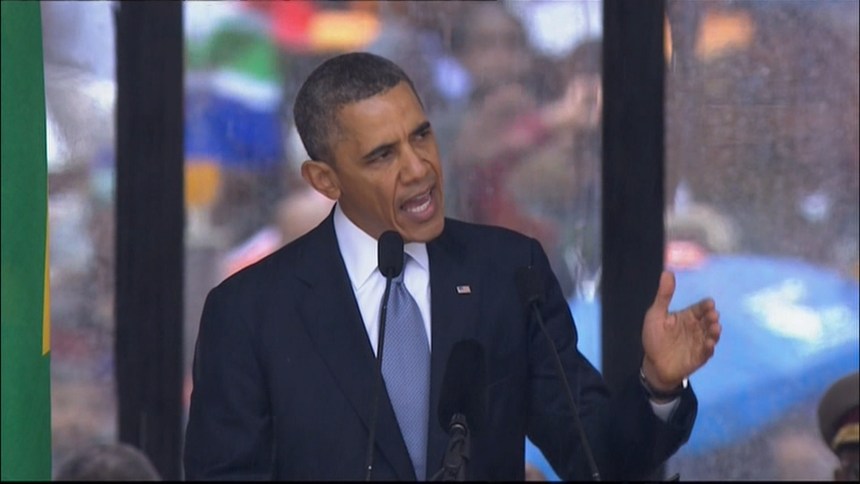
In a rain-swept stadium in Johannesburg, the first black president of the United States celebrated the life of the first black president of South Africa, praising him as “a giant of history.”
Obama, who was introduced as “our very son of the African soil” traced the course of Mandela’s life: from his childhood herding cattle to the legal training that shaped a liberation struggle as great as that of Mahatma Gandhi and Martin Luther King Jr. He retold the story of Mandela’s trial in 1964, his decades in prison, and his astonishing presidency as the great reconciler of a country few believed could ever heal from the violence and injustice of apartheid.
However it was not just the sense of history that made this Obama speech remarkable; it was the uniquely personal perspective that shed light on Obama’s political struggles.
“It is hard to eulogize any man,” Obama began, “to capture in words not just the facts and the dates that make a life, but the essential truth of a person – their private joys and sorrows; the quiet moments and unique qualities that illuminate someone’s soul.”
In the quiet moment before he ran for president, Obama hung several photos on the wall of his Senate office. Unlike other politicians with longer careers, the wall was not full of grinning photos of himself with other luminaries. Instead there were iconic photos of Gandhi, King, and Lincoln: the three historic figures that he cited in his Mandela eulogy.
“Given the sweep of his life, the scope of his accomplishments, the adoration that he so rightly earned, it’s tempting I think to remember Nelson Mandela as an icon, smiling and serene, detached from the tawdry affairs of lesser men,” Obama explained, before using Mandela’s tribal name.
“But Madiba himself strongly resisted such a lifeless portrait. Instead, Madiba insisted on sharing with us his doubts and his fears; his miscalculations along with his victories. ‘I am not a saint,’ he said, ‘unless you think of a saint as a sinner who keeps on trying.’”
There is no reasonable comparison of the careers of Obama and Mandela that would place the two presidents in the same league. But the Mandela example of leadership that Obama describes carries echoes of the style he has tried to adopt himself.
Obama warned from the outset of his presidential campaign that he was not a saint – not “a perfect vessel” as he put it.
In office, especially in the deeply troubled start of his second term, he has been more than ready to share publicly “his doubts and his fears; his miscalculations along with his victories.” In his interview with Chris Matthews just last week, his remarks on his own struggles and stumbles were among the most striking.
“It was precisely because he could admit to imperfection – because he could be so full of good humor, even mischief, despite the heavy burdens he carried – that we loved him so,” Obama said. “He tells us what is possible not just in the pages of history books, but in our own lives as well.”
The lessons of Mandela, as described by Obama, are the mixture of hope and power that represent his own political philosophy: a combination of what he called “struggle and shrewdness, and persistence and faith.”
It was a philosophy that Obama adapted from his earliest days as a community organizer, where the movement was built on the lessons of organized labor. Organizers were supposed to forget about “the world as it should be” and concentrate on “the world as it is.”
Contrary to what his far-right critics suggest, Obama rejected the model of the socialist radicals in favor of the inspiration of civil rights and liberation leaders like Gandhi, King and Mandela. He understood the power of King’s dream and President Lyndon Johnson’s civil rights laws, and tried to combine a sense of hope and the exercise of power in his own career. “Mandela taught us the power of action, but he also taught us the power of ideas; the importance of reason and arguments; the need to study not only those who you agree with, but also those who you don’t agree with,” Obama explained, before insisting that Mandela’s achievements were “chiseled into law and institutions.” Those words are a clear response to those who argue that his own leadership should be less compromising and accommodating. It is not enough to talk about health care; no matter how flawed his reforms, Obamacare has been chiseled into law. “On core principles he was unyielding, which is why he could rebuff offers of unconditional release, reminding the Apartheid regime that ‘prisoners cannot enter into contracts.’ But as he showed in painstaking negotiations to transfer power and draft new laws, he was not afraid to compromise for the sake of a larger goal,” Obama continued. Obama’s louder message was to those leaders – at home and abroad – who claim to have embraced Mandela’s legacy but whose politics show nothing of the kind. Whether they are African dictators like Robert Mugabe who violently oppress political opponents – or conservative Republicans who want to cut food stamps and unemployment benefits – they are failing to live up to Mandela’s example. “There are too many people who happily embrace Madiba’s legacy of racial reconciliation, but passionately resist even modest reforms that would challenge chronic poverty and growing inequality,” Obama said in his most pointed remarks. “There are too many leaders who claim solidarity with Madiba’s struggle for freedom, but do not tolerate dissent from their own people. And there are too many of us on the sidelines, comfortable in complacency or cynicism when our voices must be heard.” It was a strange coincidence of timing that Obama’s eulogy was delivered on the same morning that the Nobel peace prize was accepted in Oslo. Four years ago, Obama was delivering his own acceptance speech in Oslo, in another of his landmark speeches directed – at least figuratively – at one of his heroes. That peace speech revolved around the legacy of Martin Luther King Jr. and how – as a war president – he needed to interpret King’s lessons. Obama’s take on Mandela was less complicated but no less powerful. He celebrated the South African concept of Ubuntu – loosely translated as togetherness – a concept that Obama campaigned on twice for president, and has simply called citizenship in his speeches on American soil. “We will never see the likes of Nelson Mandela again,” Obama said, before retelling the story of how Mandela’s struggle inspired him to get involved with politics as a young man. “It woke me up to my responsibilities to others and to myself, and it set me on an improbable journey that finds me here today,” he said. “And while I will always fall short of Madiba’s example, he makes me want to be a better man.” It is rare to see a sitting president eulogize one of his life’s heroes, an epic figure in recent history. It is even rarer to watch a president contemplate his own position in such a historic setting on the world stage.
Richard Wolffe Recommended


