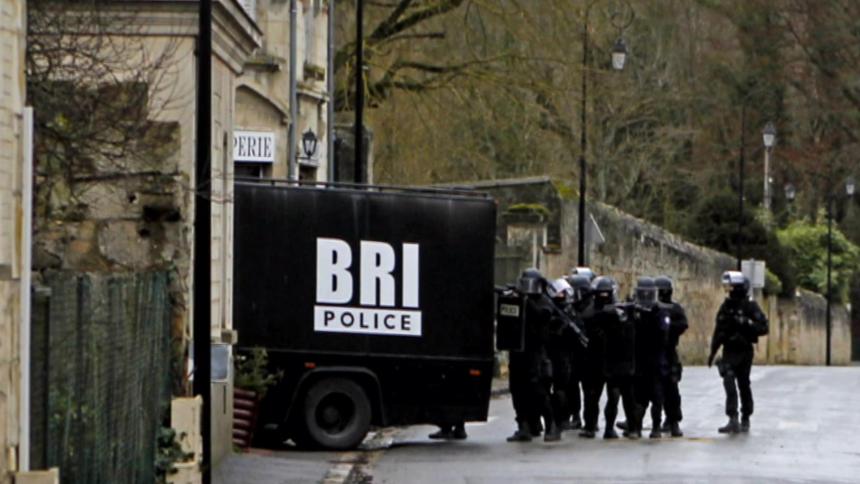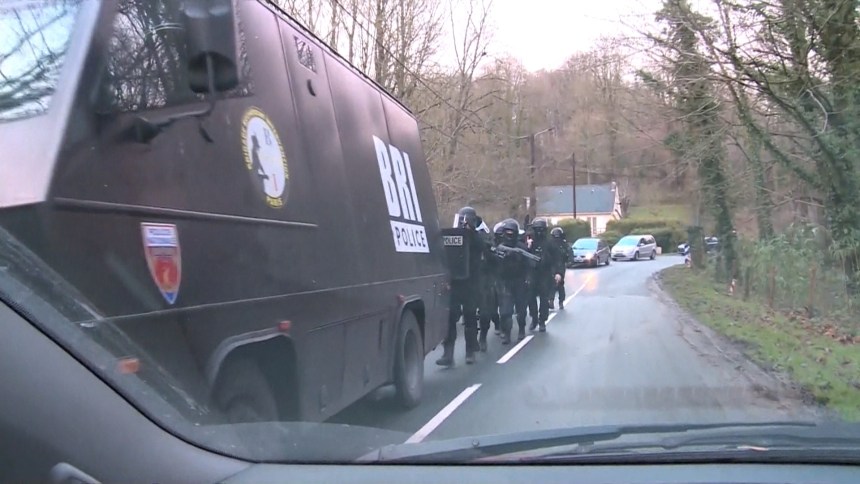
Dozens of police officers armed with automatic weapons descended on a quiet French town Thursday in a frantic search for the two brothers suspected of brutally killing 12 people at the Paris offices of the satirical publication Charlie Hebdo. Helicopters, police cars, and a heavily armored vehicle were present as officers went door to door, searching homes and buildings in Crépy-en-Valois, about an hour northeast of Paris.
Throughout Thursday, more clues emerged in the investigation — including an abandoned C3 Citroën and a passport that appeared to have been left accidentally as the gunmen fled — and a potential sighting was reported at a nearby gas station.
As dusk fell at the end of a long day of national mourning in France, officials continued to uncover new information about the suspects and their pasts. French Interior Minister Bernard Cazeneuve revealed at a press conference on Thursday that the parents and brothers of suspected gunmen Saïd Kouachi and Chérif Kouachi were interviewed by the police. Additionally, nine others were detained, and a hotline received calls from 90 witnesses.
Cazeneuve said Chérif Kouachi was described by a former accomplice as being wildly anti-Semitic. The 32-year-old, who was convicted on terrorism charges in 2008, was known to be part of an Islamist cell working to recruit French nationals to fight against U.S. forces in Iraq. Saïd Kouachi, 34, is believed to be his older brother. The two were listed in U.S. terrorism databases on the American no-fly lists “for years,” a Homeland Security official told NBC News.
Cazeneuve said on Thursday that both were “being watched over, but there were no elements at the time to warrant starting an inquiry.” Another man, 18-year-old Mourad Haymd, surrendered late Wednesday and remains in custody near the French-Belgian border.
RELATED: Suspects sighted as authorities raid nearby town
France has mobilized 88,000 security forces and added 4,000 military personnel in light of security concerns, Cazeneuve said. In addition, the country increased security provided for media organizations, tourist areas, embassies and schools. Cazeneuve noted that the Ministry for Education had canceled some school trips. “We are not frightened and will remain united in the face of this tragedy,” Cazeneuve said. “I would like to tell the French people that the government has taken steps to secure their safety.”
The tragedy — one of the worst shootings in France in decades — sent the country into waves of shock and grief. Editor and cartoonist Stéphane Charbonnier, as well as economist Bernard Maris, were among the dozen killed in the attack. Charlie Hebdo had long been the subject of threats for its satirical treatment of Islam, as well as its cartoons depicting the Prophet Muhammad. Some interpret the Quran as prohibiting visual depictions of the prophet.
Thousands gathered in Paris on Thursday night to hold candlelight vigils for the victims and to reiterate support for the freedom of the press. Many held signs and wore stickers proclaiming “Je suis Charlie,” or “I am Charlie.” People left pencils and notepads at monuments as a symbol of press freedom. Similar demonstrations of solidarity occurred worldwide. On Thursday, the Guardian Media Group pledged more than $150,000 to Charlie Hebdo so that the magazine can continue publishing.
No motive has been established, but the men reportedly yelled “Allahu akbar,” meaning “God is great,” as they fled the scene. Cazeneuve, as well as other officials and Muslim organizations around the world, have been careful to distinguish the men’s actions as being that of extremists, not generally representative of Muslim beliefs. “I would like to note how strongly all the Islamic organizations in France denounced the attacks,” he said on Thursday, adding that there was no established connection between the shooting at Charlie Hebdo on Wednesday with the shooting of a policewoman early Thursday morning in the Paris neighborhood of Montrouge. “France is a secular republic that protects the right to believe and not to believe,” Cazeneuve said. “We will not tolerate any act that would target these [beliefs].” Cazeneuve will hold a meeting on Sunday with his counterparts in other European countries, as well as the U.S., to discuss national security challenges. Attorney General Eric Holder is expected to attend. U.S. President Barack Obama made a surprise visit to the French Embassy in Washington D.C. on Thursday after returning from a trip to Phoenix. He signed a condolence book, writing in part, “We go forward together knowing that terror is no match for freedom and ideals we stand for — ideals that light the world.”
Joy Y. Wang Recommended