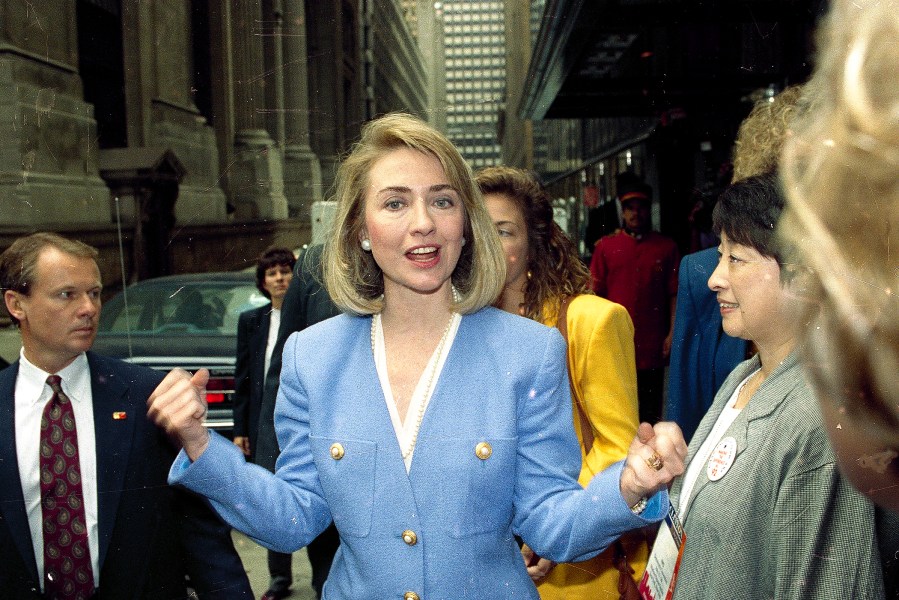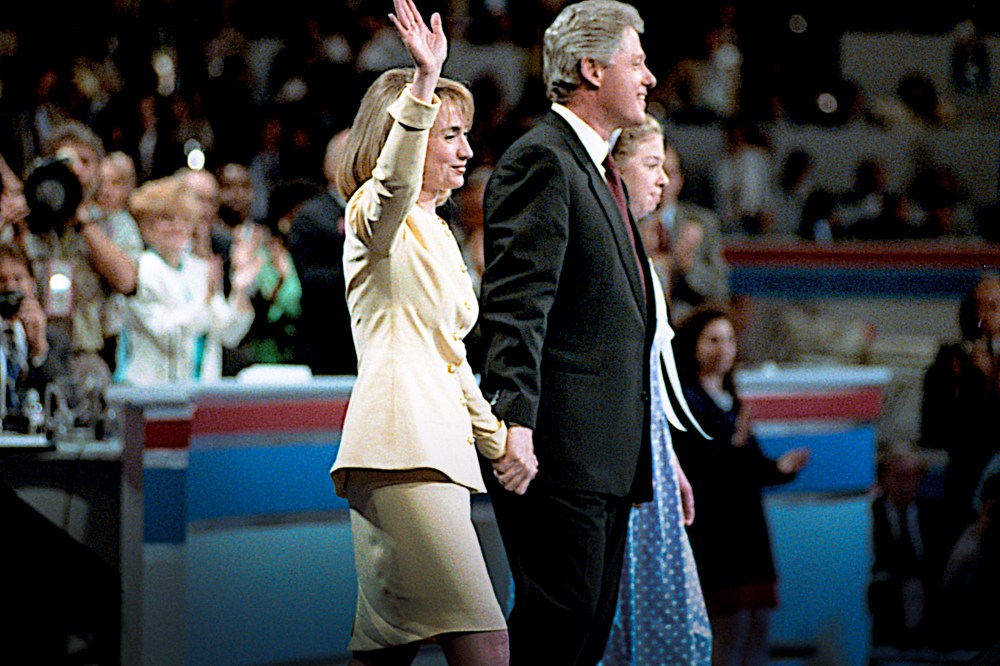
As the Clintons took center stage at the Democratic National Convention in 1992, victory in that year’s general election was anything but assured. Bill Clinton had been trailing eccentric third party candidate Ross Perot as recently as that June, and a series of embarrassing headlines regarding allegations of his marital infidelity had left many voters feeling that he was untrustworthy. Meanwhile, Hillary Clinton had emerged as a particularly polarizing potential first lady. Her decidedly independent and outspoken demeanor stoked fears about potentially too much influence from the president’s spouse on policy.
In fact, a major focal point of Republican Pat Buchanan’s fiery speech at the Republican National Convention that year was a critique of the Clintons’ pitch that a vote for the former Arkansas governor would result in “two for the price of one” in the White House. At the time, Hillary Clinton was viewed as the more conventionally liberal of the two, and that reputation would persist for the most part until she established more moderate-to-conservative credentials as the U.S. senator for New York.
Today, Hillary Clinton is the one vying for voters’ affections, and she is tackling some of the same challenges her husband faced as a general election candidate. She too has struggled to shake the perception that she is untrustworthy and had her ideological purity questioned. And while 24 years ago, Clinton told reporters that she had “never seriously entertained” the possibility of running for office herself some day, now she is in the awkward position of trying to sidestep the stigma of being a “career politician.”
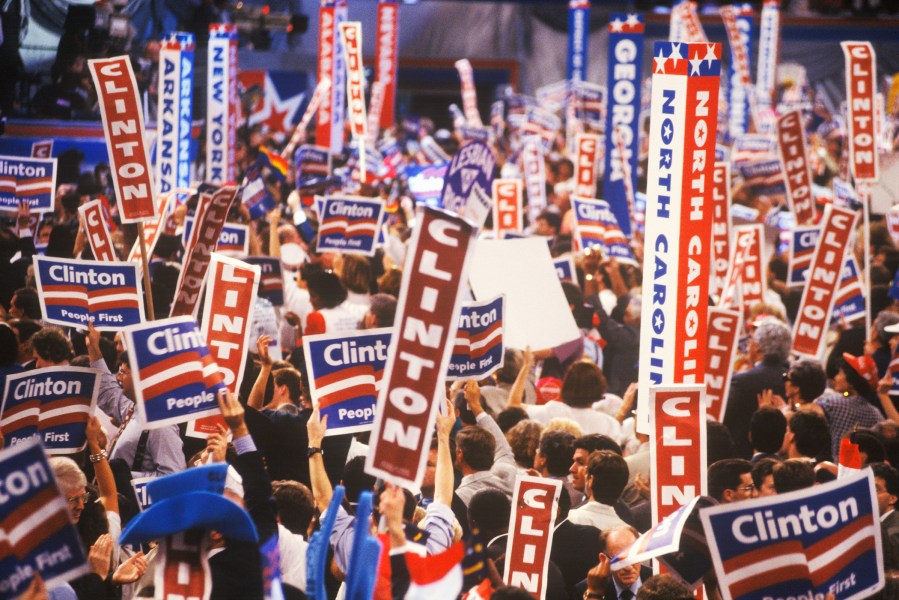
In a way, Clinton may have to follow her husband’s blueprint in how to combat a string of bad headlines — from the FBI director’s harsh condemnation of her use of a personal email server to the better-than-expected reception of Donald Trump’s lengthy RNC acceptance to speech, and most recently the leak of thousands of internal DNC correspondence, which has resurrected divisions between her supporters and backers of her chief primary rival, Sen. Bernie Sanders.
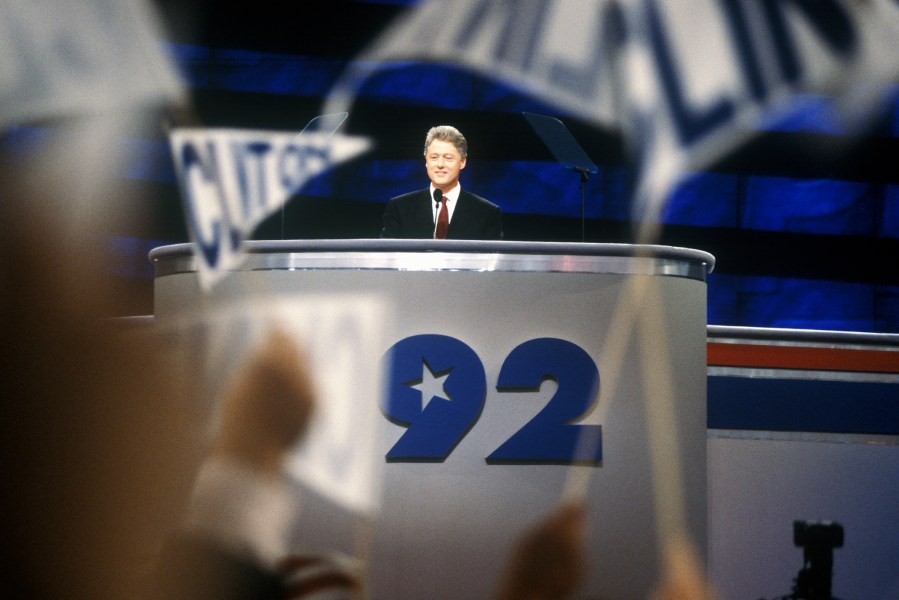
In his acceptance speech, Bill Clinton leaned heavy on his inspirational biography — name-checking his birthplace of Hope, Arkansas — and linking it to the anxiety that many Americans were feeling with an economy that was in recession. As a relatively unknown figure, Clinton was able to re-introduce himself to the American people and to co-opt Fleetwood Mac’s, Baby Boomer-beloved hit “Don’t Stop” as an inspirational campaign theme. He surged into the lead following his strong convention performance, and he was aided tremendously by Perot’s abrupt departure from the race, which allowing Clinton to consolidate the anti-George H.W. Bush incumbency vote. (Perot would jump back in that fall, but never regain his footing.)
Curiously, Hillary Clinton did not address the convention at all in 1992, perhaps signalling her efforts to take more of a back seat on the campaign trail.
Fast forward to 2016, when Hillary Clinton is much better known — and opinions about her about much more entrenched and extreme. But she will also have an opportunity to humanize herself, and remind supporters of what brought her to this historic moment as the first female presidential nominee of a major political party.
Clinton will be addressing a very different Democratic Party than her husband did, too. Instead of a party that had been out of the White House for 12 years, she will be advocating for a continuation of an eight-year reign. And instead of trying to assuage fears that she is too liberal, Clinton will be trying to persuade progressives that she is one of them. And although she enters her convention in a neck-and-neck race with her opponent, Clinton in many ways has more to lose than her husband did two decades ago. “[F]or whatever reasons — and I don’t want to try to analyze the reasons, I see it, I understand it — people are very willing to say things about me, to make accusations about me…,” she said during a recent interview with “60 Minutes.” “I don’t get upset about them anymore, but they are very regrettable.” Still, Clinton supporters should take heart in the fact that she and her husband are infamous for making unprecedented comebacks. After a rocky first term, during which he lost control of the House and Senate, Bill Clinton still managed to win a second term handily in 1996. And after a painfully close defeat in the Democratic primaries of 2008, Hillary Clinton has re-emerged with a formidable, better-organized campaign that is still viable despite numerous setbacks and relentless attacks from both sides of the political aisle. Can she be the latest Clinton to assume the “Comeback Kid” mantle? This week could provide the answer.
Adam Howard Recommended