








WASHINGTON — It will be history in the making in the nation’s capital Tuesday when the Supreme Court hears arguments in the case of Obergefell v. Hodges, which is widely expected to bring marriage equality to all 50 states. The big day is both a long time coming, and sooner than expected — made possible by decades of activism as well as two short years of remarkable change.
People have been lining up outside the court for days, hoping to catch a glimpse of Tuesday’s hearing, leaving plenty of time to brush up on gay rights history or thumb through thousands of pages of legal briefs. But for those just tuning in, here are five things to know about the case:
The basics
Tuesday’s case is a consolidation of challenges to same-sex marriage bans in four separate states: Ohio, Kentucky, Michigan and Tennessee. Each of those bans fell at the trial court level, but went on to prevail at the 6th Circuit Court of Appeals. The 6th Circuit is the only federal appeals court to have ruled against gay and lesbian couples since the Supreme Court’s 2013 decision invalidating the Defense of Marriage Act (DOMA), a law which prevented the U.S. government from recognizing marriages between two people of the same sex.
Before the high court now are two questions: Does the 14th Amendment require states to license a marriage between two people of the same sex, and does that same amendment require a state to recognize legally valid same-sex marriages performed elsewhere? If the answer to each ends up being “yes,” marriage equality will become law of the land. If the answer is “no,” the country’s remaining 14 same-sex marriage bans will survive, while the effort to reinstate fallen bans will revive.
RELATED: Gay hotelier apologizes for hosting Cruz
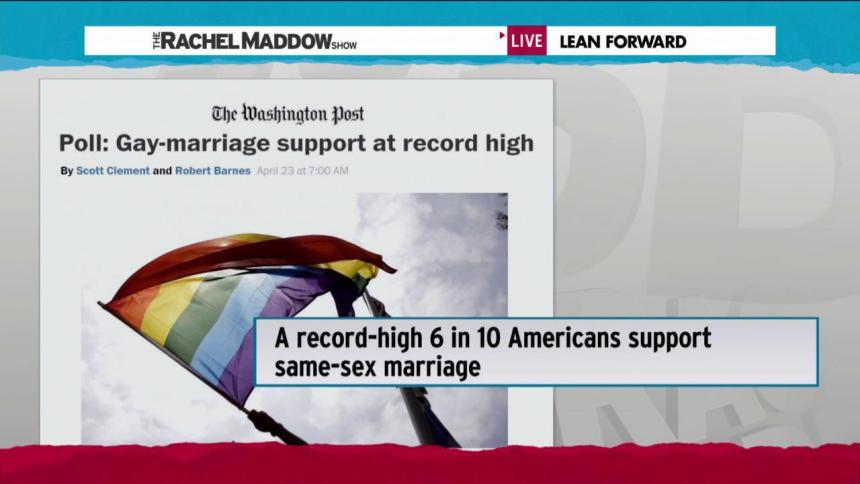
Approximately 140 briefs have been filed to the high court either in support of, or against same-sex marriage. In the not-too-distant past, some of those groups now taking action on behalf of gay and lesbian couples would have come as a shock to many — including 28 of the countries biggest financial firms, former Pentagon officials and nearly 2,000 religious leaders. But today, their support reflects the remarkable sea change that has gripped the country on this issue in recent years.
In fact, one of the most powerful converts to the pro-marriage equality camp is the Justice Department, which filed a brief arguing that same-sex marriage bans should have to satisfy a higher standard of judicial review, known as “heightened scrutiny,” in order to stand. Until three years ago, President Obama did not support same-sex marriage.
At the same time, plenty of marriage equality opponents filed briefs making the case for why the institution should be kept between a man and a woman. Among their wildest claims? Marriage equality will lead to hundreds of thousands of abortions and may even kill people.
Main arguments for same-sex marriage
A common refrain heard within so-called “traditional” marriage circles is that gay and lesbian couples are seeking to create a completely new constitutional right to same-sex marriage. The plaintiffs in this case, however, are making an entirely different claim.
Marriage, they argue — not same-sex marriage — has been established by the Supreme Court numerous times as a “fundamental right,” one which the states have denied same-sex couples without sufficient justification under any standard of judicial review. Without a valid reason for excluding gay and lesbian couples from the institution of marriage, the plaintiffs continue, the states have engaged in a form of animus by enacting marriage laws with the “design, purpose and effect” of making same-sex couples and their families second-class citizens.
The plaintiffs go on in their merits briefs to take down the states’ various lines of defense for banning same-sex nuptials — chiefly, that such bans encourage “responsible procreation,” and that broadening the institution of marriage to include same-sex couples warrants further debate. States have no problem allowing opposite-sex couples to marry if they can’t or have no desire to procreate, the plaintiffs argue. And banning same-sex couples from marrying does not facilitate debate on the issue; it ends it completely.
RELATED: A watershed moment for marriage equality?
On the question of recognizing out-of-state same-sex marriages, the plaintiffs rely heavily on the DOMA ruling, which found that a refusal to recognize marriages legally performed in a certain state marks those marriages as less-than. The Tennessee brief goes further, arguing that the state’s non-recognition laws “infringe upon married same-sex couples’ fundamental right to travel,” in that moving to Tennessee carries the unreasonable burden for those couples of nullifying their marriages.
Main arguments against it
Tradition, procreation and states’ rights loom large in the merits briefs defending same-sex marriage bans. States have always had the power to define marriage for themselves, defendants argue, and should continue to as their citizens engage in a robust conversation on the issue. The DOMA ruling reaffirmed that right of the states, defendants say. And the U.S. Constitution offers neither a guarantee to same-sex marriage, nor a reason to subject marriage laws to a higher standard of judicial review.
Furthermore, the states have solid justification to restrict marriage to opposite-sex couples, defendants argue, in that only opposite-sex couples can naturally procreate. Because same-sex couples are not similarly capable of producing children, the argument follows, they can essentially be treated dissimilarly when it comes to marriage. The states have a rational government interest in preserving the traditional definition of marriage and encouraging procreation, the briefs state.
The back story
In the last two years, marriage equality has skyrocketed from being legal in only a handful of states to well over a majority of the country. Sudden though it may seem that progress was actually decades in the making. In May 1970 — less than a year after the riots at Stonewall in New York City effectively launched the modern gay rights movement — several same-sex couples applied unsuccessfully to Minneapolis Court Clerk Gerald R. Nelson for marriage licenses. Their refusal sparked the first federal lawsuit seeking marriage rights for same-sex couples — one which ended in failure with a one-line 1972 Supreme Court order dismissing the plaintiffs appeal “for want of a substantial federal question.” That case, Baker v. Nelson, is still cited by many traditional marriage supporters as fully binding precedent holding that the Constitution does not extend marriage rights to same-sex couples. A few years later, in 1975, a half-dozen same-sex couples were able to obtain marriage licenses from the Boulder County clerk’s office before Colorado Attorney General J.D. MacFarlane put a stop to the practice. One of those couples went on to sue and lose in the first federal lawsuit against the U.S. government seeking recognition of a same-sex marriage. Supreme Court Justice Anthony Kennedy, then a 9th Circuit judge, actually authored the final blow to that couple’s quest in a 1985 decision, cutting against the major gay rights victories that would later flow from the justice’s pen — the most recent of which being the 2013 ruling that gutted DOMA. RELATED: 14 wacky claims against marriage equality Fast forward to 1990 when three same-sex couples attempted to file for marriage licenses at the Hawaii Health Department. Once denied, the couples went on to sue and win in state court on the grounds that Hawaii had violated its constitution’s equal protection clause. That victory was short-lived, however, as Hawaii voters soon enacted a constitutional ban on same-sex marriage. Meanwhile, lawmakers in Washington moved to pass the 1996 federal DOMA. Both provisions remained intact until 2013. That action-reaction pattern continued into the new millennium. While the Massachusetts Supreme Court declared that state’s same-sex marriage ban unconstitutional in 2003, clearing the way for the Bay State to become the first in the nation where gay and lesbian couples could legally wed, the decision also spurred conservatives to push for a wave of constitutional amendments banning same-sex nuptials at the ballot box — which, in turn, helped propel President George W. Bush to re-election in 2004. The Massachusetts decision also inspired San Francisco Mayor Gavin Newsom to begin granting marriage licenses to same-sex couples in that city and county for a brief period before the California Supreme Court halted the practice in 2004 and later voided all of those licenses. Four years later in 2008, the California Supreme Court ended up finding the state’s statutory bar to same-sex nuptials unconstitutional. But that same year, voters enacted Proposition 8, the Golden State’s now-defunct constitutional ban. States continued to slowly legalize marriage equality over the next few years, as the movement began to gain increasingly more powerful allies. In 2012, President Obama became the first sitting U.S. president to publicly endorse same-sex nuptials. But the major turning point came in 2013, when the U.S. Supreme Court handed down two landmark rulings — one allowing California’s Prop 8 to fall, and the other invalidating DOMA. At the time of those decisions, gay and lesbian couples could only marry in nine states. But the DOMA ruling, which repeatedly referred to the equal dignity of same-sex couples and their families, opened the floodgates to dozens of successful challenges against same-sex marriage bans across the country. RELATED: Huckabee: Gay marriage a major threat In October, the Supreme Court rejected appeals to hear marriage equality cases out of three different federal circuits, clearing the way for gay and lesbian couples to marry in 11 more states. At the time, no appeals court had ever ruled in favor of same-sex marriage bans. But that changed a month later when the 6th Circuit Court of Appeals upheld bans in Kentucky, Michigan, Ohio and Tennessee — the four states now at the center of the debate. With that so-called “circuit split,” the justices felt compelled to take up the case before them today and likely settle the matter once and for all. The state of marriage equality in the U.S. Marriage equality is legal in 36 states, the District of Columbia and parts of Missouri. It is still prohibited in Alabama, Arkansas, Georgia, Kentucky, Louisiana, Michigan, Mississippi, most of Missouri, Nebraska, North Dakota, Ohio, South Dakota, Tennessee and Texas.
Emma Margolin
Emma Margolin is a reporter at MSNBC.com. Recommended


