








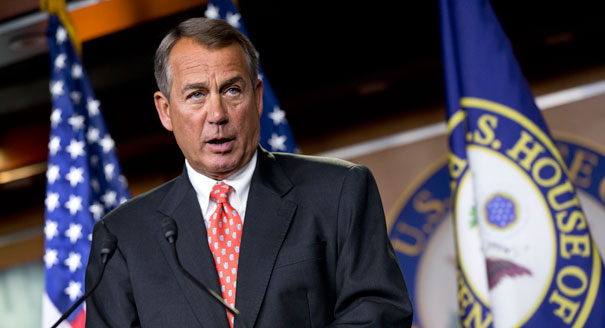
House Republican leaders say a new proposal from the White House to avoid the fiscal cliff is “a small step in the right direction” but insist that “there are still substantive issues that are unresolved.”
Still, they didn’t reject the White House proposal outright, which may hint that both sides are finally edging towards an agreement. There are just 13 days until the New Year.
The White House proposed today what they call a $2.4 trillion deficit reduction package, including $1.2 trillion in new revenues and $1.22 trillion in spending reductions. Included in the revenue increases is the expiration of the Bush-era tax rates for incomes of $400,000 and more, marking the first time the White House has moved on their stance of raising rates on incomes of $250,000 and more. The $1.2 trillion in increased revenue is also down from the $1.4 trillion in new revenues the White House included in their last proposal.
But Republicans feel the package is not balanced, and say that interest savings included in the White House’s $1.2 trillion in spending reductions should not be included in the proposal. “When you attempt to use all of those interest savings en lieu of programmatic structural reforms like the ones that we’ve been talking about, you further enhance the unbalance between revenue and spending,” a senior GOP aide said. Because of that, the aides say that the spending reductions included in the White House proposal don’t balance out the rise in revenue increases.
“Any movement away from the unrealistic offers the president has made previously is a small step in the right direction, but a proposal that includes $1.3 trillion in revenue for only $930 billion in spending cuts cannot be considered balanced,” said Boehner’s spokesman Michael Steel. “We hope to continue discussions with the president so we can reach an agreement that is truly balanced and begins to solve our spending problem.”
Aides said that Boehner has agreed to allow marginal tax rates on incomes of $1 million or more to move back to the Clinton-era level of 39.6%. He would also agree to raise revenue through limits on itemized deductions and expenditures, which they say would raise a total of around $700 billion. Aides said they would have to work out how they would raise more revenue according to the still-to-be-decided target number.
But the Republican aides said details are still lacking in how spending would be cut, and how the tax code would be reformed to achieve the increase in revenues and cuts that is eventually agreed upon.
On both sides, it appears the White House and Republicans have agreed, in principal, to make both the cuts to entitlements, and the tax increases, occur in a two-step process. The first step would take place in January of 2013. The second would come a year later–January of 2014–but would be so unsavory that fundamental reforms of both the tax code and entitlement programs would be far more appealing. This approach would effectively create another cliff at the end of 2013, when Congress would be forced to agree on comprehensive reforms to entitlement programs and the tax code, or face an alternative that neither side really wants. The Republican Leadership aides say they are still talking to the White House. “The issues that we’re talking about are not technically difficult to resolve,” one aide said. “There are not hundreds of moving parts, but they may be fundamental issues that are difficult to resolve.” Also unclear is how Republicans on Capitol Hill will react to Speaker Boehner’s concession on tax rates. The House Republican conference will meet Tuesday morning.
Frank Thorp V Recommended


