








First Read is a morning briefing from Meet the Press and the NBC Political Unit on the day’s most important political stories and why they matter.
Watching Obama — and his approval rating
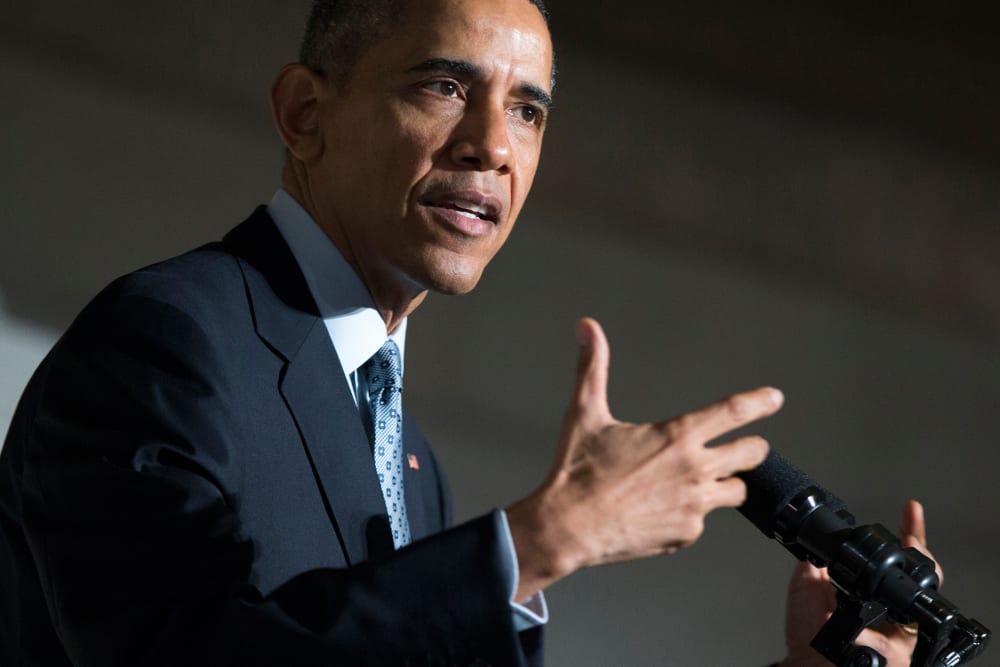
Despite the declarations — including from us — that the 2014 midterm results would render President Obama a lame duck, he’s been anything but over the past year, as White House Press Secretary Josh Earnest reminded reporters yesterday. And Obama will likely make the same reminder at his year-end news conference at 1:50 pm ET. Consider: Normalization of relations with Cuba. The Iran deal. The Paris climate deal. Trade. Throw in the Supreme Court decisions on gay marriage and health care. That string of victories boosted Obama’s approval rating to as high as 48% in our NBC/WSJ poll. Then came the Paris and San Bernardino terrorist attacks, and the president’s approval is now down to 43%. So he’s had a very good first 10 ½ months of 2015, and then he’s had a rough last month and a half. And it’s all a reminder that Obama will play an important role in the 2016 general election — maybe not a decisive role, but certainly an important one (from framing the debate nationally to making decisions that everyone has to react to). Hillary Clinton (or the Democratic nominee) will be sitting pretty if Obama, six months from now, is back in the high 40s. A Dem victory still might be doable if Obama’s approval in in the mid-40s. But it will be much, much more difficult for the party if he’s in the low 40s.
Also watching the early State of the Union and a possible endorsement
What’s more, Obama’s impact on 2016 will likely go well beyond his approval ratings. At the beginning of next year (on Jan. 12), he’ll deliver an early State of the Union, which will certainly influence the Dem/GOP races before Iowa and New Hampshire. This won’t be a typical SOTU, so we’re told. It will likely be aspirational that some political opponents will likely view as an attempt to throw down the gauntlet on a progressive agenda. And it will come just three weeks before Iowa. Also, the White House has opened the possibility of an endorsement (pre-Iowa/New Hampshire?) from the president. Bottom line: The political focus remains fixed on the 2016 campaign trail, but the folks over at 1600 Pennsylvania Avenue will be playing a role, too.
Three storylines for tomorrow’s Democratic debate
Obama’s press conference this afternoon helps tee up Saturday night’s Democratic debate – the third so far of the cycle. And there are three storylines we’ll be watching:
- Which Hillary Clinton will we see — October Hillary or November Hillary? Clinton was on top of her game at the first Democratic debate in October (when, if you’ll remember, Joe Biden was still sitting on the sidelines). But she was just so-so in the second debate (especially after getting criticism for associating her Wall Street campaign donations with 9/11).
- Is Bernie Sanders commander-in-chief material? That was certainly a key question heading into November’s debate right after the Paris attacks. But it’s even more so after San Bernardino — and after Sanders hasn’t changed his stump speech much after those back-to-back events. As MSNBC’s Alex Seitz-Wald wrote earlier this month, “As Washington and the campaign trail are consumed by questions of terrorism and gun control after last week’s shooting in San Bernardino, California, Bernie Sanders chafed this weekend at the idea that news events should dictate what his campaign says or does.”
- Will Martin O’Malley get any look at all? Despite all of the moving poll numbers in the 2016 race, there have been two polling constants so far — Donald Trump remaining above the rest of the field, and Martin O’Malley stuck between 2% to 5%. He’s now been an official candidate for more than six months (and he’s been essentially running for longer than that), but this could very well be his last chance to make a strong impression that matters.
Sanders staffer fired after accessing Clinton campaign data
There’s one additional Dem drama playing out before tomorrow night’s debate: The Sanders campaign fired a staffer for accessing the Clinton camp’s data, and the DNC subsequently barred Team Sanders (at least temporarily) from accessing the voter file. “NGP VAN, the vendor that handles [the DNC’s] master [voter] file, said the incident occurred Wednesday while a patch was being applied to the software. The process briefly opened a window into proprietary information from other campaigns, said the company’s chief, Stu Trevelyan. He said a full audit will be conducted. The DNC has told the Sanders campaign that it will not be allowed access to the data again until it provides an explanation as well as assurances that all Clinton data has been destroyed,” the Washington Post reports. A Sanders campaign official responded with this statement, per NBC’s Kristen Welker: “After discussion with the DNC, it became clear that one of our staffers accessed some modeling data from another campaign. That behavior is unacceptable and that staffer was immediately fired. We are as interested as anyone in making sure that the software flaws are corrected since mistakes by the DNC’s vendor also have made our records vulnerable. We are working with the DNC and the vendor and hope that this kind of lapse will not occur again.”
Why the DNC has to walk a careful line
From our vantage point, it seems that two mistakes were made — by the vendor (for making the data available) and by the Sanders campaign (for accessing the Clinton campaign’s data). But the DNC has to walk a careful line here: If the Sanders campaign takes appropriate action and disposes of the data it obtained, the DNC can’t look like it is slow-walking giving Sanders access again or they’ll get accused of tipping the scales. By the way, imagine if it was the Clinton camp that had done this — and what the reaction would have been!!!
Cruz is the first to hit the airwaves in immigration fight with Rubio Turning to the Republican race, Ted Cruz is now up on the air in Iowa with a new TV ad blasting the “Gang of Eight” immigration bill — all in response to the back-and-forth over immigration with the Rubio campaign. “Securing our borders and stopping illegal immigration is a matter of national security. That’s why I fought so hard to defeat President Obama and the Republican establishment’s Gang of Eight amnesty plan,” Cruz says in the TV ad. While the ad doesn’t mention Rubio by name, the ad pans to a shot of Rubio standing next to Democratic Sens. Chuck Schumer and Dick Durbin. Cruz wants this dustup to be about immigration; Rubio wants it to be about authenticity. Let’s see if/how Team Rubio responds on air. NYT: Rubio backers are worried that he isn’t playing to win either Iowa or New Hampshire Speaking of Rubio, it shouldn’t be surprising that when donors get nervous, they go to the New York Times. “[A]s the primary fight becomes fiercer, and Mr. Rubio’s closest competitors start zeroing in on a single, must-win contest — like Iowa for Senator Ted Cruz of Texas and New Hampshire for Gov. Chris Christie of New Jersey — Mr. Rubio’s all-things-to-all-people strategy is stretching his campaign thin, posing challenges in focusing his message and raising doubts among his supporters about his seriousness.” On the trail Ted Cruz campaigns in Virginia and Georgia… Marco Rubio is in Iowa and Missouri… Ben Carson holds three events in the Hawkeye State… Carly Fiorina also stumps in Iowa… And Lindsey Graham hits New Hampshire. Click here to sign up for First Read emails. Text FIRST to 622639, to sign up for First Read alerts to your mobile phone. Check us out on Facebook and also onTwitter. Follow us @chucktodd, @mmurraypolitics, @carrienbcnews
Chuck Todd
Chuck Todd is NBC News' chief political analyst and the former moderator of "Meet The Press."
Carrie Dann
Mark Murray Recommended


