








FERGUSON, Missouri — The first photos of Michael Brown’s dead body lying in the middle of the street landed on Twitter within minutes after the 18-year-old was shot and killed, in broad daylight, at the hands of a police officer. The graphic images were still streaming down his timeline when Taurean Russell began making calls and organizing groups to the scene.
By the time Russell’s crew arrived at Canfield Green Apartments more than four hours later, tensions among the crowd had boiled over after authorities left Brown’s body lying in the street for the entire afternoon. There were eight other community organizers with Russell protesting the slain teen’s death. Within two hours, their numbers swelled to over 100.
“When Mike Brown died, I went to the area immediately because I’m from that neighborhood, I felt the need to be there and experience what was going on,” said Tef Poe, a community organizer. “I was seeing a lot of stuff on social media, and I just wanted to be there to help out whatever way I could help out.”
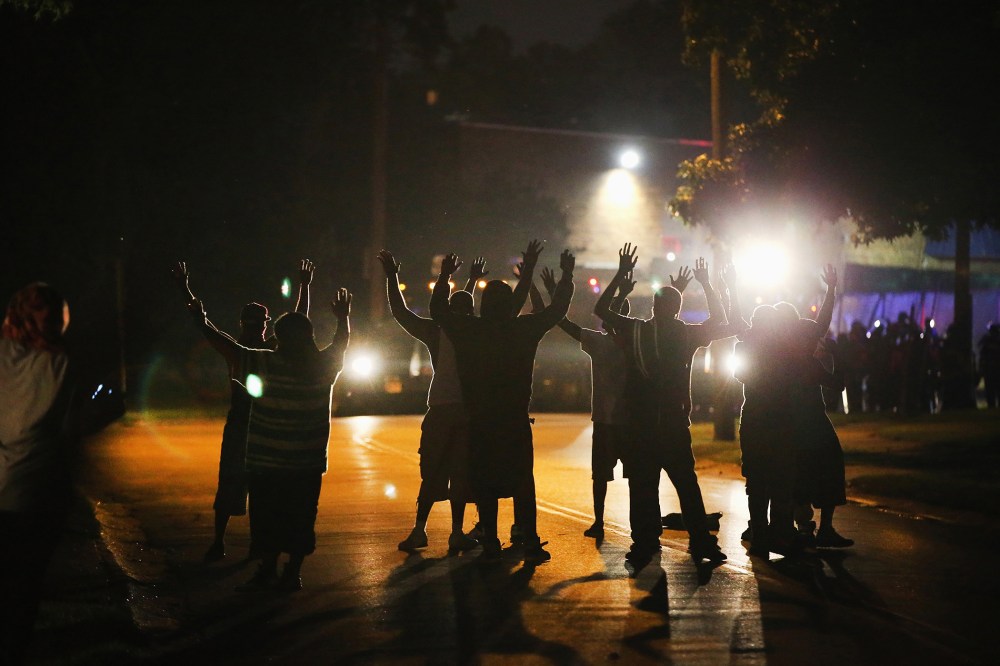
For the residents and community members here, Brown’s death tapped into wounds that were long festering between local law enforcement officials and the neighborhoods they’re tasked with protecting. And as the camera crews and armored vehicles begin rolling away from this St. Louis suburb, the young people organized on the ground are vowing to maintain the momentum while also quelling the image of their protests as being overrun by violence.
“It hurts to try to activate the people and keep their spirits up when the sadness leads to anger, and then that anger leads to outrage,” Russell said at a press conference Friday, flanked by fellow St. Louis organizers coming out in support of Brown.
The protests and uprisings in the area have been a long time coming, they said. African-American men here learn from an early age to avoid driving on certain streets in North County after dark. Never travel in groups if you don’t want to be stopped by police, and never listen to loud music, they say. If you do get stopped for a seemingly minor infraction, be prepared to get slapped with a ticket, or worse.
“Every instance of why I ever met with police was completely ridiculous and unwarranted,” said Wes Suber, a St. Louis resident. “They just generate fear.”
“Our parents have to even teach you police survival skills to not be killed,” Russell said. “Or you try to stand up for yourself and you become Mike Brown.”
The surrounding region had built a reputation among residents as a hotbed for police stops over minor traffic violations. A nonprofit watchdog group found that court fees and fines stacked up from police pulling over residents accounted for more than $2.6 million, the second-highest source of revenue for the city of Ferguson.
“Every time I had an interaction with the police, it was either a money grab or just some kind of an abuse of power,” Russell said.
The economic pinch is knocking the wind out of the young people in particular who live in this majority African-American suburb. According to census data, almost half of the young black men under the age of 24 are unemployed. Russell and other community organizers are pressing Ferguson’s youth to channel the unrest in their hometown and translate it into action. Ferguson organizers are staging a walkout Monday for college freshmen to leave their classes in honor of Brown, who was supposed to attend his first day at technical college days after he was killed. Over the last two weeks, protesters have struggled to reclaim their image after it was seemingly hijacked by a small subset of sometimes violent instigators. Young men, masked with bandanas, scooped up canisters of tear gas in their baseball caps and hurled them back at police. Groups hunched over a makeshift Molotov cocktail, blocked the wind to light the fire bomb. Hot-headed youths sprinted out of a busted in supermarket, bottles of liquor tucked under their arms. Crowds of young people linking arms to create a human barrier blocked looters from breaking through. The kids up in the early hours of the morning, picked up trash and the remnants from uprisings the night before. Those are the ones who will continue to be there once the attention and whirlwind dies down. “The youth is not going to take this lying down,” Russell said.
Amanda Sakuma Recommended


