








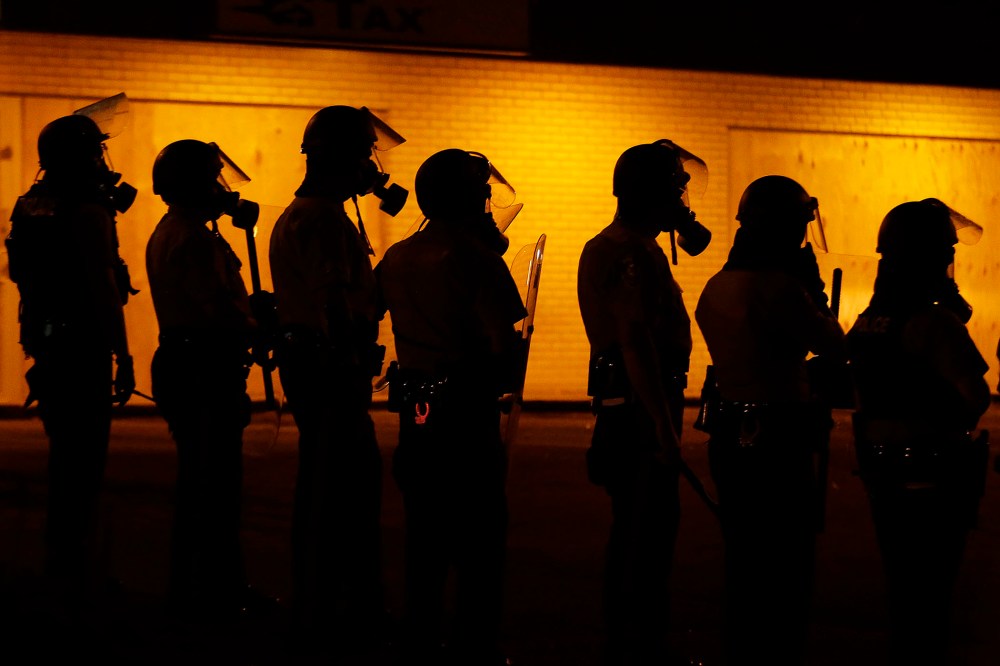
Almost every black person I know, regardless of socio-economic status, has a story about a run-in with the police. If it didn’t happen directly to them, the story is about a friend or relative; some of us have also internalized and taken lessons from those stories growing up. If you’re lucky, you also have a good story involving a police officer, which counters the negative. Because like everyone else, you want to be able to trust and rely on the police.
When I was about eight or nine years old, my father and I were pulled over late one night on a dark stretch of highway. Like a scene from a horror movie, it was late so there weren’t many other cars on the road, and it was very hot. We’d been visiting relatives in Martinsville, Virginia, and were heading back to New York City. I knew my dad hadn’t been speeding, so at first I honestly didn’t think much of it. As my father got out of the car he told me not to worry. But the terse and disrespectful tone in the officer’s voice as he questioned my father made things feel even tenser, which scared me.
He had the power. Then he said, “Boy, you got some ID?” I’d never heard anyone speak to my father like that. I was stunned and then furious. Then I realized why we’d been pulled over – my father was a black man driving a nice car; that image just didn’t seem right to the officer, who was white. The officer was rude as he asked about where we were coming from and where we were going, I noted how patient my father was with these irrelevant questions. Finally, we were free to go. Part of the reason that incident has always stayed with me is how different the whole experience and tone of the interaction was from ones I’d had with my mother, who is white.
That incident was long before police departments had military-style equipment at their disposal.
%22The%20confrontational%20tone%20set%20by%20the%20police%20not%20only%20exacerbated%20the%20situation%2C%20it%20played%20right%20to%20the%20heart%20of%20the%20point%20the%20protesters%20were%20trying%20to%20make%20about%20the%20all-too-common%20use%20of%20excessive%20force.%22′
In the wake of the protests in Ferguson, Missouri following the shooting death of Michael Brown, some have proposed changes to federal policies that help police departments across the country acquire military equipment — it’s is an important step. But in Ferguson, it wasn’t the equipment that made the decision about when to be used, creating an environment where police officers looked more like soldiers in combat rather than protecting and serving in an American city. The leadership of the St. Louis County Police Department made that choice, and they set the tone for the interaction that followed.
The decision to use tear gas, restrict media access, deploy sweep-type formations along with other military tactics and weaponry against peaceful protesters — likely influenced by both conscious and unconscious biases and attitudes about what was acceptable behavior — was a huge mistake. It took days and a visit from the Attorney General of the United States to turn the situation around. The confrontational tone set by the police not only further exacerbated the situation, it played right to the heart of the point the protesters were trying to make about the all-too-common use of excessive force.
A recent study from the University of California at Berkeley (a city that has seen its fair share of protests) found, as we saw in Ferguson, that the actual use of military tactics and gear sets a tone that makes it more likely that a protest or demonstration will become violent, and makes it that much harder to de-escalate the situation and rebuild trust. The goal of the project is to identify what factors contribute to an escalation in violence, and which can actually de-escalate an encounter between police and protesters. As the lead researcher Nick Adams told The Huffington Post, “We’re finding police have a lot of capacity to set a tone. When police show up in riot gear you get a different kind of interaction than when they show up in their regular uniforms.”
The researchers also pointed to instances where police were deployed in smaller clusters rather than sweep lines, leading to fewer violent confrontations in a number of cities during the Occupy protests. Another important finding was that police departments in many communities are unaware of the way their actions and tactics can actually escalate events, nor do they have the training and resources to help better handle these situations. %22Beyond%20being%20aware%20of%20bias%2C%20we%20have%20to%20change%20actual%20behavior.%22′ Like the decision to use excessive force against those who protested Michael Brown’s killing, the decision to use excessive force when confronting an unarmed young black man — in this case at least six shots — as he walked in the street was also made in a specific racial context. And given the number of instances in other communities across the country in which young black men and women have been viewed as a deadly threat – including the deaths of Oscar Grant, Abner Louima, Latasha Harlins, Renisha McBride and the arrest of Harvard Professor Henry Louis Gates – we know those decisions in Ferguson were also influenced by our broader national culture. In addition to calling to demilitarize local police, the Congressional Black Caucus and civil rights groups this week called on President Obama and Attorney General Eric Holder to implement mandatory racial bias training for police departments across the country. But we need more than that. Beyond being aware of bias, we have to change actual behavior. Law enforcement must learn new ways of doing their job in a manner that holds people accountable, mitigates whatever real risk there could be, and increases trust between the police and the communities they serve. Karen Finney is political commentator for MSNBC, hosted the show “Disrupt with Karen Finney,” and is a member of the board for NARAL Pro-Choice America.
Karen Finney Recommended


