








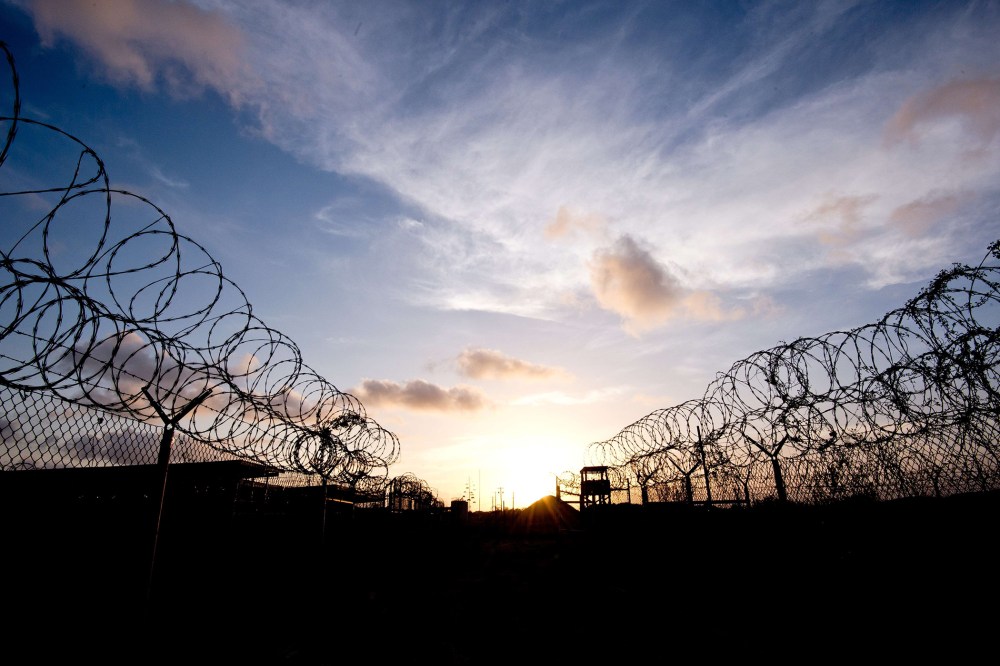
A Kuwaiti man was released Wednesday after being held for nearly 13 years without trial at the military prison at Guantanamo Bay.
37-year-old Fawzi al Odah is the first detainee to go home after taking his case before the Periodic Review Board (PRB), a process by which a committee reviews the conditions and circumstances of prisoners’ detention. He is the seventh Guantanamo prisoner released this year.
The PRBs have been compared to parole board hearings, although the vast majority of the men still held at Guantanamo have never been charged with any crime, let alone convicted. 148 men remain at the island prison, and 79 have already been cleared for transfer or release.
More transfers are reportedly coming, and a recent report from The Wall Street Journal suggested that Obama is once again looking for ways to empty the prison. But time is running out on Obama’s presidency, and with Republicans set to control both houses of Congress for the rest of his term, shuttering one of the most shameful relics of the U.S. war on terror will not get easier.
%22If%20Americans%20could%20see%20the%20truth%20about%20what%20is%20really%20going%20on%20%E2%80%A6%20%5Bthey%20would%5D%20shutter%20the%20prison%20and%20never%20tread%20that%20way%20again.%22′
Obama has been promising to close Guantanamo since he signed an executive order demanding it be shut down on one of his first days in office. He reiterated that promise in a major national defense speech last year, but progress has remained slow. The board that reviewed Odah’s case only began hearing cases last fall, more than two and a half years after Obama signed an executive order to establish the review process.
It’s easy to imagine a scenario in which Republicans use their newly won power to make it harder to close Guantanamo. While Senate Republicans were in the minority, they supported amendments to the National Defense Authorization Act that made it more difficult to transfer detainees from the prison and banned bringing them to the United States. They also fought changes that eased transfer restrictions last year. Senate Republicans were also outraged in May, when Obama traded five Taliban detainees for American POW Bowe Bergdahl without notifying them 30 days in advance.
If Congress puts more restrictions on prisoner transfers, an already slow process could again grind to a complete halt. Releasing prisoners at a faster pace now could help the President prepare for the looming political fight over what to do with prisoners the U.S. does not plan to release.
Republican Sen. Pat Roberts of Kansas spent the last days of his tough reelection campaign railing against the possibility that detainees might be brought to Fort Leavenworth, despite no plans to do so. Regardless of whether the release of Odah is finally the beginning of the end of Guantanamo after years of false starts, the government continues to fight attempts to bring transparency to allegations of prisoner mistreatment. In addition to the ongoing battle over the release of the Senate report on CIA torture, the Obama administration is fighting a judge’s order to release ten hours of footage that shows a hunger-striking Guantanamo detainee being removed from his cell and force-fed. Cori Crider, a lawyer representing Guantanamo detainees for human rights group Reprieve, which is suing for the release of the tapes, told msnbc that releasing more prisoners is necessary, but that the public needs to know what conditions are really like. “It’s a relief to see a Gitmo prisoner finally going home, and I very much hope we see more released before the end of the year,” Crider said in an email. “I also firmly believe that if Americans could see the truth about what is really going on at the base … the majority of them would understand that we need to shutter the prison and never tread that way again. What is happening to the men in Gitmo is a stain on our honor — not just from the bad old days, but today, in 2014. It needs to be closed.”
Meredith Clark
Meredith Clark is a freelance writer and editor. She was previously a senior news producer for "Patriot Act with Hasan Minhaj," a reporter with MSNBC.com, the digital politics and culture editor at Glamour and a senior news and politics editor at Refinery29. She has written for Vulture, Rolling Stone, Self, Marie Claire, Cosmopolitan, The Daily Beast and Bustle. Recommended


