








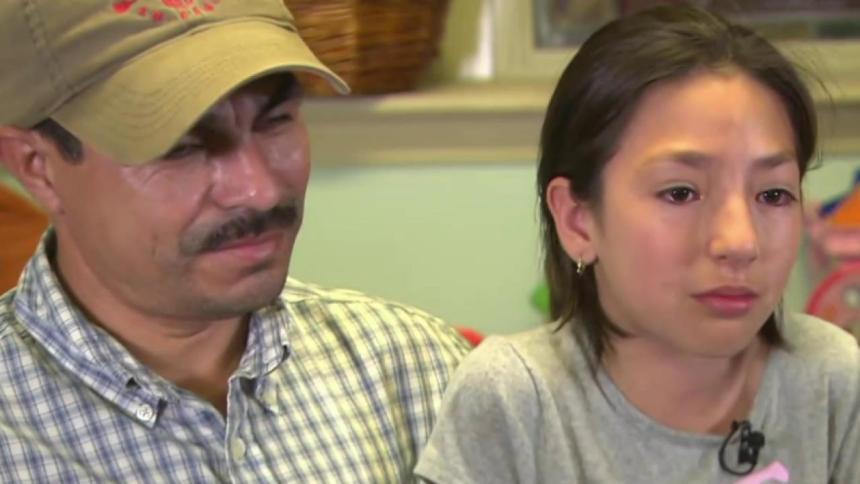
NEW ORLEANS, Louisiana — Melvin Vasquez was just hours away from being deported. He sat in a holding cell — filled with other fathers like him — just steps away from a plane to ship him back to Honduras. He had been detained for weeks, away from his three children, without knowing where he was, or where they were taking him.
But in a dramatic turn, immigration officials last week let Vasquez go.
“It gave me a really beautiful surprise, even made me cry,” Vasquez told msnbc. “I had asked the official if he were to return me to my cell. And that’s when he said, ‘No you’re going home, you’re going to see your kids, your family.’”
%E2%80%9CI%20was%20constantly%20worried%20about%20my%20children.%20I%20didn%E2%80%99t%20sleep%20I%20just%20thought%20about%20their%20future.%E2%80%9D’
While the bulk of President Barack Obama’s executive actions on immigration have been wrangled through the courts for nearly two months, there’s already one key pillar of the measures that has been quietly underway since November: Enforcement of which undocumented immigrants should be deported, and which shouldn’t.
Top administration officials have said they want to deport felons — not families. They have ordered agents in field offices across the country to take into account an individual’s entire story — their families, roots in the U.S. and ties to the community — before immediately deporting them for being in the country illegally.
The father of two American citizens and one DREAMer (an undocumented immigrant brought to the U.S. as a child), Vasquez would have been the first in line for Obama’s executive actions. An arrest for a disturbance that never led to a charge is the only mark on his record, but it was enough for Immigration and Customs Enforcement agents here in New Orleans to pick him up in December, and throw him into detention.
The question is: Why was Vasquez nearly deported in the first place? The deportation guidelines come from the highest political office in the U.S., but they’re not always a reality on the ground. Over the last two months, while the executive actions have been frozen under a court order, families like Melvin’s have slipped through the cracks.
“It was a really hard experience,” Vasquez recalled. “I was constantly worried about my children. I didn’t sleep I just thought about their future.”
***
In the same town where the Vasquez kids have lived, played and gone to school in for years is now at the epicenter of the battle over Obama’s unilateral actions. On Friday, the 5th Circuit Court of Appeals in New Orleans will be taking up a lawsuit brought by Texas and 25 other states that say the measures amount to “executive overreach.” A conservative-leaning three-judge panel will decide whether to lift a temporary hold a Texas judge placed on the program, and allow undocumented families to begin enrollment.
Immigration advocates have feared the legal delays that have gone on since mid-February have had real human costs. In his Nov. 20 address unveiling his sweeping executive actions on immigration, Obama promised to provide more than 4 million undocumented immigrants two major forms of relief: A shield from deportation, and papers to live and work in U.S. lawfully for three years.
Technically, the first portion of deportation relief is already underway with firm directives from Obama and Secretary of Homeland Security Jeh Johnson to focus resources on targeting criminals. But advocates fear the Texas lawsuit has cause confusion over what those directives really mean.
Related: ICE director to face tough questions
Greg Chen, advocacy director for the American Immigration Lawyers Association (AILA), said member attorneys have reported back “widespread” disparities between the policy on paper and what is being practice on the ground.
“There is inconsistent application and an unwillingness to implement the policy,” Chen said.
Gillian Christensen, ICE’s press secretary, said that the policies “remain in full force and effect.”
“ICE officers, agents, and attorneys have been directed to evaluate all cases on an individualized basis throughout the immigration enforcement process to consider any factors that warrant the exercise of prosecutorial discretion when appropriate,” she said in a statement.
Obama encouraged those who would have qualified for the program to continue to gather their papers in preparation for the legal issues to be ironed out. In a town hall event with MSNBC’s Jose Diaz-Balart, Obama reassured the community that Immigration and Customs Enforcement officials would only be targeting criminals and recent border-crossers.
“If you’ve been here for a long time and if you qualify generally, then during this period, even with legal uncertainty, they should be in a good place,” Obama said. But even as Obama said that in late February, another father, Henry Alvarado, was being hauled back to Honduras. The father of four — three American citizens of his own and one U.S.-born stepchild — had been serving time in an immigrant detention center since October after a routine traffic stop outside Corpus Christie, Texas, revealed that he had entered the U.S. illegally. Aside from two minor traffic tickets, Alvarado had no criminal record to his name. His wife, Jenny Rodriquez, went to Washington to tell members of Congress that she was struggling to make ends meet now that it was up to her to take care of her stepchildren on her own. “Things have been incredibly difficult,” Rodriguez said. “Immigration isn’t just going after criminals, they’re going after families — families like mine who have been unjustly divided and separated.” *** Vasquez was met with a homecoming of a packed crowd with more than 200 other parents and their kids piled into a local church Wednesday night, the families on their feet chanting “Sí, se puede” — “Yes we can” — to see him reunited with his kids. New Orleans has seen its Latino population boom in recent years — according to U.S. census data, the Latino community grew 10% between 2010 and 2013. That community had come together for Vasquez’s case, called local the local ICE office, signed petitions and protested for his release — and it worked. “It took a tremendous amount of public outcry, outcry from his family and just general conscious raising in order for him to be released,” said Jolene Elbert, a community organizer with the New Orleans Workers’ Center for Racial Justice. “The fact of the matter is that had that not have happened, he would have been deported back to Honduras last friday.” The community is ready to come together again this week to protest the legal battle over deportation relief that is unfolding in their city. Hundreds plan to gather in rallies outside the courthouse Friday, coming from across the country to show the families that would be able to remain together. Ashley Vasquez, Melvin’s 11-year-old daughter, said she wants others to know about the ordeal that sent her family reeling. “The experience that I had, it hurt me a lot to see that my dad was being taken away,” she said. “And i don’t want other children to feel the same way I felt.”
Amanda Sakuma Recommended


