








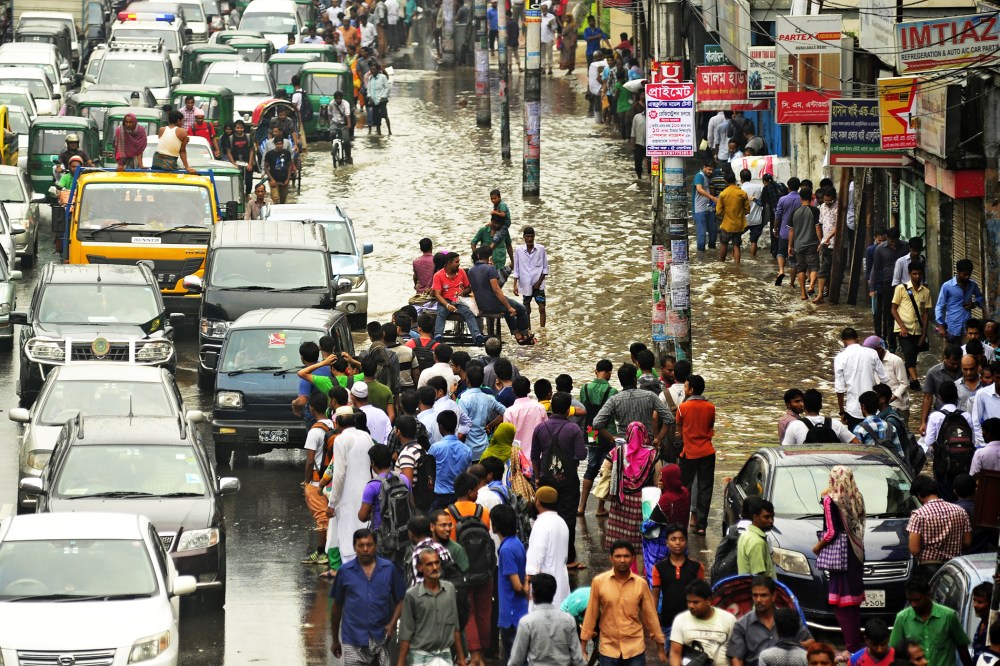
Nearly 400,000 migrants have streamed into Europe this year, setting off the continent’s largest refugee crisis since World War II. But the tide of desperation is nothing compared to the flood of environmental refugees that could be created by unchecked climate change, experts and elected officials warn.
President Obama set the tone in a speech last week in Alaska, where he summoned images of “desperate refugees,” “entire industries of people who can’t practice livelihoods” and “political disruptions that could trigger conflicts around the world.” Secretary of State John Kerry dubbed them “climate refugees,” and warned of a global fight for food, water and “mere survival.”
Now, less than 100 days before a major climate change summit in Paris, the president of France is sounding the same alarm.
%22…%20it%20won%E2%80%99t%20be%20hundreds%20of%20thousands%20of%20refugees%20in%20the%20next%2020%20years%2C%20it%20will%20be%20millions.%E2%80%9D’
“There is a risk of failure,” François Hollande said on Monday, following a meeting aimed at securing financial support for poor countries most affected by climate change. “If we don’t conclude [with a successful agreement], and there are no substantial measures to ensure the transition, it won’t be hundreds of thousands of refugees in the next 20 years, it will be millions.”
That’s not just political hot air. Kerry, Obama and Hollande are supported by some of the world’s foremost experts in national security.
David Titley, the former oceanographer of the U.S. Navy and a current member of the CNA Corporation Military Advisory Board, has warned that climate change-induced drought helped spark the Arab Spring, Syria’s civil war, and a roiling storm of related regional clashes.
RELATED: The $100 trillion climate question
In a report published last year, he and his co-authors also found that rising sea levels could swamp parts of India, Bangladesh and Vietnam, sending millions of people westward in search of a new life.
“Failure to think through these scenarios is nothing less than a failure of imagination,” he wrote in an email to MSNBC. “Furthermore, these climate impacts rarely happen in a vacuum. They are frequently exacerbated by poor governance, pre-existing grievances within that society, or economic and ethnic conflict. Collectively, the end result is instability and a significant security issue.”
His former colleagues in the Pentagon tend to agree. In the Department of Defense’s 2014 Quadrennial Defense Review, its official outline of global priorities, the Pentagon’s planners declared climate change to be a “threat multiplier,” stirring trouble in all sorts of ways.
“The pressures caused by climate change will influence resource competition while placing additional burdens on economies, societies, and governance institutions around the world,” the study states. “These effects are threat multipliers that will aggravate stressors abroad such as poverty, environmental degradation, political instability, and social tensions.”
In recent years, people with “.mil” domains — official U.S. military addresses — have been accessing more federal climate data in general. In January of 2012, for instance, the largest set of federal climate data got 155,000 hits from “.mil” domains. By this past January, the number of hits had nearly doubled, to 293,000, according to Scott Hausman, a former Air Force climatologist. “They want to know, what’s going to be the next drought area of the world? They want to know about the potential for climate-related unrest,” Maj. Ryan Harris, the director the Pentagon’s lead office for combat climatology, recently explained to MSNBC. “There’s a higher interest in all that for sure.” “When are the guys with the machetes going to come in from the east?” added climatologist Ray Kiess, referring to the destabilizing potential of extreme weather. “That’s the kind of question they want answered.” RELATED: Obama warns ‘we’re not moving fast enough’ on climate change About 2,800 migrants have died this year trying to cross into western Europe. Millions more are languishing in camps in Turkey, Lebanon, Jordan, Turkey, Libya, and Hungary. Most likely none of them would cite “carbon emissions” as the cause of their quest. They are fleeing ISIS in Iraq, civil war in Syria and smoldering conflicts in Afghanistan. But as Europeans debate how to absorb these people, they might want think about climate change as well. In a future of sinking cities and desiccated crops, the next wave of migrants could be seeking asylum from another kind of violence entirely.
Tony Dokoupil Recommended


