








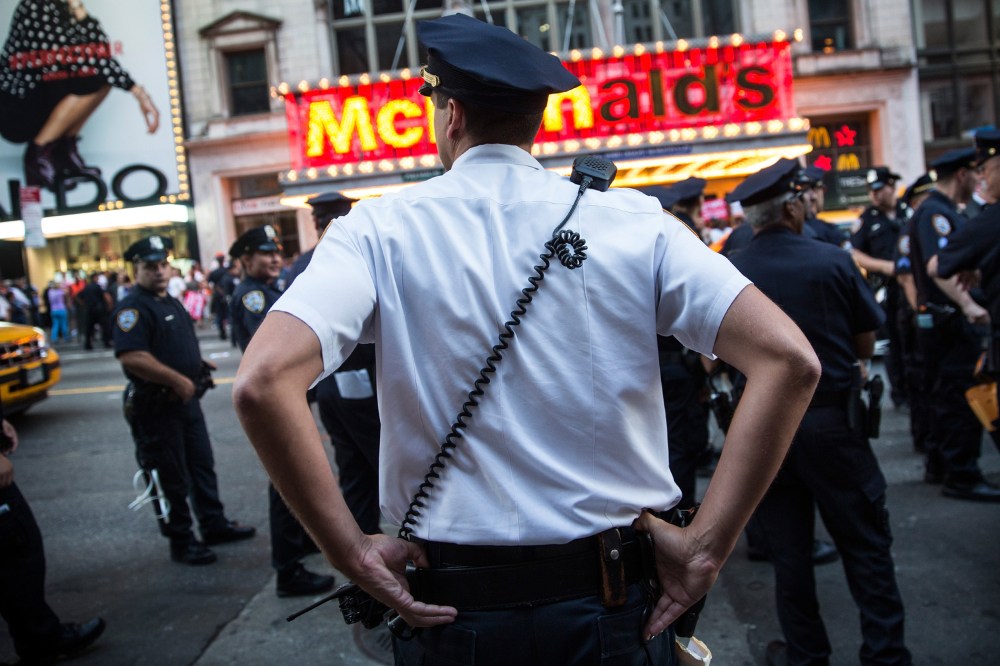
Just months after the choking death of Eric Garner at the hands of New York City police officers, the NYPD’s commissioner has called for a “fundamental shift in the culture of the department.”
Commissioner Bill Bratton, the head of the nation’s largest police force, testified during a city council hearing Monday that the NYPD is looking for ways to bolster training in the use of force for patrol officers and that the department is committed to addressing concerns that officers disproportionately stop and use force against black and Latino residents.
“We are committed to constitutional and respectful policing,” Bratton said during the hearing.
Garner’s chokehold killing by an NYPD officer in mid-July after he was stopped for selling “loosies,”— single, untaxed cigarettes—sparked anger and greater scrutiny of the department’s bolstered broken windows policing strategy, in which officers aggressively attack minor offenses with the aim of suppressing other crimes.
The strategy, a hold-over from the uber-violent New York City of decades past, was invigorated by Commissioner Bill Bratton, who in the 1990s served as commissioner under Mayor Rudy Giulliani and was an original architect of broken windows.
Garner’s killing, ruled a homicide by the medical examiner and the police killing of teenager Michael Brown in Ferguson, Mo. on Aug. 9, has sparked national outrage and a call for greater accountability on the part of police who kill civilians.
Both Garner and Brown were African-American and unarmed at the time of their deaths.
“If you don’t address the race and class issues, which are at the core of the issues between the police and the community, and if you don’t focus on the history there you’re not addressing the fundamental problems,” said Jumaane Williams, a New York City councilman who represents Brooklyn and sits on the council’s public safety committee.
Mayor Bill de Blasio was elected on a campaign that rejected controversial police tactics like stop-and-frisk, an outgrowth of broken windows policing that flourished under the previous administration. The tactic disproportionately targeted young black and Latino men for random stops and searches. Supporters and critics alike of de Blasio’s have called for a more thorough review of the department’s use of force procedures as well as greater insight into demographics of New Yorkers most often subject to stops and police use of force.
“It was evident to me and Mayor de Blasio at the time of my appointment as police commissioner that there was a need for a fundamental shift in the culture of the department,” Bratton said during the hearing, according to reports. “From an overarching focus on police activity, as measured in the number of stops, summonses and arrests, to an emphasis on problem solving in the community.”
Bratton said that he plans to launch a pilot program that would include additional training for officers on the use of force and that he hoped to expand the program from three precincts in November to include more than 20,000 patrol officers. The commissioner also said that he is consulting the heads of other big-city police departments across the country on new ideas on how to retrain police officers and that he’s looking for overtime money to pay officers to take additional training sessions.
“The verbal and physical tactics necessary to assess and control a situation are perishable skills. We cannot reasonably expect police officers to maintain those skills on the basis of training they received as academy recruits without regular refreshers.”
Councilman Williams said that while there are a number of outstanding concerns over the NYPD’s strategies and tactics, particularly around how black, Latino and poor communities are policed, today marked a bit of progress.
%22If%20you%20don%E2%80%99t%20address%20the%20race%20and%20class%20issues%2C%20which%20are%20at%20the%20core%20of%20the%20issues%20between%20the%20police%20and%20the%20community%2C%20and%20if%20you%20don%E2%80%99t%20focus%20on%20the%20history%20there%20you%E2%80%99re%20not%20addressing%20the%20fundamental%20problems.%22′
“I wish they would address the issues with broken windows in terms of the historical issues of race and class. That will get us closer to where we want to be,” Williams told msnbc minutes after Bratton concluded his testimony to the council. “Before, we couldn’t even get acknowledgement of what the problems are on the ground. At the minimum, there is an acknowledgement that there needs to be a cultural shift in the NYPD,” he said. “I think we still have some way to go in addressing some of the things going on now, but at least there’s an acknowledgement that race and class has historically played an issue here.”
Williams said he asked Bratton directly if he thinks issues of race and class factored in to the way people are policed in the city, and that Bratton said those issues have an impact on the city and precinct level as much as they do elsewhere in the country. This to Williams was a long awaited affirmative.
“If we don’t deal with the central issues we are going to fall into historical patterns,” Williams said. “Everything else is overlaid that pattern. Unless we deal with race and class, anything you put on any of these strategies is going to be a problem.” The abuses of stop-and-frisk and broken windows are inherently issues about the violation of the rights of black and brown residents, he said.
During the hearing, Williams said he cited data on summonses issued to people for riding bicycles on city sidewalks and pointed to statistics from three different police precincts. Between 2008 and 2011, he said police issued an average of eight summonses in a largely white, upper-income precinct in Parke Slope, Brooklyn. During the same time period police issued an average of 1,000 and 2,000 summonses in largely black, largely poor nearby precincts in the Brownsville and Bedford-Stuyvesant neighborhoods.
Ahead of Monday’s hearing, the New York Civil Liberties Union submitted testimony to the City Council demanding “increased oversight and transparency” regarding the NYPD’s use of force, officer training and violations enforcement.
“Eric Garner’s tragic death highlights the disastrous consequences of NYPD policies that aggressively target low-level nonviolent offenses and rely on excessive force,” said NYCLU Executive Director Donna Lieberman. “Black and Latino New Yorkers are more likely to be the subjects of force than their neighbors. The City Council must act today to bring transparency, oversight and accountability to the Police Department’s training and enforcement priorities. It’s time for the NYPD to abandon broken windows policing and to make training in de-escalation tactics a key part of police training.”
As part of the NYCLU’s testimony to the council, the group urged the council to “put an end to the NYPD’s needlessly aggressive enforcement of nonviolent, noncriminal infractions, such as selling untaxed cigarettes, possessing an open container of alcohol, riding a bicycle on the sidewalk, and possessing small amounts of marijuana.”
Candis Tolliver, assistant advocacy director for the NYCLU, sat through and testified at the council hearing. She told msnbc that one of the more concerning takeaways from Bratton’s testimony was that police officers are only trained on the use of force once, during their training at the police academy and that there is no other mandated training after they’ve graduated to full-fledged officers. Tolliver called the revelation “very troubling.” At one point, in light of Garner’s death by chokehold, a maneuver banned by the department more than 20 years ago, a councilmember asked Bratton if he’d support legislation that would make chokeholds by police illegal. He said that he would not and that a department ban was enough. Tolliver allowed that Bratton’s testimony was extraordinarily open and blunt and that “it was almost alarming how honest he is being.” Still, she said there needs to be more insight and oversight into the NYPD’s use of force practices. Over the last decade, as murder and other major crimes including aggravated assault, rape and robbery have all dropped significantly in New York City, summonses for petty crimes and misdemeanor arrests have skyrocketed. Those arrests include mostly violations for possession of small amounts of marijuana possession, traffic infractions and noncriminal offenses. The surge has mostly been fueled by stops of young men of color who have been disproportionately targeted by police. %22Eric%20Garner%E2%80%99s%20tragic%20death%20highlights%20the%20disastrous%20consequences%20of%20NYPD%20policies%20that%20aggressively%20target%20low-level%20nonviolent%20offenses%20and%20rely%20on%20excessive%20force.%22′ According to a report by the State Attorney General’s Office, just 1.5% of all stop-and-frisk arrests resulted in a jail or prison sentence. Just one in 50 stop-and-frisk led to arrests, 0.1%, concluded in a conviction for a violent crime or possession of a weapon. Close to half of all stop-and-frisk arrests did not result in a conviction.Though the practice has waned under the administration of Mayor de Blasio, so-called broken windows policing has flourished. Critics call it “stop-and-frisk light,” with less random stops but ramped up aggression in policing low-level crimes. The NYPD’s stop-and-frisk database indicates that blacks and Latinos were much more likely to be stopped than whites and also significantly more likely to have force used against them, 23% more likely in fact. About 81% of the complaints filed with the Civilian Complaint Review Board were made by blacks and Latinos, much of which were for allegations of excessive use of force by police. A federal judge has ruled that the NYPD’s use of stop-and-frisk violated the rights of the black and Latino men who were targeted by officers. As part of the judge’s findings in a federal lawsuit brought against the city and the department, a federal monitor will be assigned to the NYPD and some police officers will be outfitted with body cameras. Just last week, the first round of 60 officers was outfitted with the cameras. The NYCLU said the ramped-up encounters between police and innocent or minor offenders driven by such police tactics “have the potential to turn violent and even deadly as in the case of Mr. Garner.” “The Council should seriously consider whether New Yorkers should be subjected to serious penalties for these minor violations,” the civil liberties union said in its letter. “What we wanted from today was answers,” Tolliver said, moments before delivering testimony to the council on behalf of the NYCLU. “We wanted to know more about how police are trained in the use of force and we wanted to make it clear to folks that we need to know who force is being used against. We have data that force is most likely used on black and Latino New Yorkers. We need to know more about what they are doing and how they will be held accountable when” when someone is hurt or killed. “We still need way more answers around the accountability aspect,” she said. “We need more accountability, we need more oversight and we need it now. We don’t have time to wait.” According to Tolliver, when pressed about racial data the department has gathered around stops and use of force, Bratton said the NYPD had stopped gathering that type of data before he took over and that he wasn’t sure exactly why. But analysis of police stops and the frequency in which those stops result in use of force by police offers a startling glimpse into how often routine stops escalate into the use of force by officers. During a 10-year span between 2003 and 2013, police officers self-reported 1,381,843 acts of force in 4,984,393 stops. “This extraordinary number of acts of force self-reported by officers is particularly alarming when one considers that nearly 90 percent of stops during this period were of innocent people –people who were neither issued a summons nor arrested,” the NYCLU said its statement. The NYCLU’s recommendations to the council include a demand for transparency around simple violation enforcement and demographic data, a requirement that the police disclose the frequency and content of officer training on use of force. The group also called for increased oversight of use of force training and that the NYPD create “opportunities for stakeholders to weigh on proposed changes or new trainings, and ensuring the NYPD is adopting best practices in its training and policies.”
Trymaine Lee
Trymaine Lee is an NBC News correspondent. Recommended


