








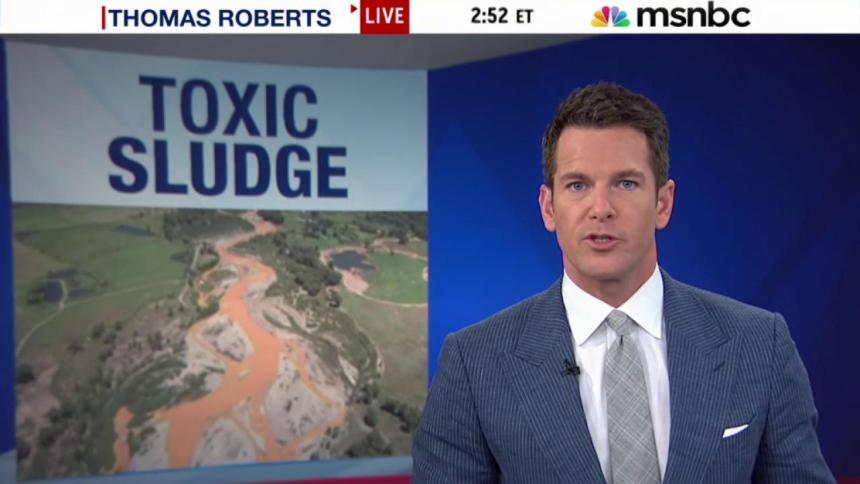
For almost a week, a torrent of toxic sludge — the color of hot mustard and rife with poisonous metals — has been flowing through Colorado, Utah and New Mexico. On Monday, the governor of Colorado declared a belated state of emergency, as officials announced that the popular Animas River would remain closed until at least August 17.
The Environmental Protection Agency was on the scene faster than usual, containing the spill and starting the cleanup process. That’s the good news. The bad news is that the EPA caused the spill in the first place.
RELATED: Rio’s not alone. How clean are America’s beaches?
“We’ve launched an independent investigation to see what happened and we’ll be taking steps to ensure that something like this doesn’t happen again,” Shaun McGrath, the EPA administrator in charge of the region, told reporters on Monday.
At a public meeting on Friday, David Ostrander, the EPA’s regional director of emergency preparedness, struck an even more contrite tone. “It’s hard being on the other side of this,” he said. “We typically respond to emergencies. We don’t cause them.”
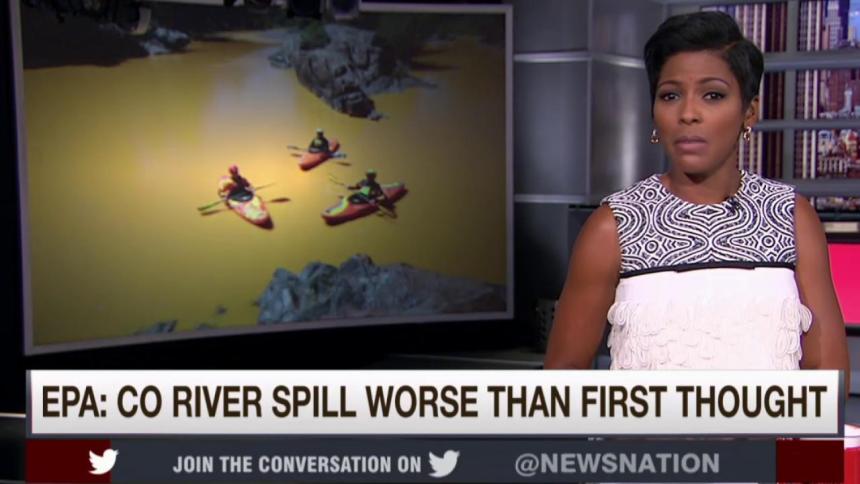
The spill is a costly and ill-timed error for Mother Nature’s premier federal defender. By law, the agency has to pay off people who suffered personal injury or property damage as a result of governmental actions, and there’s likely to be a number of those claims.
On Wednesday morning, the EPA now admits, more than 3 million gallons of errant goo slid out of a dormant gold mine and into the Animas River. That’s three times as much as original estimates.
But the appearance of incompetence is likely to make this spill a political headache, too. It comes as the agency is already under broad attack for its role as the muscle behind President Obama’s Clean Power Plan, and, indeed, much of the administration’s broader plan to combat global warming.
So far, the EPA has said very little about the cause of the spill, and it declined msnbc’s request for additional comment. Officials acknowledged that the spill was triggered while an EPA-supervised crew was working near Silverton, Colorado, in the southwest part of the state.
Fluid from inside the Gold King Mine, shuttered since 1923, has been leaching into the surrounding area. That mine alone was a slow motion disaster, in the EPA’s opinion, and the area is shot through with dozens of similarly toxic wells. It’s so bad that the EPA has tried to declare the area a Superfund site — clearing the way for an ambitious clean-up.
But after local opposition, the agency opted for a more modest, incremental plan. A crew would slurp out the worst pools of sludge and dispose of them properly. That was the goal near Silverton when heavy equipment somehow disturbed an earthen wall that secured the liquid, releasing an up to 80-mile ribbon of pollution downstream.
RELATED: Obama unveils ‘biggest step we’ve ever taken’ on climate The extent of the damage was still unknown late Monday. The orange color had dissipated, but it left behind layers of sludge in some places and a plume of toxins still cruising downriver. The most worrisome pollutants are arsenic and lead, which respectively peaked at 300 times and 3,500 times the normal levels, according to EPA test results released on Friday. In nearby Durango, Colorado, the mayor assured people that the water was safe to drink because the city shut off its intake valve from the Animas. But farmers, tribal leaders and municipal officials elsewhere closed wells and switched thousands of residents to alternative sources of water as a precaution. Seven water systems in New Mexico and Colorado have been affected, officials said, and the Animas River ultimately connects with the Colorado River — a source of drinking water for much of the West. The less calculable costs, of course, are all psychological. The beauty of the Animas River was the backdrop for parts of the film “Butch Cassidy and The Sundance Kid,” and thousands of tourists ride down it on kayaks or paddle boards every year. “The river for us is an integral part of our community,” state Sen. Ellen Roberts, who represents Durango, told msnbc on Monday. “It’s where people get married. People do their own private ceremonies along there. It’s our daily life.”
Tony Dokoupil Recommended


