








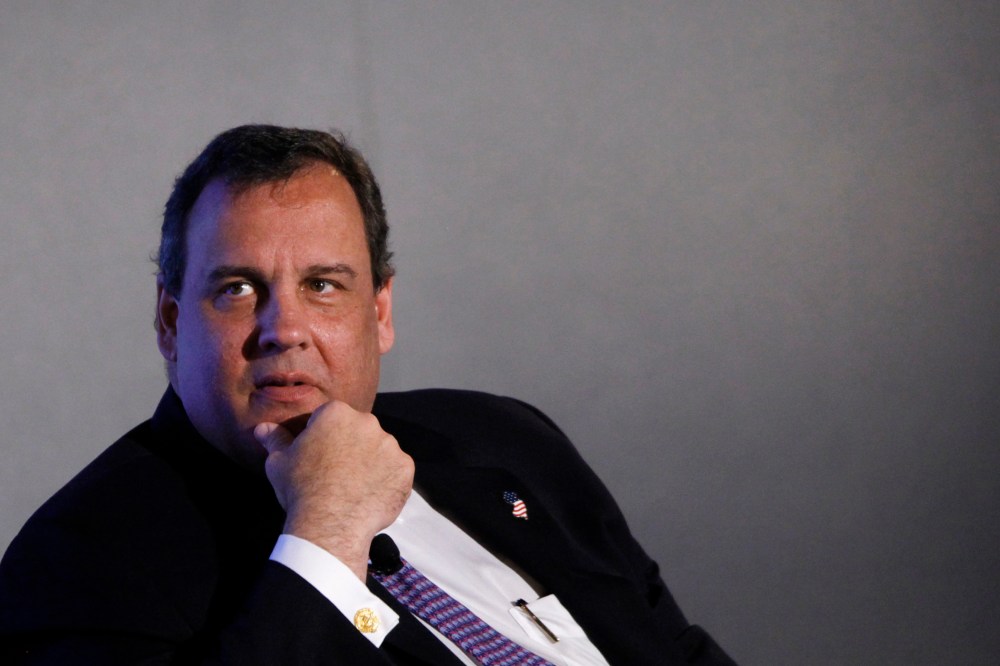
GLASSBORO, N.J. – Embattled New Jersey Governor Chris Christie told graduating students at Rowan University on Friday morning that while their diplomas will open doors, it won’t guarantee success.
What matters, Christie said, is “how hard you’re willing to work.”
The Republican was invited to deliver the 2014 commencement address at the southern New Jersey school despite student and alumni complaints. A petition to Rowan University on change.org asking the school not to celebrate the Republican with an honorary degree or with the privilege of being the keynote speaker garnered nearly 3,000 signatures by Friday morning.
“No governor in N.J. history has been more adversarial to teachers and public education than Chris Christie,” the petition reads. “His policies have damaged public education and the teaching profession as a whole. He is not deserving of this honor from Rowan. “
Petitioners also pointed to the fact that Christie’s administration is under state and federal investigation concerning the September George Washington Bridge lane closures, orchestrated by some of his staffers and allies, seemingly for political retribution. Half a dozen protesters, who identified themselves as Rowan students, were booted from one of the governor’s town halls in March after they interrupted Christie on a number of issues, including so-called “Bridgegate.”
But Christie’s speech was met with calm. The “free speech zone” — a university-issued tent under which protesters could gather — had no one under it during the start of the ceremony. And at the end, he received a standing ovation.
The governor centered his 15-minute remarks on the personal story about his grandmother, who was born on a boat coming from Italy to the United States. She received no education beyond middle school and was put into an arranged marriage at a young age. After finding out her husband had been cheating on her, Christie’s grandmother kicked her spouse out of their home and filed for divorce – atypical in the early 1940s.
Christie recounted his grandmother’s commitment to hard work and family. She got a job at the Internal Revenue Service in Bloomfield, N.J. (a two-hour commute) and depended on her 10-year-old daughter to take care of herself and two other siblings. They may have been poor, but their life felt full, said Christie.
“She taught me that your life is not determined by what you don’t have, but what you’re willing to do,” the governor said.
Christie was supposed to speak in front of the approximate 2,200 graduates at the school’s stadium, but due to rain, the governor delivered his keynote address and received his honorary degree of law at the school’s smaller, Pfleeger Concert Hall, where approximately 130 seniors majoring in mechanical engineering received their diplomas.
Though students complained after the school announced that Christie would be their keynote speaker, many on Friday said at the end of the day, it didn’t make a difference.
“It’s about us. It’s our day, no matter who is speaking,” said graduating senior Sarah Dores, 22, of Maple Shade, N.J.
Others like Sarah Schanck, another graduating senior, said Christie’s visit put a cloud over what should be a celebratory day. She noted several students she knew were debating not going to their ceremony because Christie was headlining.
“This is about celebrating our achievements but it’s not as happy because there are a lot of mixed feelings on campus,” said the 21-year-old from Hollywood, Maryland.
Several high-profile commencement speakers backed out of headlining ceremonies this month following protests by students and faculty. That includes former Secretary of State Condoleezza Rice at Rutgers University after student demonstrators railed against her role in the 2003 Iraq War. International Monetary Fund managing director Christine Lagarde canceled her May 18 appearance at Smith College, citing anti-IMF protests from faculty and students. And on Tuesday, Robert Birgeneau, the former chancellor at the University of California-Berkeley, withdraw as a 2014 commencement speaker at Haverford College. Birgeneau is known as an advocate for minority and undocumented students. But during his tenure as chancellor, he came under fire for how Berkeley’s police force responded to Occupy protests in 2011.
While some applauded the speakers’ cancellations, others have criticized students for not creating a culture that’s friendly toward free speech.
University spokesman Jose Cardona said Christie was not paid to deliver the remarks and was being considered by the school to be a commencement speaker for almost a year because of his support for school and his commitment to higher education. “We’re not surprised by the reaction of people,” said Cardona. “But it is what it is. No matter who is the governor, there is going to be people on both sides of the issue. He’s the kind of speaker people want to hear. He’s a dynamic speaker.” Citing his no-nonsense reputation, Cardona said he never questioned if Christie – who once led the GOP pack in the nascent race to be the GOP presidential nominee — would back out of delivering his speech like Rice, Lagarde and Birgeneau. “He’s not a guy that’s going to pull out. He’s not a guy that’s going to shy away from anything,” Cardona said. “We knew as soon as we asked him – unless a major event happened – he would be here.” The same could apply to Christie’s political agenda. Despite the governor’s popularity taking a hit since the lane closure scheme erupted — a recent Washington Post/ABC News survey showed Christie ranking fifth among a field of possible contenders for the 2016 Republican presidential nomination — on Wednesday, Christie told CBS News’ Bob Schieffer at the Peter G. Peterson Foundation’s annual fiscal summit that he didn’t think his recent troubles would impact his future political plans. “I’m not the first chief executive who had someone on their staff do something they didn’t know something about they disapproved of and later had to fire them,” Christie said. “I don’t think that that hurt anybody’s career and it’s not going to hurt mine.” In continuing the story of his grandmother, Christie recounted spending time as a child going to the library, museums, operas and mass with her. He said he wasn’t allowed to watch television on the weekend with her except to watch one college football game and Meet The Press on Sunday. Christie noted that his grandmother, who passed away at the age of 92, would have turned 100 the year he became governor. “I know today that my grandmother looks down and shakes her head, often probably at some of the things that come out of my mouth,” he joked. He ended telling the students: “I believe you too can experience a great American life, just like my grandmother did.” Recommended


