








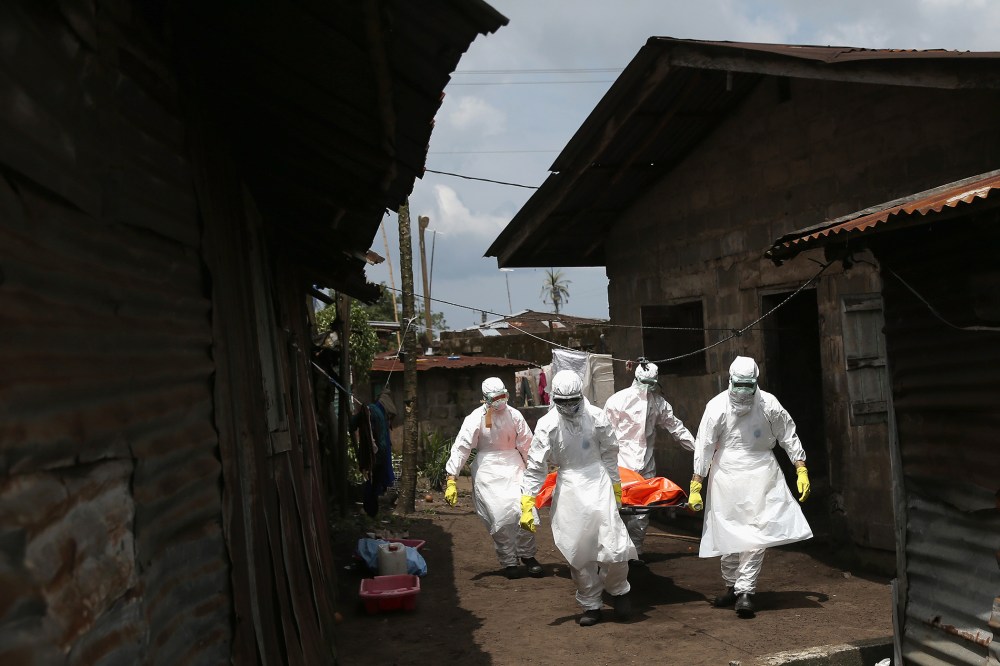
By the end of this year, there will be 5,000 to 10,000 cases of Ebola per week in Guinea, Liberia, and Sierra Leone, the World Health Organization (WHO) reported Tuesday.
The three countries have been ravaged by the disease, with the outbreak disrupting the food trade—a United Nations official reported Monday that up to 40% of farms have been abandoned in hard-hit areas in Sierra Leone, creating food shortages as trade volume in the market is half of what it was a year ago—and killing thousands and overwhelming existing public health infrastructures.
The current outbreak, which began in April, is the worst to be record; it’s already killed 4,000 according to WHO, but the estimate suggests the outbreak is about to worsen dramatically.
U.S. hospitals are currently treating two patients with Ebola; one in Dallas, where Nina Pham, a nurse who treated the first person to die of Ebola in the U.S., is being treated for the disease, and the second, an NBC News freelance cameraman who is being treated in Nebraska. Pham is the seventh American to be diagnosed with Ebola. A half dozen others came before her, with at least one confirmed fatality.
Despite Pham’s contraction of the disease, Center for Disease Control officials swear the protocols work and the disease will be managed in the U.S., saying she contracted the disease because there was a breach in the protocols. Still, suspected cases of the virus are popping up across the United States as public fear grows. On Monday, three patients were evaluated for the deadly virus in three states.
Kansas University Hospital officials have placed a man into isolation while awaiting the results of Ebola tests, officials said Monday. The patient—a medic who had recently worked in West Africa treating locals for the virus—admitted himself to the hospital with flu-like symptoms. Despite his exposure, officials described his case as “a low risk patient.”
Photo essay: Ebola continues its deadly march In Jacksonville, Florida a patient with flu-like symptoms was isolated and tested for Ebola “on the basis of self-reported casual contact with a West Africa traveler,” according to the hospital. In Boston, Massachusetts on Monday, a patient who had recently traveled to Liberia was evaluated for Ebola and deemed not to have the virus. In both cases, it’s unlikely the patients were at risk or contracted the virus, but it’s clear that the fear—and the mistakes made in the Dallas case, when an Ebola patient, Thomas Eric Duncan, was sent home after visiting the hospital before being diagnosed and later dying—have left Americans and their hospitals using extreme caution when it comes to the virus. Elsewhere, a nurse who contracted the disease treating a patient in Spain is also being treated for the disease; in Germany, the Associated Press reported that a 56-year old Sudanese member of the United Nations’ medical team stationed in Liberia died of Ebola three days after arriving in Europe.
Jane Timm Recommended


