








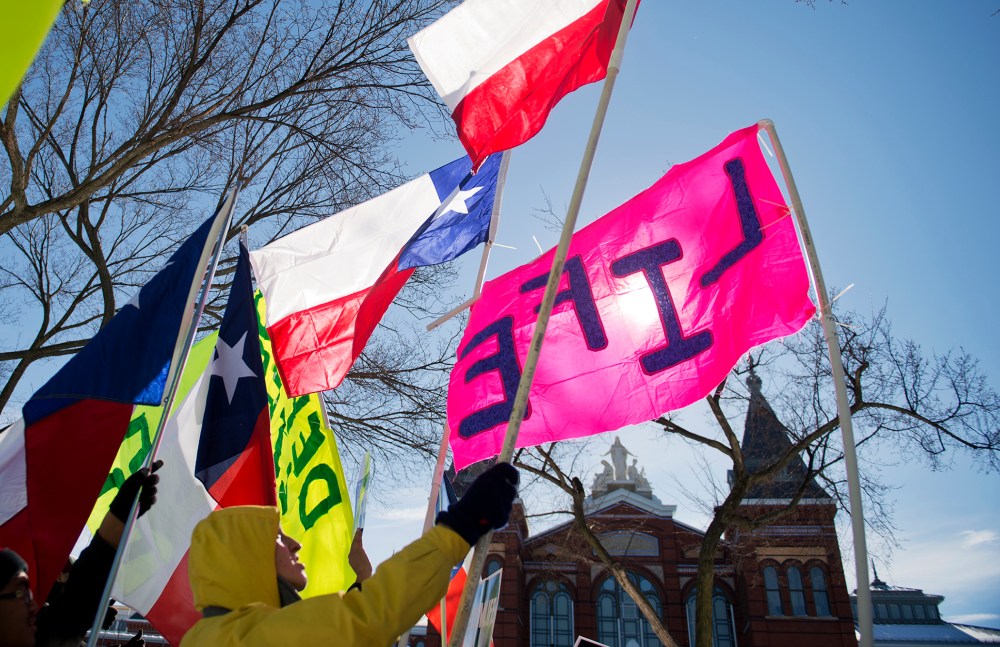
Texas may enforce its law requiring that abortions only take place in mini-hospitals, a three-judge federal appeals court panel ruled Tuesday. The decision will likely leave only seven or eight abortion clinics in a state with 5.4 million women of reproductive age. If allowed to stay in place, the law would have by far the most devastating effect on abortion access of any law in recent history.
“In plain terms, H.B. 2 and its provisions may be applied throughout Texas,” the panel wrote in an unsigned opinion. That means that the provision requiring that abortions only take place in ambulatory surgical centers, temporarily halted by the Supreme Court in October 2014, can go into effect. The ruling does not take effect immediately, but plaintiffs have already said they’ll ask the Supreme Court to stop the law again.
A district court judge found after a trial that the law was intended to block women’s access to abortion, which is unconstitutional, and that the law was medically unnecessary. But the appeals court opinion took at face value Texas’ stated justification for the law, which is that it was intended to protect women’s health.
RELATED: 42 years after Roe v. Wade, women’s reproductive rights in danger
According to a map maintained by the advocacy group Fund Texas Choice, there were 20 abortion clinics in Texas in October. Eight clinics currently have facilities that comply with the law — which major medical organizations say is medically unnecessary — including one Planned Parenthood will soon open in San Antonio. Another clinic that is not an ambulatory surgical center, Whole Woman’s Health in McAllen, Texas, that was allowed to stay open under the Supreme Court order will close if the highest court does not block the law a second time.
Texas Gov. Greg Abbott hailed the decision. “This unanimous decision is a vindication of the careful deliberation by the Texas Legislature to craft a law to protect the health and safety of Texas women,” said Abbott in a statement. “I am pleased with the 5th Circuit’s decision to uphold H.B. 2 and the State of Texas will continue to fight for higher-quality healthcare standards for women while protecting our most vulnerable — the unborn.”
“We now look to the justices to stop the sham law shutting down clinics,” said Stephanie Toti, an attorney for Whole Woman’s Health with the Center for Reproductive Rights. The Supreme Court has not yet ruled on the merits of any part of Texas’ abortion law, only stopped it from taking effect while the 5th Circuit fully considered it. The justices were not asked to hear an earlier Texas requirement that all abortion providers have admitting privileges at local hospitals, which has already halved the number of abortion clinics in the state, though they are considering whether to take a challenge to a similar law in Mississippi. The 5th Circuit opinion points out that in its most recent abortion decision, Gonzales v. Carhart, Justice Anthony Kennedy wrote for the majority, “Medical uncertainty does not foreclose the exercise of legislative power in the abortion context any more than it does in other contexts.” Kennedy would again be the swing vote when the case goes back to the Supreme Court. Texas passed the law in 2013 in a special session, following a filibuster from then-Sen. Wendy Davis.
Irin Carmon Recommended


