








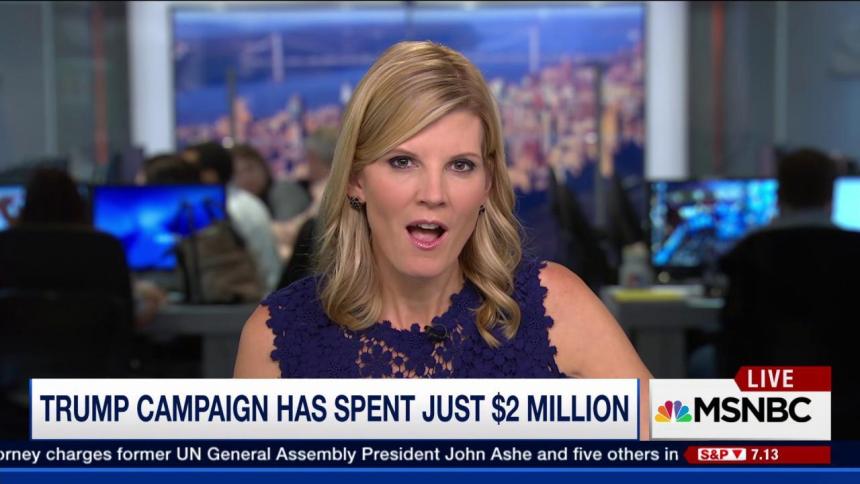
Many Republicans have tried and failed to win the presidential nomination without support from the party establishment. Donald Trump argues he is different from those hopefuls because his wealth enables him to fund an insurgent campaign all by himself. But for all the talk about his money, so far, Trump isn’t using it.
Trump campaign officials say he has only spent about $2 million — far less than fellow GOP candidates Dr. Ben Carson and Sen. Ted Cruz, for instance. each spent $5.5 million just through July, according to the latest FEC reports. Hillary Clinton’s campaign, meanwhile, spent $18 million in the same period; that’s nine times Trump’s entire spending to date.
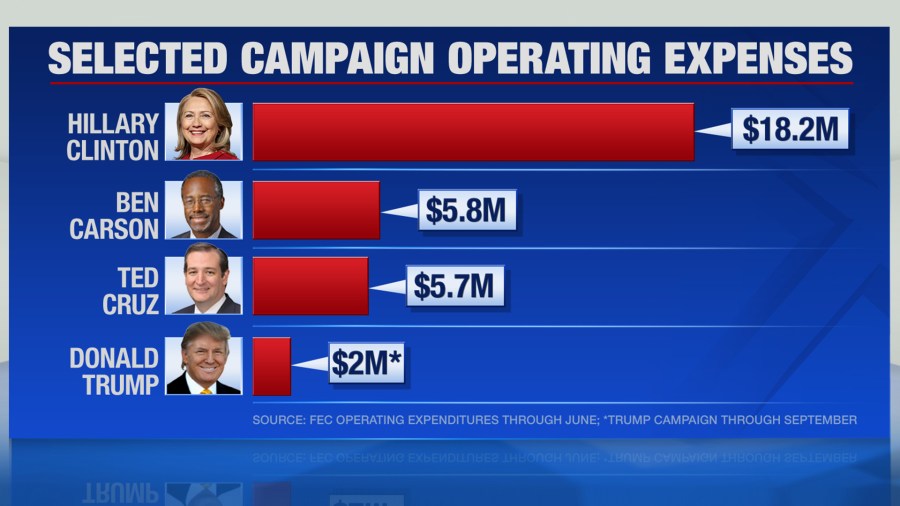
Politicos and reporters often cast Trump as a self-funded outsider candidate, assuming he will follow the pricey campaign model of businesspeople like Meg Whitman and Michael Bloomberg, each of whom spent $100 million of their own money on a single race. Three months into Trump’s unusual campaign, however, the evidence suggests his candidacy remains largely buoyed by his celebrity status and free press, not his actual wealth.
RELATED: Donald Trump backs out of Q&A with Hispanic Chamber of Commerce
Leading news organizations have covered Trump’s brash campaign more than any other candidate. According to a September tally by the Tyndall Report, Trump drew 43% of all GOP coverage on network news this year, despite his late entry into the race. Experts say Trump’s celebrity status yields coverage that money can’t buy.
%E2%80%9CI%E2%80%99ve%20been%20around%20the%20business%20for%2050%20years.%20I%20haven%E2%80%99t%20ever%20seen%20a%20candidate%20get%20this%20kind%20of%20attention%20over%20this%20sustained%20period%20of%20time.%E2%80%9D’
Ed Rollins, former political director for Ronald Reagan, says it would have cost “$100 million, easily, to get the attention Trump” generated since entering the race. “I’ve been around the business for 50 years,” Rollins told MSNBC, “I haven’t ever seen a candidate get this kind of attention over this sustained period of time.”
Even Trump acknowledges he’s been able to run on the cheap. “I’ve gotten so much free advertising,” he told The New York Times. “When you look at cable television, a lot of the programs are 100% Trump, so why would you need more Trump during the commercial breaks?” he asked.
This approach to political attention is a clear extension of Trump’s business strategy, which he outlined in his 1987 bestseller “The Art of the Deal.”
“From a pure business point of view, the benefits of being written about have far outweighed the drawbacks,” he writes, contrasting the cost of a $40,000 real estate ad in The New York Times to generating press coverage of the same real estate project.
“If The New York Times writes even a moderately positive one-column story about one of my deals, it doesn’t cost me anything,” he argues, “and it’s worth a lot more than $40,000.”
While many commentators analyze Trump’s media strategy on emotional terms – a thirst for attention – the book outlines its financial benefits, proposing that generating “a lot of attention” will “create value” for a project.
RELATED: CNBC sets bar for upcoming GOP presidential debate participation
Trump’s near-total reliance on this strategy today — riding a wave of free media — suggests his candidacy at this stage is powered by fame rather than money. The model is more Arnold Schwarzenegger than Michael Bloomberg — but it probably can’t last.
His frugality is at odds with the mogul’s message on the campaign trail. Trump tells voters he is using his personal wealth to win and, unlike every other rival, that he can self-fund and never “owe” donors or special interests. Yet his willingness to spend big money hasn’t been tested, and his discount approach to campaigning, while clearly effective in the pre-season, still faces a time limit.
%E2%80%9CA%20Super%20PAC%20is%20going%20to%20come%20in%20before%20New%20Hampshire%20or%20wherever%2C%20and%20hit%20him%20with%20%2410%20million%20of%20negative%20attacks%2C%20and%20he%E2%80%99s%20going%20to%20have%20to%20respond%20in%20some%20way.%E2%80%9D’
He is on a collision course with certain unavoidable costs of a long primary campaign.
In the 2008 GOP primary, for example, candidates spent about $48 million on ads, according to the Wesleyan Media Project. Mitt Romney spent $42 million of his own money that year, $28 million of which went toward ads.
Some advertising has since shifted to super PACs; Jeb Bush’s curent super PAC has $103 million, and it announced a $24 million advertising campaign last month.
That massive spending, including potential attack ads down the road, could press Trump to spend his own fortune in response.
“A super PAC is going to come in before New Hampshire or wherever, and hit him with $10 million of negative attacks, and he’s going to have to respond in some way,” political scientist Travis Ridout, who co-directs the Wesleyan Media Project, told MSNBC.
“I suspect if he’s still in the race, and still finds this interesting, he will probably have to go on the air at that point,” Ridout predicts. Over the 15 years that Wesleyan has tracked ad spending, Ridout says every single winning nominee has spent substantially on ads. Beyond the air war, other costs accrue as actual voting approaches in February 2016. Airtime does not cover the costs of a functional national effort – field offices and staff in dozens of states, ballot access operations, and targeted polling. According to a source familiar with the Trump campaign, political director Michael Glassner drafted a $350,000 budget for ballot access which has yet to be approved. It’s a minor cost compared to what’s coming; the Romney Campaign and RNC spent about $50 million on staff and polling throughout 2012, and another $100 million on Internet operations to target and mobilize voters. RELATED: Poll: Trump leads, but negatives are high For his part, Trump has said he will spend huge sums if necessary, and then rely on party funding after he wins the nomination. He told reporters this summer that he would spend a billion dollars if he “had to,” but lately he has offered $100 million as a more practical target, a figure Trump’s staff confirmed to MSNBC. Still, the Trump campaign declined to address other budget specifics. (They referred to the October FEC filing, when details on all the campaigns will be released.) According to financial publications, spending $100 million would tap about a third of Trump’s liquid assets – a sizeable liquid commitment even for a billionaire – though Trump told CNBC his liquid assets are actually higher. %E2%80%9CSooner%20or%20later%20you%20have%20to%20spend%20in%20Iowa%2C%20New%20Hampshire%2C%20South%20Carolina%20and%20in%20half%20a%20dozen%20states%20immediately%20after%20that%2C%20when%20the%20calendar%20comes%20up%20very%20fast.%22′ “Sooner or later you have to spend in Iowa, New Hampshire, South Carolina and in half a dozen states immediately after that, when the calendar comes up very fast,” says Roger Stone, a political operative who had a dispute with Trump and departed the campaign in August. Stone thinks the GOP race could last through June, a long, costly battle that would require major spending before the RNC money kicks in for the nominee. “He showed $358 million in cash in his financial disclosure,” Stone told MSNBC, “so he has the money if he chooses to spend it.” Rollins, who managed billionaire Ross Perot’s independent bid for the presidency in 1992, says a rich candidate’s true commitment to spend is only tested when the voting begins and costs pile up. “Sooner or later, you have to drive your message through paid media, radio, and putting people on the ground in these states,” he told MSNBC. RELATED: More TV ad money, more problems Perot was a famously stingy candidate. Rollins recounts preparing a $150 million budget that the billionaire approved but later refused to fund. (He recalled disputes with Perot over the necessary costs to mount a modern campaign, the billionaire ultimately spent about $63 million in 1992.) “My sense is that Perot, like Trump, knew absolutely nothing about government or how it functions,” Rollins says, adding that Trump is more combative and has a better grasp of modern media. “I think Trump understands it,” Rollins says, “whether he is going to spend his own money or not, we will wait and see.”
Ari Melber
Ari Melber, an Emmy Award-winning journalist, writer and attorney, is the host of “The Beat with Ari Melber” airing nightly at 6 p.m. ET on MSNBC. He also serves as MSNBC’s chief legal correspondent and an NBC News legal analyst. Before joining MSNBC, Melber practiced First Amendment law and served as a legislative aide in the U.S. Senate. He received a J.D. from Cornell Law School and is a member of the New York Bar. Recommended


