








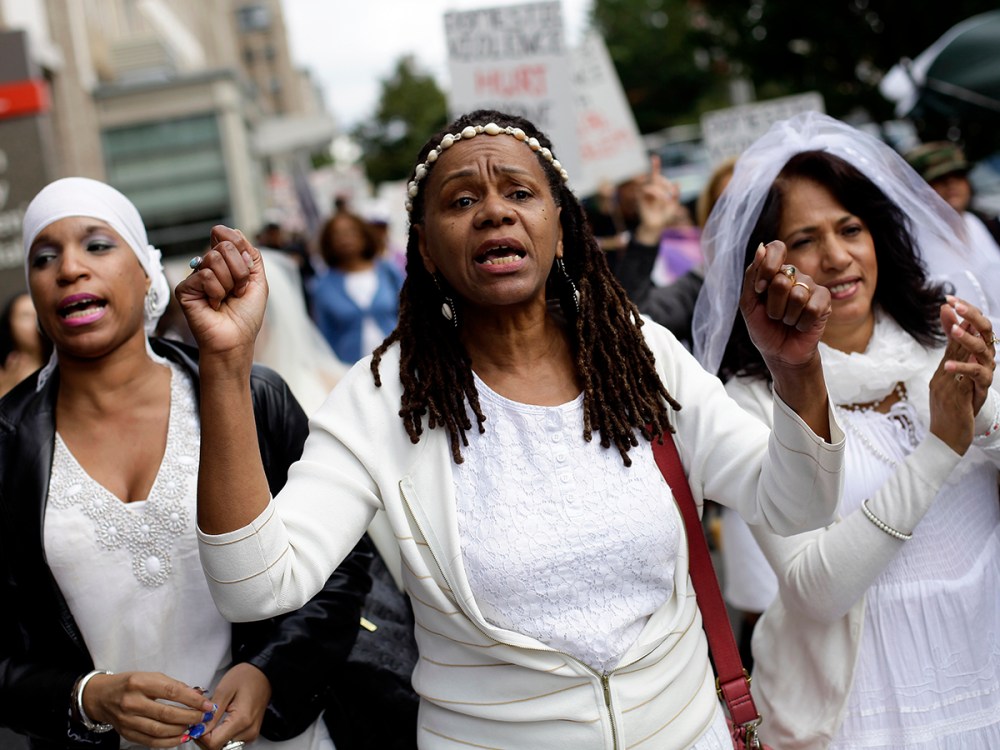
October 1 was the first day of Domestic Violence Awareness Month. It was also the day on which the federal government shut down, cutting off federal funding for domestic violence shelters across the country.
As with most of the shutdown’s immediate effects, the consequences vary state by state, and shelter by shelter. In places like New York, many shelters can compensate–at least for a while–for lost federal money through a combination of state and municipal funds, as well as private donations. For shelters like the YWCA in Flint, Mich., the shutdown has had a far greater impact.
“As a nonprofit, we don’t have a great deal of cash reserves, and it’s sort of day to day right now,” said Harmony Langford, the YWCA’s chief program officer and incoming CEO.
Shelters like the Flint YWCA are funded almost entirely by grants from the federal Department of Justice. Those grants, which are awarded either directly to shelters or filtered through state government agencies, reimburse the shelters for work already done in the past month. The Flint YWCA has been informed that it will not receive any more reimbursements until the shutdown is resolved, Langford said.
“Because of the shutdown, we have been told that the departmental staff that would be reimbursing us will not be in operation,” she said. “Yet we are expected to continue operating on our own cash reserves as long as possible.”
The YWCA is the only domestic violence shelter in its county, and typically houses about 15 women and 20 children. If it is forced to close due to lack of funds, staff will work to relocate the current residents to other shelters in neighboring counties. However, “many of the other shelters in Michigan are in the same position” and may not be able to accommodate additional residents, said Langford. As a last resort, some of the women and children currently staying at the YWCA could be placed in homeless shelters.
Shelters in other states may have the funds they need to make it through the month, though their position looks uncertain if the shutdown drags on for longer than that. In Nevada—the state with the highest domestic violence fatality rate in the nation—the future of the Reno-based shelter A Safe Embrace could depend on whether the shutdown gets resolved by November 1.
“It looks like we’re good for October, and if we submit our claims by the last day of October or the first day of November, they’ll be able to reimburse us,” said A Safe Embrace executive director Jill Boyer. “But after that, they really don’t know.”
There’s no federal money going directly from Washington, D.C. to A Safe Haven, and that means the shelter has had to put a hold on its transitional housing program, which was going to relocate abuse victims out of the shelter and into new, more permanent accommodations. However, the state government will continue to finance shelters within the state while it awaits its own federal reimbursement. The state aid means that A Safe Haven can continue providing basic services to its 10 current residents—at least for now.
“There’s no question that if this thing drags on, it will be difficult, primarily because the state has a limited amount of funds to operate the state expenditures, and right now they’re taking on this extra burden,” said Liz Greb, grants and projects manager for the office of the Nevada attorney general. “The state does not have the wherewithal to provide any additional money. The state does not have stopgap money.”
Other assistance programs for domestic violence survivors, besides shelters, have also been affected. DC SAFE provides emergency crisis intervention and other forms of support for victims of abuse in Washington, D.C., Congress’ own backyard. Like shelters, DC SAFE depends on grants from the federal government, and until this week it appeared that the non-profit would soon be in the midst of a financial emergency. “We were not considering closing, just because of the types of services we provide,” DC SAFE executive director Natalia Otero told MSNBC.com. Instead, she was getting ready to ask staff and volunteers to all work without pay, indefinitely. Two things happened to ensure that wouldn’t be necessary. First, DC SAFE held its annual fundraiser on Thursday, October 10. Prior fundraisers have averaged about 150 attendees, said Otero, but 250 people joined this year’s event. All told, DC SAFE raised about $25,000 in one night—not enough to balance out the money lost due to the shutdown, but certainly a start. Then Otero received a phone call from the city. The municipal government would be tapping its contingency fund in order to keep DC SAFE funded. Otero said she was “ecstatic.” Flint’s YWCA has also received an outpouring of private support; General Motors donated $14,500 to the shelter on Thursday after its plight was featured on local news, said Langford. But that won’t be enough to keep the doors open. “People are trying to step up and are certainly helping, but the level of funding it requires to run a domestic violence program is just not something our local community is able to sustain,” she said. “We really do have to have that support from the government.”
Ned Resnikoff is an urban policy analyst, researcher, writer, and editor. His byline has appeared in a variety of publications, including the New York Times, San Francisco Chronicle, Dissent, and The Nation. He writes the newsletter Public Comment, which can be found at publiccomment.blog. Recommended


