








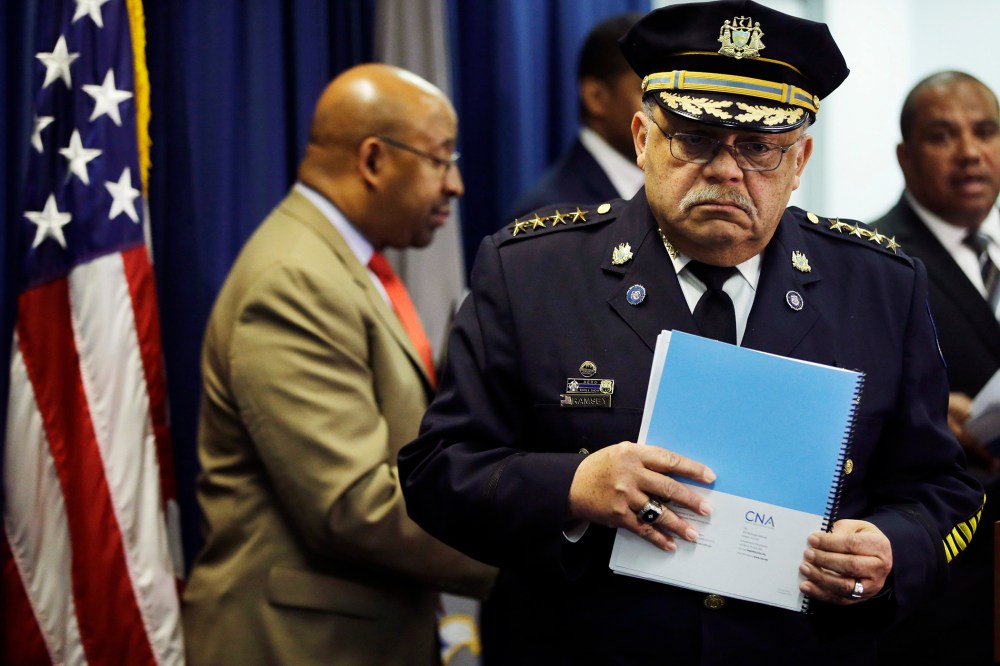
A Department of Justice review of the Philadelphia Police Department reveals a force that routinely shoots civilians, is inadequately trained, and lacks a transparent review process of police-involved shootings.

Most of the people shot by police were young and black, and police often relied on the premise that simply fearing for their lives sufficed to justify use of deadly force, which led to more than twice as many black suspects being shot by police than whites.
And even as violence against police officers has fallen in the city in recent years, police-involved shootings rose, with an average of about one per week, according to a report released by the DOJ’s office of Community Oriented Policing Services on Monday.
The study comes on the heels of the DOJ’s scathing report on the police department in Ferguson, Missouri, where the shooting of unarmed, black teen Michael Brown Jr. by a now-resigned Ferguson police officer last summer sparked massive unrest. That Ferguson report found a police department that colluded with local courts to target African-American residents for arrest and fines as part of a money-making scheme to bolster the municipal budget. The DOJ launched an investigation into Ferguson following widespread unrest and allegations of various abuses by police on black citizens.
Monday’s report on the Philadelphia police department is much less blistering and was compiled by federal law enforcement experts with the office of Community Oriented Policing Services (COPS), not federal prosecutors.
RELATED: Four Fort Lauderdale cops out over racially charged behavior
In 2013, with the number of use-of-force cases on the rise, Police Commissioner Charles Ramsey requested the assistance of the COPS office.
“I applaud Commissioner Ramsey for stepping forward to take a more critical look at the use of force policies and practices within the Philadelphia Police Department,” Ronald Davis, director of the COPS office said in a statement. “Through enhanced training, improved transparency of deadly force investigations, and strengthened use of force review processes, I am confident the Philadelphia Police Department will see great improvement to its law enforcement policies.”
Between 2007 and 2014, there were 394 officer-involved shootings in the city with an annual average of about 49. The victims were most often about 20-years-old, and 81% were black, 9% were Hispanic and 8% were white. While the bulk of the people shot by Philadelphia police were black, whites who were shot were more likely to be unarmed at the time. Nearly 16% of black suspects shot by the police were unarmed compared to 25% of whites.
The report, though less staggering than the findings in Ferguson, still reveals a big-city police force with major issues in its use of violence against the people it is charged to protect. Investigators scoured through department records, reviewed hundreds of departmental policies and training plans and conducted 164 interviews with police and community stakeholders. It held focus groups and observed use-of-force review board hearings for nearly two-dozen officers.
RELATED: NY judge will not release grand jury transcripts in chokehold death
Monday’s report identified “serious deficiencies” in the department’s use-of-force policies and training, including inconsistent supervision of officer-involved shooting investigations, crime scenes and accountability.
In response, the COPS office report issued 91 recommendations to help the department improve and develop best practices. For the next 18 months, the COPS office will work with the police department to implement those recommendations.
This process, unlike the federal consent decrees entered in between the Justice Department and local police departments in cities including Los Angeles, New Orleans, Detroit and Pittsburgh, is aimed at course-correcting before the DOJ embarks on a so-called pattern and practice review to determine the extent at which a department has violated federal law or the civil rights of citizens.
“What we’re doing here today is a start,” said Ramsey, who was recently appointed to co-chair a White House task force on policing, during a press conference on Monday. “You can’t fix something until you recognize and acknowledge that it exists.” RELATED: The state of Black America in a word: ‘Crisis’ Even before the uproar in Ferguson spilled to cities across the country, police tactics targeting minorities had been scrutinized. New York City’s controversial stop-and-frisk tactic had become the model of what many activists say has been an assault on black and brown people and the criminalization of majority-poor, minority communities. A federal judge found the tactic — in which police targeted mostly black and Hispanic young men for random stops and searches — had violated the constitutional rights of the people it targeted. Opponents of stop and frisk said it further damaged trust between police and the communities they patrol and was widely ineffective. Over the past decade, more than 4 million New Yorkers were targeted under the program. Of that number, according to official reports, just 1.5% of all stop-and-frisk arrests resulted in a jail or prison sentence. And just one in 50 stops, 0.1%, led to a conviction for a violent crime or possession of a weapon. New York City Mayor Bill de Blasio was voted into office in part because of his commitment to ending stop and frisk. While the New York Police Department had been the poster child for unfair stops and the sanctioned harassment of mostly innocent civilians, another big-city police department has come under fire for its similar not-so-random, random stop and search program. On Monday, as the DOJ’s Philadelphia report was being rolled out, the American Civil Liberties Union of Illinois released a report of its own on the Chicago Police Department. In its report, the ACLU says that Chicago police last summer initiated stop and frisks at a higher rate last summer than the NYPD ever did. RELATED: Virginia to investigate bloody arrest of black college student According to the report, between May 2014 to August 2014, Chicago police officers say there were 250,000 stops which resulted in no arrests. African-Americans were about three-quarters of those stopped despite blacks only making up about a third of the city’s population. The per capita analysis of those stops is stark, at nearly 94 people per 1,000 Chicago residents. That’s four times New York’s peak rate from May to August 2011 of about 23 stops per 1,000 residents. “The Chicago Police Department stops a shocking number of innocent people,” Harvey Grossman, the ACLU’s legal director, told the Associated Press. “And just like New York, we see that African-Americans are singled out for these searches.”
Trymaine Lee
Trymaine Lee is an NBC News correspondent. Recommended


