








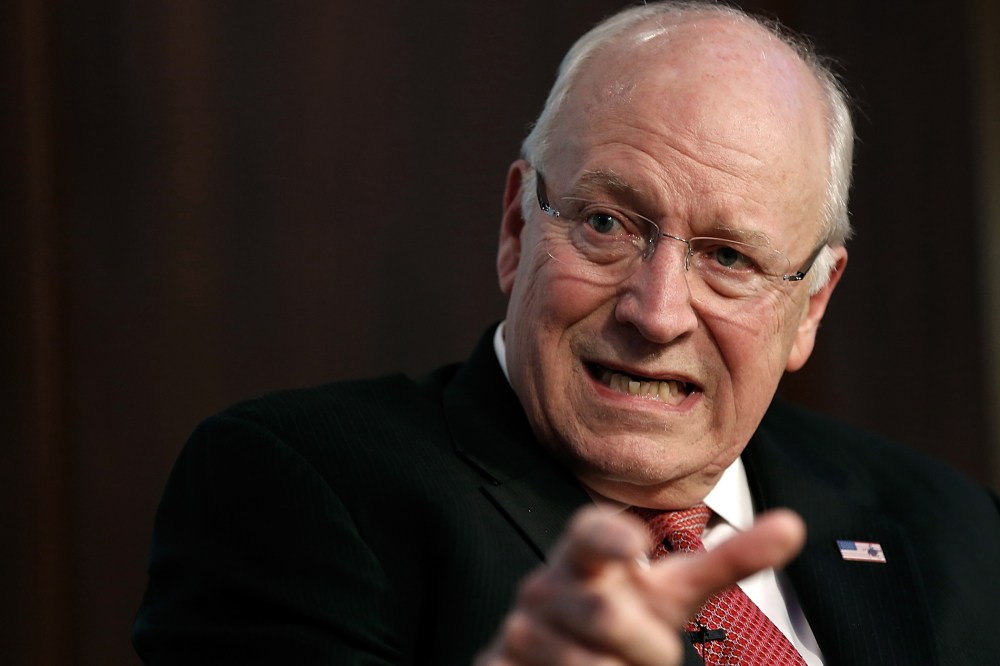
Dick Cheney just won’t let it go.
In a new book, the former vice president mounts a furious assault against President Obama’s foreign policy, which Cheney argues has damaged American security by retreating from a position of global leadership. And Cheney takes the obligatory shot at former Secretary of State Hillary Clinton over the deadly attack on a U.S. diplomatic post in Benghazi, Libya. But Cheney often seems more concerned with defending the disastrous foreign policy decisions of the Bush administration—from invading Iraq to the use of torture—made more than a decade ago.
In “Exceptional: Why the World Needs a Powerful America,” Cheney, writing with his daughter Liz Cheney, a former State Department official during the Bush administration, takes aim at the Obama administration’s nuclear deal with Iran, writing it will “guarantee an Iranian nuclear arsenal.” The Cheneys insist that invading Iraq was the right call, writing “things were in good shape” in the country when Obama took office. Oh, and they suggest that National Security Agency leaker Edward Snowden was probably a Russian spy.
RELATED: Dick Cheney urges Joe Biden to run
Almost the first half of the book is devoted to defending Dick Cheney’s tarnished legacy as perhaps the most important figure in the Bush administration’s push for war in Iraq and its handling of the war on terror.
At one stage, the Cheneys write that “history will be the ultimate judge of our decision to liberate Iraq.” But just two pages later, as if unable to resist re-engaging the issue, they describe the late Iraqi president Saddam Hussein as a “grave threat to the United States” before concluding: “We were right to invade and remove him from power.”
They even insist that U.S. troops “were in fact greeted as liberators,” just as Dick Cheney predicted before the invasion—a quote that Bush administration critics have frequently hung around his neck.
The Cheneys also offer a strained rationale for why, even though Hussein had nothing to do with 9/11, the terror attacks still were a reason to invade Iraq. “[A]fter 9/11 … we had an obligation to do everything possible to prevent terrorists from gaining access to much worse weapons. Saddam’s Iraq was the most likely place for terrorists to gain access to and knowledge of such weapons.”
As for the Bush administration’s enhanced interrogation program, “it worked,” the Cheneys write. “As we pieced together intelligence about al Qaeda in the aftermath of the 9/11 attacks, the enhanced interrogation program was one of the most effective tools we had. It saved lives and prevented attacks.”
And, they claim, it’s a “falsehood” to say that the torture that occurred at the Abu Ghraib prison “represented official policy,” or “had something to do with or was related to America’s enhanced interrogation program.”
The prison at Guantanamo Bay “was and remains safe, secure, humane and necessary,” according to the Cheneys. And people who oppose the Bush administration’s controversial warrantless wiretapping program “will be accountable for explaining to the American people why they fought to make it more difficult for the United States government to effectively track the communications—and therefore the plans—of terrorists inside the United States,” they write.
Still, the thrust of the book is an attack on Obama’s foreign policy, which, the Cheneys argue, has made the U.S. less safe by failing to wield American power around the globe.
“President Obama has departed from the bipartisan tradition going back 75 years of maintaining America’s global supremacy and leadership,” the Cheneys write, calling the idea that that “America is to blame and her power must be restrained” the “touchstone of [Obama’s] ideology.”
With the Iran nuclear deal, Obama “is gambling America’s security on the veracity of the Mullahs in Tehran,” they write, calling it a “falsehood” that the pact will prevent Iran from getting a nuclear weapon. “The truth is the opposite,” they write. “This agreement will guarantee an Iranian nuclear arsenal.”
Indeed, the Cheneys compare the deal to the Munich agreement of 1938, a frequently used example among conservatives of the dangers of appeasement. “Hitler got Czechoslovakia,” the Cheneys write (in fact, at Munich, Hitler got the Sudetenland, an area of western Czechoslovakia mostly inhabited by German speakers). “The Mullahs in Tehran get billions of dollars and a pathway to a nuclear arsenal.” RELATED: Dick Cheney: Iran deal will bring world closer to nuclear war The Cheneys also take the chance to go after Clinton on Benghazi, in an effort to reinforce questions about her character as she runs for the 2016 Democratic presidential nomination. They accuse her of “adopting a false narrative because it serves political purposes,” adding, “It is the difference between lying to the American people and dealing with them truthfully.” Dick Cheney also recounts that a Pentagon official told him in a phone call that the administration’s “pivot to Asia” was “all about budgets.” From this Cheney writes: “President Obama was pretending the war on terror was over so that he wouldn’t have to continue to allocate significant military resources to the Middle East.” “We’ll decline comment on second-hand anonymous quotes, but the President has been clear about the re-balance and its place in our national security. The re-balance to the Asia-Pacific region is based on a comprehensive assessment of long-term U.S. interests,” Defense Department spokesman William Urban told msnbc. “The security and prosperity of the United States depends on continued stability in the Asia-Pacific region, and therefore, the United States will stay fully engaged in the region to ensure that we continue to promote those interests.” Perhaps the strangest charge in the book is the one about Snowden, the former NSA contractor who leaked a trove of classified documents before fleeing to Hong Kong, and, ultimately, Russia. “Whether Snowden was a Russian operative at the time he stole the U.S. secrets is a subject of debate, although it is hard to conceive of his landing in Moscow as a coincidence,” the Cheneys write. Snowden has denied being a Russian spy.
Zachary Roth Recommended


