








DETROIT — Since the 2008 financial collapse, food banks around the country have been slammed with record demand for emergency food services, brought on by historically elevated levels of food insecurity.
Detroit is an exception, but not because the city is better off than most; instead, the main food bank here has been overwhelmed by soaring levels of hunger for so long, it has no way of measuring rising demand.
“A lot of the way our food distribution works is dependent on what we get in versus what’s needed, because the amount of need is always greater than the food that we have,” said Gerry Brisson, president of Gleaners Community Food Bank.
Brisson’s food bank serves five Michigan counties, with a combined population of about 4.2 million people, according to U.S. Census Bureau. But Brisson estimates that Detroit, which by last count had fewer than 700,000 residents, eats up about half of the food bank’s supply.
“That’s probably a byproduct of poverty more than any other thing,” said Brisson. In other words, although it could be difficult to measure the exact level of hunger in Detroit, there is no question that the troubled city has been wracked by food insecurity for a long time. The U.S. Department of Agriculture defines food insecurity as lack of access to “enough food for an active, healthy life.”
%22Basically%2C%20we%E2%80%99re%20on%20the%20ground%20organizing%22′
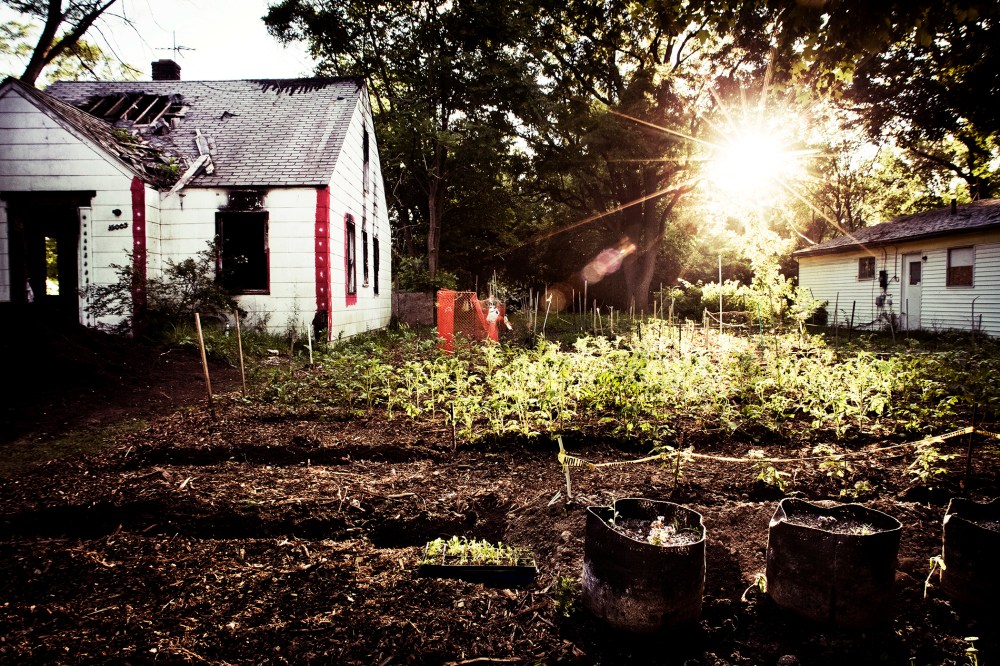
Rather than waiting for help that might never arrive, some locals have been at work organizing their own response. Detroit may be one of the hungrier cities in the United States, but in recent years it has also become the country’s urban agriculture capital. The nonprofit Greening of Detroit estimated in 2013 that between 1,500 and 2,000 urban gardens were being maintained within the city limits. Some of these gardens are there just for the purposes of beautification, but many of them exist to feed people who would not otherwise have access to fresh produce.
Groups like the Detroit Black Community Food Security Network (DBCFSN) combine urban farming with community organizing. In the words of DBCFSN compost manager and Detroit native Kadiri Sennefer, the food security network works toward “uprooting racism, and planet justice.”
“Basically, we’re on the ground organizing,” he said during a panel on Detroit’s food insecurity at the liberal conference Netroots Nation earlier this month.
DBCFSN runs several farmers markets within the city limits and operates D-Town Farm, where volunteers can farm the land in exchange for produce or other goods.
The group also lobbies the city on food policy and worked to establish the Detroit Food Policy Council in 2008. Other large farms have stayed away from overt political organizing, instead focusing mainly on agriculture and education.
But many of the city’s gardens — perhaps even the “vast majority,” according to Tepfirah Rushden, who works with the group Greening of Detroit and also sat on the Netroots panel — are so-called guerrilla gardens, farmed on land the gardeners do not legally own.
Sennefer described guerrilla gardening as a “necessity,” given the amount of un-utilized land in Detroit and the difficulty which low-income communities tend to have in acquiring it for their own purposes. “It’s not like we’re striving to bypass the law,” he said during the panel. “But at the same time, the way the system is set up, we will never get anything done if we wait for someone to give us the OK to do something.” There’s still quite a bit of hunger in Detroit, and urban agriculture alone probably won’t relieve it. So far, the produce coming from the city’s urban gardens has done more to supplement other food sources than replace them. Gleaners Community Food Bank has even started its own community garden, producing between 20,000 and 30,000 pounds of fresh produce per year, but Brisson says he doesn’t expect those efforts to measurably bring down hunger in Detroit. “I see it as less about reducing demand for food and more about systemtically getting people to think differently about the kinds of food that are available and the kinds of food they want to eat,” he said. Researchers from Rutgers University, the Urban Agricultural Network and the Southside Community Land Trust have found that urban agriculture may help improve health outcomes, but thus far nobody has attempted to turn urban agriculture into the primary food source for a major U.S. city. Yet it’s clear that urban agriculture hasn’t yet reached capacity. Around the country, other food banks are starting up community gardens of their own in an attempt to get more fresh produce to needy families. If other cities experience an economic collapse similar to Detroit’s, the nationwide urban farming infrastructure may grow yet further.
Ned Resnikoff is an urban policy analyst, researcher, writer, and editor. His byline has appeared in a variety of publications, including the New York Times, San Francisco Chronicle, Dissent, and The Nation. He writes the newsletter Public Comment, which can be found at publiccomment.blog. Recommended


