








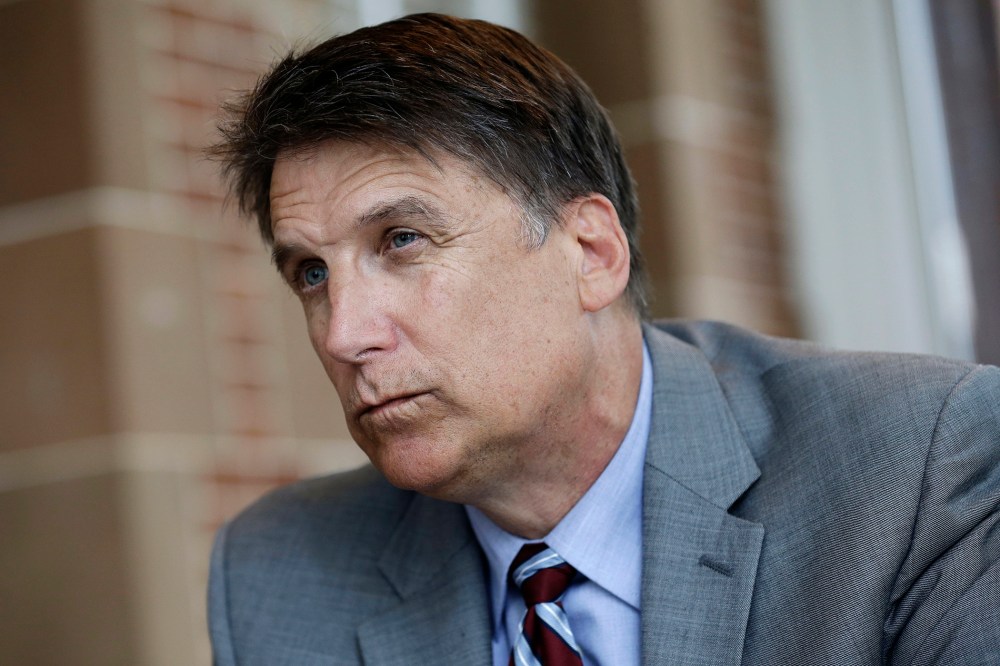
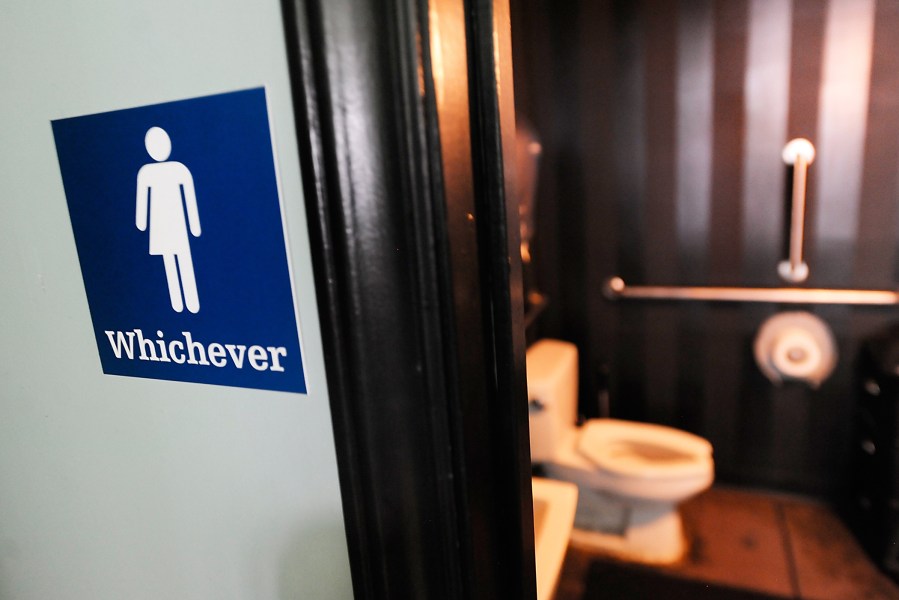
North Carolina Gov. Pat McCrory got some good news this week when a conservative judge was assigned to hear his lawsuit against the Justice Department over House Bill 2, his state’s controversial law requiring people to use government building bathrooms in line with the sex listed on their birth certificates, rather than with their gender identities. But the bad news for McCrory is he’s likely to lose the case anyway, as the legal tide continues to shift in the direction of greater protections for transgender people.

Looking at the district where McCrory filed the lawsuit on Monday, it’s easy to see how he might have felt confident.
The Eastern District of North Carolina (EDNC), which spans 44 counties from Raleigh to the coast, is almost entirely stocked with Republican appointees. In its 143-year history, the court has never had an African-American judge, despite encompassing North Carolina’s “Black Belt,” where the population is 27 percent African-American. Furthermore, the EDNC has had a vacant seat for more than a decade, making it the longest current vacancy in the federal judiciary. President Obama has nominated two African-American women to fill the judgeship in the past three years, but Republican Sen. Richard Burr blocked the first and has vowed to stand in the way of the second.
In short, McCrory was almost certain to get a conservative judge to hear the case — a seemingly vital advantage for a Republican governor fighting on the front lines of one of the most highly-charged and partisan political battles of the day. Yet even with those factors working in his favor, McCrory still faces an uphill climb in his quixotic effort.
“The trajectory of cases since the early 2000s is that district courts and appellate courts are seeing that trans people are guaranteed protection under federal law,” said Ezra Young, an associate at the law office of Jillian T. Weiss, who specializes in Title VII litigation for transgender people. “Cases going the other way are outliers.”
RELATED: Justice Department says “bathroom bill” violates federal law
McCrory’s lawsuit asks for a judgment declaring that HB 2 does not violate two separate provisions of federal civil rights law: Title VII of the 1964 Civil Rights Act — which prohibits employment discrimination on the basis of race, color, religion, sex and national origin — and the Violence Against Women Reauthorization Act of 2013, one of two federal statutes that explicitly protects transgender people. The suit was filed less than a week after the DOJ informed McCrory’s office that the state’s so-called “bathroom law” was “facially discriminatory” against transgender people and needed to be immediately abandoned. Rather than capitulate, McCrory decided to roll the dice in federal court.
On the surface, it might have looked like McCrory’s legal gamble would pay off. His case was assigned to U.S. District Judge Terrence Boyle, a President Reagan appointee and former aide to the late Sen. Jesse Helms, who was a preeminent culture warrior in the 1980s and 90s, and staunch opponent of gay rights, among other liberal causes. Boyle was twice nominated to the 4th Circuit Court of Appeals by both Presidents Bush. But he never made it to the Senate floor for a confirmation vote, having been painted by Democrats as an ultra-conservative whose record was hostile to civil rights.
In 1998, Boyle was part of a three-judge panel that ruled North Carolina’s black majority 12th District was unconstitutional. That congressional district was drawn with the intent of electing more minority lawmakers, and Boyle earned the ire of many Democrats and civil rights activists for his ruling. The Supreme Court later allowed the district to stand.
Boyle has also angered liberals for his decisions in employment discrimination cases. In 1996, he refused to approve a settlement agreed upon by North Carolina and the Justice Department that would have expanded job opportunities for female corrections officers in the state. In opposing Boyle’s nomination to the 4th Circuit, the progressive National Partnership for Women and Families said his decision in that case “makes clear his skepticism about the discrimination allegations, and his resistance to imposing concrete remedies to expand job opportunities for women.”
Indeed, Boyle’s assignment to McCrory’s case seemed so fortuitous for the governor that some legal scholars initially suspected his office of forum shopping, or filing the lawsuit in such a way as to score a favorable judge. (For what it’s worth, there appears to be no evidence of this happening; civil lawsuits in the EDNC are randomly assigned so that each active judge receives the same share of cases, regardless of which division they were filed in.)
Yet as conservative as Boyle’s record may be, one ruling from last year could signal trouble for McCrory. In the 2015 case of Lewis v. High Point Regional Health System — a lawsuit in which a transgender woman sued a hospital for allegedly harassing and refusing to hire her because of her gender identity — Boyle denied High Point’s motion to dismiss the case. He agreed with the hospital’s argument that Title VII did not bar employment discrimination based on sexual orientation. But he also recognized that sexual orientation was different from transgender status and left open the question of whether discrimination based on gender identity qualified as unlawful discrimination based on sex.
RELATED: Grassroots protest movement takes aim at NC “bathroom bill”
Boyle also denied the transgender woman’s motion for summary judgment in that case. But he did so because he found she had not met the burden of demonstrating that High Point “intentionally discriminated against her because of her transgendered status,” not because he disagreed with her argument that transgender people were guaranteed protection under Title VII.
Though most people would probably be unable to read anything significant in that order, Young sees it as an encouraging sign Boyle will rule against McCrory.
“In the Lewis order, Judge Boyle signals that he understands Title VII’s sex discrimination prohibition extends to trans people,” Young said. “He doesn’t say it explicitly in a way that’s easy to quote as a journalist. But as a lawyer looking at that case, it’s pretty clear to me.” Despite the partisan nature of the current bathroom debate, Young found that the political affiliation of the president who appoints a federal judge tends to have little impact on how that judge interprets Title VII’s reach over trans bias. It’s often the conservative judges who argue Title VII protects transgender people, he explained, citing in a follow up email nine “pro-trans” decisions that were authored or joined by Republican-appointed judges. That’s no coincidence; the trend is actually deeply rooted in the way conservative judges interpret statutes like Title VII, which many believe to be ambiguous when it comes to its prohibition on sex discrimination. “Very conservative judges don’t look to public opinion to see what a statutory text says if it’s unclear, which it is in the case of Title VII,” said Young. “It’s clear Congress wrote ‘sex.’ They didn’t define ‘sex’; there was no discussion on the floor in 1964 about gender identity. There’s nothing there… North Carolina is asking Judge Boyle to read words into the statute that aren’t there, and that’s not something conservative judges do.” Furthermore, because conservative judges are usually averse to playing the guessing game with federal statutes, they tend to believe in a strong degree of deference for agency interpretation — which, in the case of Title VII, is another blow for McCrory. Both the DOJ and the Equal Employment Opportunity Commission, the two agencies tasked with interpreting civil rights law, have made explicitly clear that they believe Title VII’s ban on employment discrimination based on sex protects transgender people as well. Numerous court decisions further contradict McCrory’s charge of “radical reinterpretation of Title VII” on part of the Justice Department. The 1989 Supreme Court case, Price Waterhouse v. Hopkins, established that Title VII barred sex discrimination on the basis of gender stereotyping — a doctrine many courts have since turned to in transgender discrimination cases to conclude that Title VII prohibits employment evaluations based on societal expectations of male and female behavior. In 2004, the 6th Circuit became the first federal court to extend the sex-stereotyping theory of Price Waterhouse to transgender plaintiffs in the case of Smith v. City of Salem, which found that “employers who discriminate against men because they do wear dresses and makeup, or otherwise act femininely, are also engaging in sex discrimination.” In 2011, the 11th Circuit concluded in the case of Glenn v. Brumby that “discrimination against a transgender individual because of her gender-nonconformity is sex discrimination, whether it’s described as being on the basis of sex or gender.” RELATED: NCAA goes soft on North Carolina after House Bill 2 There are other examples of cases that show transgender people are protected under federal law. But none of them can be found in McCrory’s complaint. Nor can the most recent legal victory for transgender rights — the 4th Circuit’s April decision siding with the Obama administration’s interpretation that Title IX of the 1972 Education Amendments, which bars sex discrimination in education, also protects transgender students seeking equal access to bathrooms and facilities. Notably, McCrory made no attempt to seek a federal declaration that North Carolina’s “bathroom law” does not violate Title IX. The 4th Circuit has jurisdiction over North Carolina, and even if Boyle ends up siding with McCrory, he’d have a hard time getting around the April decision on appeal. All told, said Young, “North Carolina is in a bad shape” from a litigation standpoint. It doesn’t help that McCrory’s forging ahead without the support of the state’s top law officer, Democratic Attorney General Roy Cooper, who called the law “a national embarrassment.” But perhaps the governor was just feeling lucky, and given the makeup of the EDNC, it’s not entirely hard to see why. McCrory saw numerous political advantages working in his favor, and maybe some of them will indeed play out. Ultimately, though, he’s probably still going to lose.
Emma Margolin
Emma Margolin is a reporter at MSNBC.com. Recommended


